Glendale Community College (GCC), located in Southern California, maintains specific academic policies regarding the International Baccalaureate (IB) program to facilitate credit transfers for incoming students. Students who have completed IB coursework and examinations must provide official documentation to the college’s Admissions and Records office to be evaluated for college credit. Under current institutional policy, GCC grants credit for higher-level (HL) IB examinations when a student achieves a score of 5, 6, or 7, provided the coursework aligns with the college’s existing curriculum requirements. According to the official Glendale Community College Credit by Examination guidelines, these credits can be applied toward associate degree requirements and general education certifications.
Understanding IB Credit Evaluation at Glendale Community College
The recognition of International Baccalaureate credits at Glendale Community College is governed by the California Community College system’s broader standards for credit by examination. When a student submits their official IB transcript, the college’s evaluators assess the specific subject matter and the score achieved. While the college accepts scores of 5 or higher for most Higher Level subjects, the specific number of units awarded depends on how the course maps to the college’s internal degree requirements. It is essential for students to consult the current GCC College Catalog to determine exactly how individual IB subjects satisfy specific general education areas, such as those required for the IGETC (Intersegmental General Education Transfer Curriculum) or CSU General Education Breadth patterns.

It is important to note that IB credit recognition does not always equate to a letter grade in the student’s GPA. Instead, these are typically recorded as “Credit” (CR) or “Pass” (P) on the student’s academic record. This distinction is vital for students planning to transfer to four-year universities, as individual university departments may have varying policies regarding how they accept transfer credit from community colleges. According to the University of California admissions guidelines, while community colleges may grant credit for specific scores, the receiving four-year institution maintains final authority on how those units apply toward a bachelor’s degree.
Admissions Requirements and Enrollment Eligibility
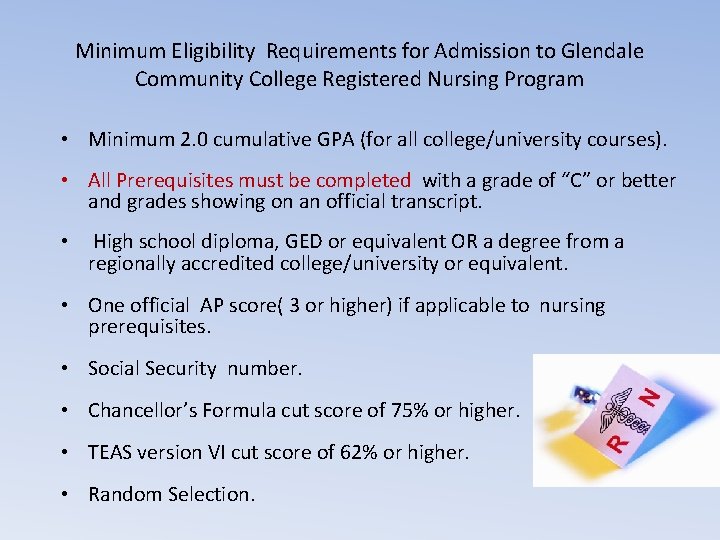
Glendale Community College operates under an open-admission policy, meaning that any high school graduate, holder of a GED, or individual 18 years of age or older is eligible for enrollment. The IB program status of a prospective student does not change this fundamental eligibility, but it does impact the student’s placement and academic planning. Students are encouraged to submit their official IB transcripts as early as possible during the matriculation process. This ensures that academic counselors can accurately assess which courses the student has already satisfied, preventing the unnecessary repetition of coursework.
The admissions process for new students involves an online application through the California Community Colleges’ CCCApply portal. Once the application is processed and a student ID number is assigned, students should immediately request that the International Baccalaureate Organization (IBO) send their official scores directly to the Glendale Community College Admissions and Records office. Hand-carried or unofficial copies of score reports are generally not accepted for the purpose of granting official college credit.
Academic Planning and Transfer Implications
For students utilizing IB credits, the primary objective is often to fulfill prerequisite requirements for higher-level coursework or to satisfy general education requirements to expedite the transfer process. Glendale Community College provides dedicated counseling services to help students integrate their IB achievements into a comprehensive educational plan. Students should meet with an academic counselor to review their “Student Educational Plan” (SEP) after their IB credits have been officially posted to their GCC transcript.

The impact of these credits on a student’s transfer trajectory is significant. By clearing lower-division requirements through IB examinations, students may be able to enroll in major-specific coursework sooner. However, students should verify the specific “credit by exam” policies for their target transfer institutions. The ASSIST.org database serves as the official repository for articulation agreements between California Community Colleges and the University of California (UC) and California State University (CSU) systems, providing a clear view of how specific courses and exam credits are treated across the state.
Next Steps for Incoming Students
Students currently holding IB scores should monitor the GCC student portal for updates regarding their credit evaluation. The process typically requires several weeks after the receipt of official transcripts during peak enrollment periods. For those who have not yet submitted their scores, the first step is to contact the IBO to request that an official transcript be sent to the Glendale Community College registrar. For further guidance, students may contact the Admissions and Records office directly to confirm receipt of documents or to clarify specific subject-area credits.
Updates regarding institutional policy changes or new articulation agreements are posted periodically in the college’s online academic schedule. Students are encouraged to check the college website regularly for any changes to credit-by-exam procedures. Your experiences or questions regarding the transfer process can be shared in the comments section below to help foster community discussion on navigating the California community college system.
Keep reading
- The Exceptional Sound and Power of Steinway Pianos
- Trump’s Iran Agreement: Why Iran is Now Violently Seizing Control of Global Energy Waterways
- Free AI Travel Planner: Day-by-Day Itineraries, Maps & Tips for Fillmore, California (archynewsy.com)
- New Mexico Attorney General Launches Investigation Over High Rates of Harsh Prison Conditions (news-usa.today)