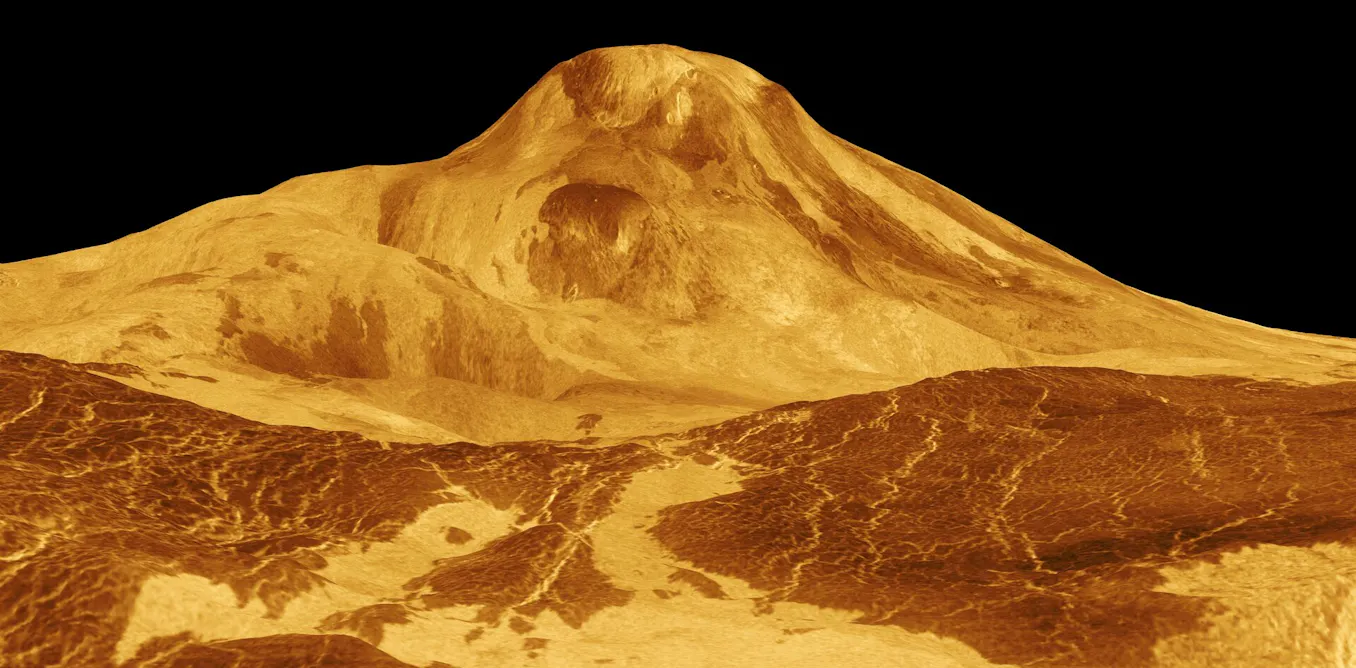
Venus is the hottest planet in our solar system, with surface temperatures reaching approximately 867 degrees Fahrenheit (464 degrees Celsius), despite Mercury being closer to the Sun. This extreme heat is caused by a runaway greenhouse effect, where a thick atmosphere composed primarily of carbon dioxide traps solar radiation, preventing it from escaping back into space, according to data from NASA.
While Mercury sits closer to the Sun, it lacks a substantial atmosphere to retain heat. Consequently, the planet experiences massive temperature swings, with daytime highs of about 800 degrees Fahrenheit (430 degrees Celsius) and nighttime lows that plummet to minus 290 degrees Fahrenheit (minus 180 degrees Celsius), as reported by NASA’s planetary science division.
The Mechanics of a Runaway Greenhouse Effect
The fundamental reason for the temperature disparity lies in atmospheric composition. A greenhouse effect occurs when a planet’s atmosphere absorbs infrared radiation emitted from the surface. On Earth, this process is essential for maintaining a habitable environment, keeping the average global temperature at a moderate 59 degrees Fahrenheit (15 degrees Celsius) rather than a freezing 0 degrees Fahrenheit (minus 18 degrees Celsius), according to NASA’s climate research archives.

Venus, however, represents a extreme version of this phenomenon. The planet’s atmosphere is roughly 96 percent carbon dioxide, which acts as a dense thermal blanket. Because this atmosphere is so thick, the surface pressure is more than 90 times greater than that of Earth at sea level—a pressure equivalent to being 3,000 feet (940 meters) underwater. This pressure and the resulting heat create a stable, hostile environment where temperatures remain nearly constant regardless of whether it is day or night.
Historical Evolution of Venus
Scientific models of the early solar system suggest that Venus and Earth may have shared a similar origin 4.5 billion years ago. Early in its history, Venus likely possessed significant quantities of water. However, as the Sun’s luminosity increased over billions of years—models indicate the Sun is now roughly 40 percent brighter than in the early solar system—the increased solar energy likely triggered the evaporation of Venusian oceans.
Once the surface water disappeared, the planet lost its primary mechanism for scrubbing carbon dioxide from the atmosphere. On Earth, carbon dioxide is largely sequestered in oceans and geological formations like limestone. On Venus, the absence of these carbon sinks allowed carbon dioxide to accumulate in the atmosphere, fueling a self-reinforcing loop of rising temperatures and further evaporation. This “runaway” feedback loop ultimately locked the planet into its current state.
Comparing Planetary Atmospheres
The difference in thermal regulation between the two inner planets can be summarized by their lack of atmospheric protection. Mercury, which is essentially an airless rock, cannot hold onto the heat it receives during the day. In contrast, the dense, chemically active atmosphere of Venus ensures that heat is redistributed and trapped across the entire surface.

| Feature | Mercury | Venus |
|---|---|---|
| Atmosphere | Negligible | Dense (96% Carbon Dioxide) |
| Average Surface Temp | ~800°F (Day) / -290°F (Night) | ~867°F (Constant) |
| Surface Pressure | Near-vacuum | ~90x Earth’s pressure |
Research into these planetary conditions remains ongoing. These studies are critical for understanding how terrestrial planets evolve and how atmospheric feedback loops function on a global scale.
Keep reading