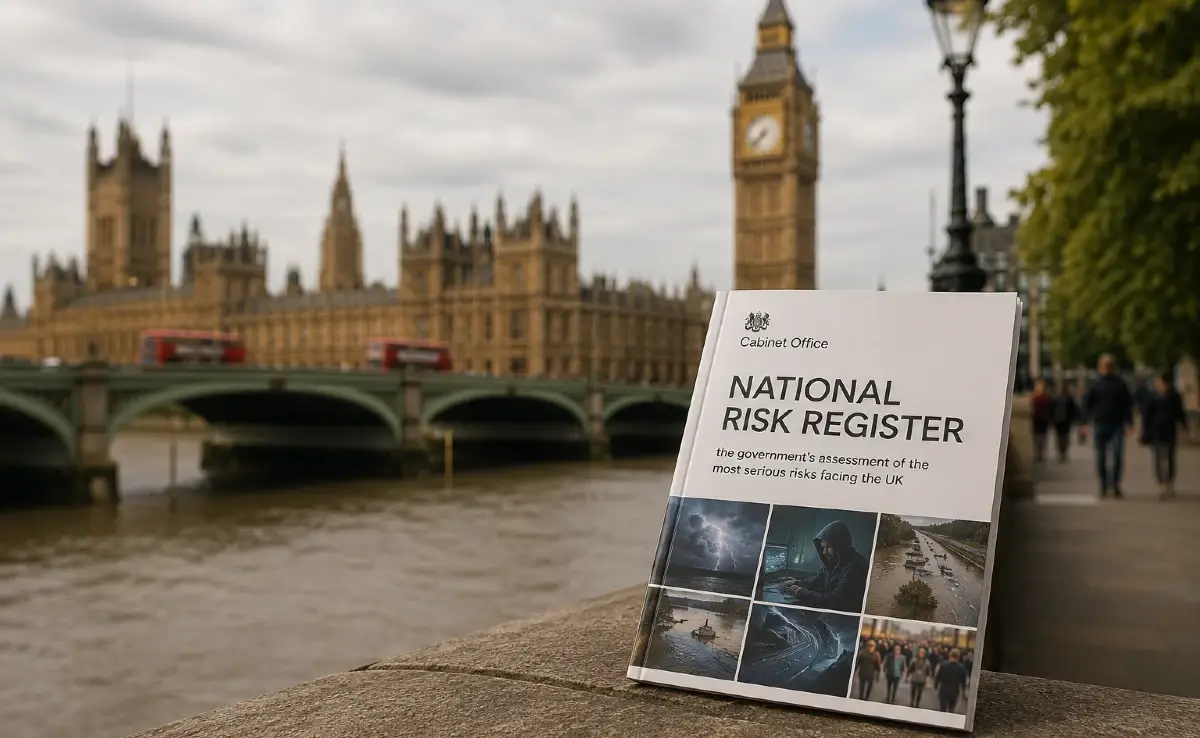
The UK government has formally updated the National Risk Register, adding seven new threats to its public assessment of national security, including risks to democratic processes and digital infrastructure. Published on 14 July 2026 by the Cabinet Office, the updated register serves as a foundational document for emergency planning across the United Kingdom, reflecting an evolving landscape of technological, geopolitical, and environmental hazards.
Chief Secretary to the Prime Minister Darren Jones, who oversaw the publication alongside the Annual Resilience Statement to Parliament, noted that the government’s approach is to consistently evaluate potential threats to ensure the UK remains prepared for emerging challenges. The register, which is informed by the classified National Security Risk Assessment, does not attempt to predict specific future events but provides a framework for government departments, local authorities, and the public to build resilience against a wide range of disruptions.
New Threats: Democratic Interference and Digital Resilience
The latest iteration of the register introduces specific categories aimed at addressing modern vulnerabilities. One of the most significant additions is the inclusion of interference in democratic processes. This risk assessment follows recent government efforts to implement more rigorous safeguards surrounding political finance, including enhanced due diligence for corporate donations and proposed legislative caps on overseas contributions to political entities.
The register also explicitly identifies digital resilience failure as a primary concern. This category draws directly from the operational lessons learned during the widespread global IT outage in July 2024, which affected numerous organizations reliant on the CrowdStrike platform. Additionally, the government has expanded its definition of cyber threats to include specific risks to data infrastructure, water systems, and police services. Officials have highlighted that the growing accessibility of artificial intelligence tools could provide malicious actors with more sophisticated methods to target essential public infrastructure.
In a shift reflecting changing geopolitical realities, the threat of disruption to Russian gas supplies has been removed from the register. According to the Cabinet Office, this change is a direct result of the United Kingdom’s successful efforts to reduce its dependency on Russian energy imports since the risk was last assessed.
Strategic Preparedness and The 2027 Home Defence Exercise
To address these identified risks, the government has announced a comprehensive resilience programme extending through 2026 and 2027. A cornerstone of this initiative is Operation ALBISTON SHADOW, which the government has described as the largest home defence exercise in decades. The classified, multi-day operation will involve ministers and hundreds of officials from across the public sector, testing the government’s ability to coordinate a response to hybrid attacks. The exercise will run in parallel with NATO’s CMX27, ensuring that UK domestic planning remains integrated with the strategies of international allies.
Beyond high-level exercises, the government is updating its internal crisis planning documents—known as “War Books”—for the first time since 2004. These documents are designed to support departmental readiness for a variety of national emergencies. Furthermore, the government is continuing its implementation of the 2023 Biological Security Strategy. This long-term commitment, which includes the development of a network of National Biosecurity Centres backed by £1.83 billion in funding, is intended to strengthen the nation’s response to future biological threats. A new Pandemic Preparedness Strategy, supported by approximately £1 billion in health protection measures, is expected to be finalized by 2028.
Local Empowerment and Public Engagement
The government is also seeking to modernize the legal framework for emergency management. Through a public consultation on the Civil Contingencies Act 2004, officials are exploring the possibility of granting regional mayors a formalized role in local and national emergency planning. This proposal is intended to complement the work currently performed by Local Resilience Forums, ensuring that local leadership has a clearer mandate to coordinate responses to regional disruptions.
For the general public, the government intends to launch a national awareness campaign later in 2026. This campaign will provide households with guidance on preparing for various emergencies, including severe weather, flooding, and utility service outages. These efforts will build upon the existing resources available via the official GOV.UK Prepare portal. As part of this initiative, new educational materials are being developed for schools and colleges to help younger generations understand how to respond safely during a crisis.
“It is right that we consistently evaluate the risks we could face and plan for what may come,” said Darren Jones in his statement to Parliament. “The government will do all it can and we are well prepared, but we can all play our part to keep ourselves and our loved ones safe.”
The government’s next major milestone in this resilience programme involves the public awareness campaign scheduled for late 2026, followed by the execution of Operation ALBISTON SHADOW in 2027. Updates regarding the Civil Contingencies Act consultation and further departmental progress will be released through official Cabinet Office channels as they become available.
Keep reading