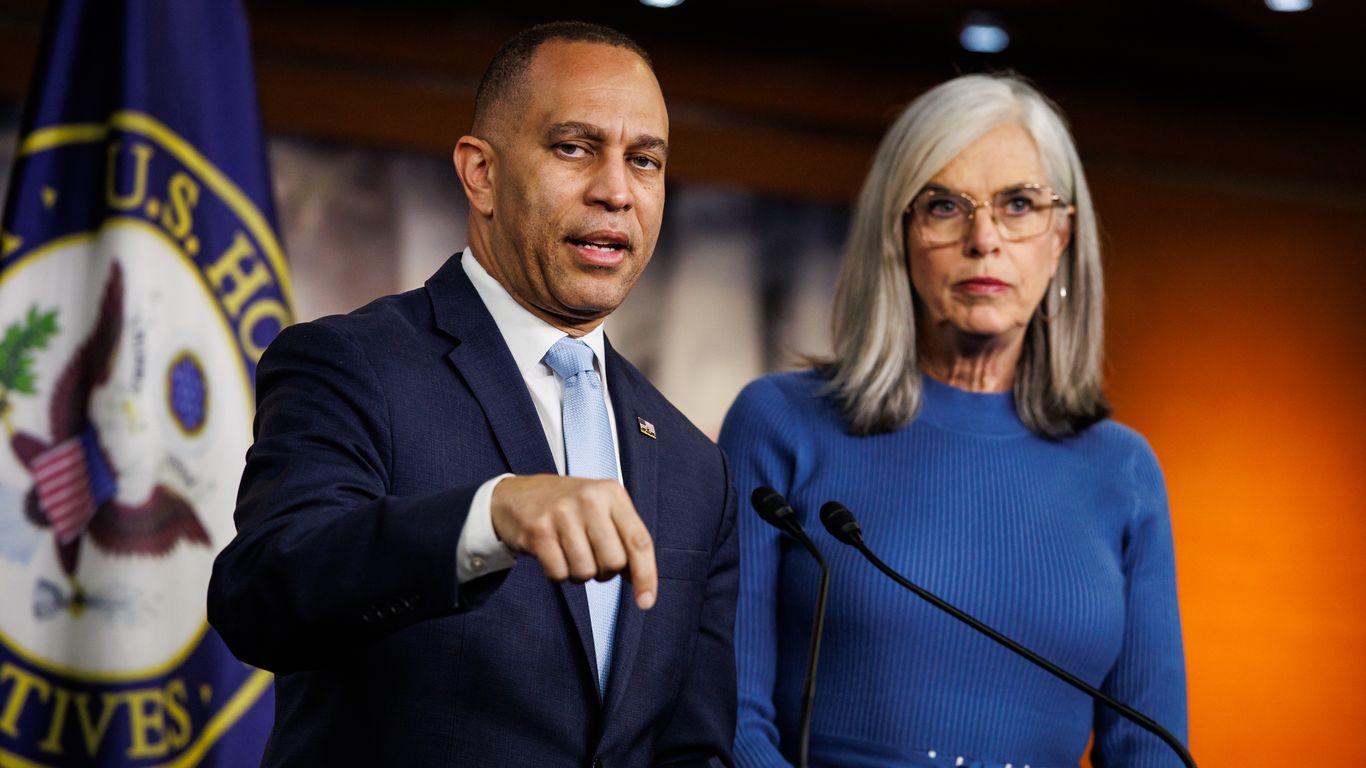
House Democratic leadership is experiencing a rare public fracture over a proposed amendment that would cut off U.S. aid to Israel. Minority Leader Hakeem Jeffries (D-N.Y.) and Minority Whip Katherine Clark (D-Mass.), the top two ranking Democrats in the House of Representatives, have diverged on how to handle the measure, which was introduced by Rep. Thomas Massie (R-Ky.) as part of a State Department funding bill.
The internal disagreement highlights the significant political and moral pressures facing the 212-member Democratic caucus. While leadership remains divided on the legislative path forward, members of the caucus are weighing concerns over the bill’s drafting against fears of potential primary challenges from the party’s left flank.
Leadership Positions and Legislative Strategy
The legislative divide became clear this week as leadership outlined their respective stances. Minority Whip Katherine Clark announced Wednesday that she intends to vote in favor of the Massie amendment. In a public statement, Clark expressed that the current status quo regarding military aid to Israel is no longer sustainable, arguing that the United States should not provide “a blank check” to any nation that does not align with U.S. laws, interests, and values.

Conversely, Minority Leader Hakeem Jeffries stated on Tuesday that he plans to vote against the amendment. In a correspondence to his colleagues, Jeffries noted that while he believes a “meaningful change in direction” is required for the U.S.-Israel relationship, he favors more decisive methods to address the policies of the current Israeli government rather than the approach proposed by the Republican-led amendment. Jeffries confirmed that his office would not be whipping the vote, allowing individual members to vote according to their conscience.
Political Pressures and Caucus Anxiety
The uncertainty surrounding the vote has created a volatile environment within the Democratic caucus. Estimates regarding the potential vote tally suggest a close divide, with some projections indicating that between 100 and 150 members may support the measure. This potential split reflects a broader struggle among lawmakers attempting to balance their legislative concerns with intense grassroots pressure.
One House Democrat, speaking on the condition of anonymity to discuss internal party dynamics, noted that many members harbor substantive misgivings about the amendment’s language. The primary concern among critics is that the text of the Massie amendment lacks a carveout for non-military aid, meaning that if passed, it would block all foreign assistance to Israel, including humanitarian funding for Palestinian refugees and civilians in Gaza.
Despite these drafting concerns, some members feel compelled to support the measure to avoid political backlash. The anonymous lawmaker observed that the grassroots base is expected to hold members accountable for their vote, regardless of whether they agree with the bill’s specific provisions or the motivations of its Republican sponsors. For these members, the political cost of appearing to oppose the measure outweighs the legislative drawbacks of the bill itself.
The Impact of the Massie Amendment
The measure introduced by Rep. Thomas Massie is attached to a State Department funding package, putting Democrats in a position where they must decide between supporting a controversial funding cut or opposing a bill that could be perceived as a test of their commitment to shifting U.S. policy toward Israel. Clark criticized the amendment as a “stunt” by Congressional Republicans, stating that it does not represent a serious attempt to debate offensive military aid, but rather an effort to score political points.

The divergence between Jeffries and Clark is considered highly unusual for a leadership team. As the House prepares for the upcoming vote, the situation underscores the difficulty of maintaining caucus cohesion on an issue where members face competing demands from their constituents, party leadership, and their own policy assessments.
The House is expected to proceed with the funding bill in the coming days, at which point the final vote tally will clarify the extent of the divide within the Democratic caucus. Updates regarding the legislative schedule and official roll call results will be available through the official House of Representatives legislative calendar.
Worth a look