July 20–26 Moon Alignment Near Spica
During the week of July 20–26, 2026, the moon provides a celestial guide for viewing bright stars and constellations. After appearing near Spica on July 20, the moon will move toward the constellation Scorpius, culminating in a close approach to the red supergiant Antares on July 24. For stargazers in North America and across mid-northern latitudes, this week offers several opportunities to observe the night sky.
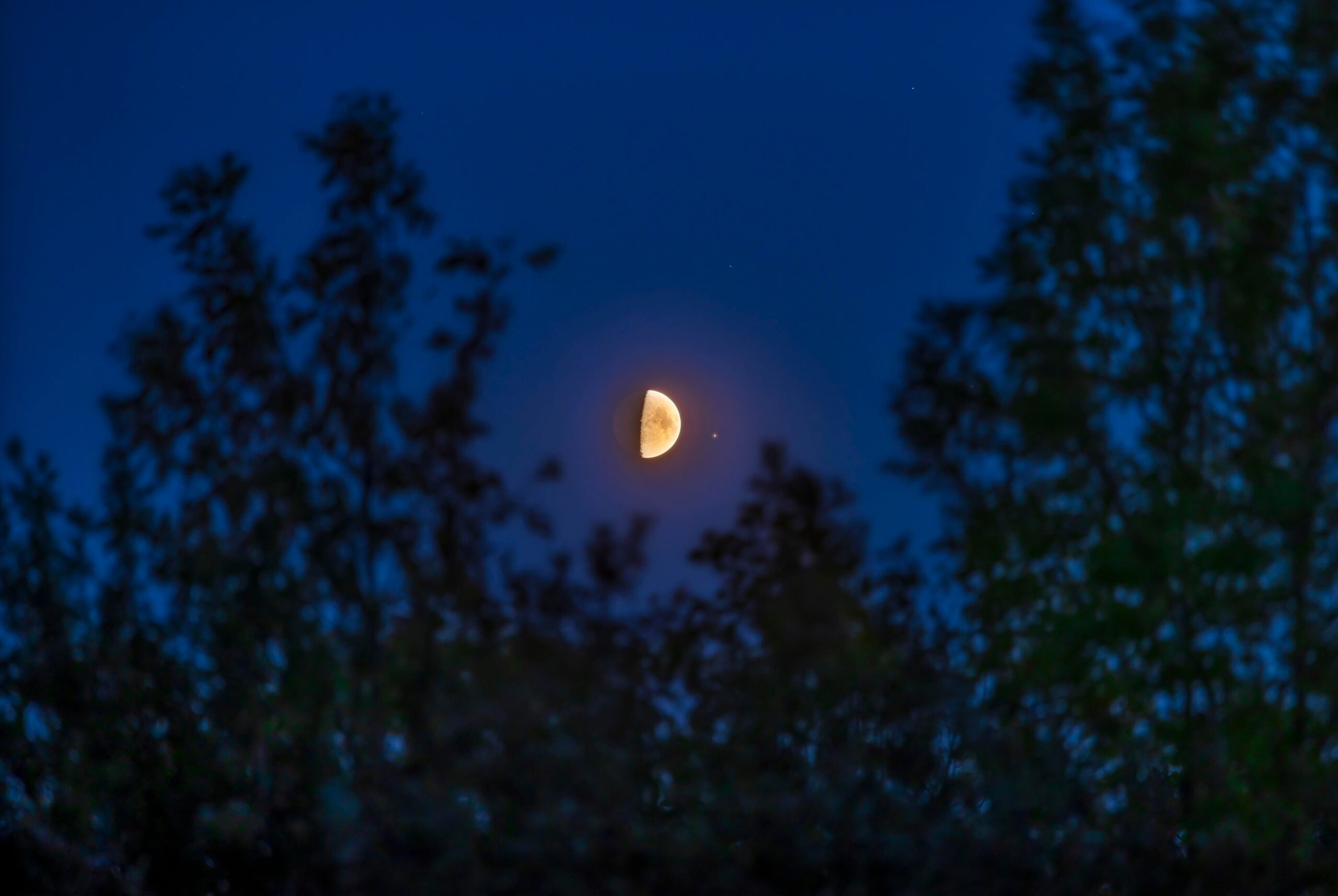
As the moon enters its waxing phase this week, it serves as a navigational tool for observers in the Northern Hemisphere. On Monday, July 20, the 46%-lit waxing crescent moon hangs below Spica, the brightest star in the constellation Virgo. While Spica appears as a single point of light to the naked eye, it is actually a binary star system—two stars orbiting each other—according to Forbes. The following day, July 21, the moon becomes half-lit as it reaches its first quarter phase.
From July 21 through July 29’s full Buck Moon, the moon begins to bleach the night sky. For those equipped with backyard telescopes, this week offers an ideal opportunity to view the lunar surface along the line between light and shadow, where dramatic craters and mountains are most visible.
July 24 Close Approach of the Moon to Antares
As the week progresses, the moon shifts its position toward the constellation Scorpius. By Thursday, July 23, the 74%-lit waxing gibbous moon moves into the vicinity of the constellation’s brightest star, Antares. Described by Forbes as the heart of the Scorpion, Antares is a massive red supergiant located approximately 550 light-years from Earth.
For more on this story, see Moon and Venus to Align in Rare Celestial Conjunction on July 17, 2026.
On Friday, July 24, observers looking south about an hour after sunset will see the 82%-lit waxing gibbous moon positioned just a couple of degrees from Antares. While Scorpius is known for having a curved body and hooked tail that resembles its namesake, the constellation remains relatively low on the southern horizon for mid-northern latitudes, making it rare to see the entire figure. In addition to Antares, observers can identify the three bright stars in the scorpion’s stinger: Shaula, Acrab, and Dschubba.
August 12 Total Solar Eclipse Path
The lunar cycle continues to build toward the full Buck Moon on July 29, which will rise during dusk. This will be followed by the peak of the Delta Aquariid meteor shower on July 31 and August 1, though these will occur during bright moonlight. Later in August, the Perseid meteor shower is expected to build toward a peak overnight on August 12–13, potentially producing around 50 shooting stars per hour.

A significant event is scheduled for August 12, 2026, when a total solar eclipse will occur. The eclipse path will cross portions of eastern Greenland, western Iceland, and northern Spain. For those within the path of totality, the sun will be obscured for up to 2 minutes and 18 seconds, potentially revealing the sun’s corona if skies are clear. Residents in parts of North America will experience a partial eclipse, with about 53% of the sun covered in St. John’s, 31% in Halifax, 16% in Boston, and 10% in New York. Safety precautions remain a priority for viewers, with solar eclipse glasses deemed essential by Forbes for any direct observation of the sun.
June 2026 Planetary Conjunctions and Solstice
Earlier observations in June 2026 featured different planetary alignments. According to Almanac, June 7–10 saw a conjunction of Venus and Jupiter low in the west. On June 16, Jupiter floated between the moon and Venus, while June 17 and June 23 featured further conjunctions. The month also included the summer solstice on June 21, marking the first day of summer and the longest day of 2026 in the Northern Hemisphere.

This follows our earlier report, August 2026 Celestial Events Include Solar Eclipse and Blood Moon.
| Date | Event |
| June 21, 2026 | Summer Solstice |
| June 29, 2026 | Strawberry Moon |
| July 20, 2026 | Moon near Spica |
| July 24, 2026 | Moon near Antares |
| July 29, 2026 | Full Buck Moon |
As the season progresses, observers are encouraged to use tools such as online planetariums, like Stellarium, to gain location-specific data for viewing these events.