
Astronomers have mapped the physical state of plasma surrounding the M87* black hole by combining 2018 data from the Event Horizon Telescope and the Global Millimeter VLBI Array. This dual-frequency study confirms that the ring structure is tied to fundamental plasma properties, providing new insights into jet formation and accretion flows.
Mapping Plasma Physics Across Event-Horizon Scales
In a significant shift from simple imaging to physical analysis, researchers at the Shanghai Astronomical Observatory (SHAO) have produced the first spatially resolved spectral-index map of the supermassive black hole M87*. By analyzing data collected in 2018 across two distinct wavelengths—1.3 mm and 3.5 mm—the team traced how radiation intensity changes with distance from the black hole’s center.
The study, published in The Astrophysical Journal Letters, reveals that the plasma environment is not uniform. In the innermost region, the spectral index remains positive, indicating that the dense plasma is heavily influenced by synchrotron self-absorption. As researchers moved farther from the center, the index shifted to negative values, signaling a transition into an optically thin regime where radiation escapes more freely.
Dr. ZHAO Shanshan, lead author and assistant researcher at SHAO, stated that obtaining the first spatially resolved spectral-index distribution of the M87 black hole allows for quantitatively characterizing how the radiation properties change across the region surrounding the black hole. This enables direct exploration of how plasma properties vary on horizon scales and provides new clues for understanding accretion flows and jet formation.
Connecting Ring Structures to Physical Reality
The research provides a critical link between visual imagery and the underlying physics of the black hole. The transition in the spectral index occurs roughly 30 microarcseconds (μas) from the center, a distance that the Chinese Academy of Sciences (CAS) reports aligns with the radius of the ring-like structure observed at 3.5 mm. This spatial overlap suggests that the iconic rings captured by telescopes are not mere visual artifacts of gravity, but are instead fundamental indicators of the physical state of the plasma near the event horizon.
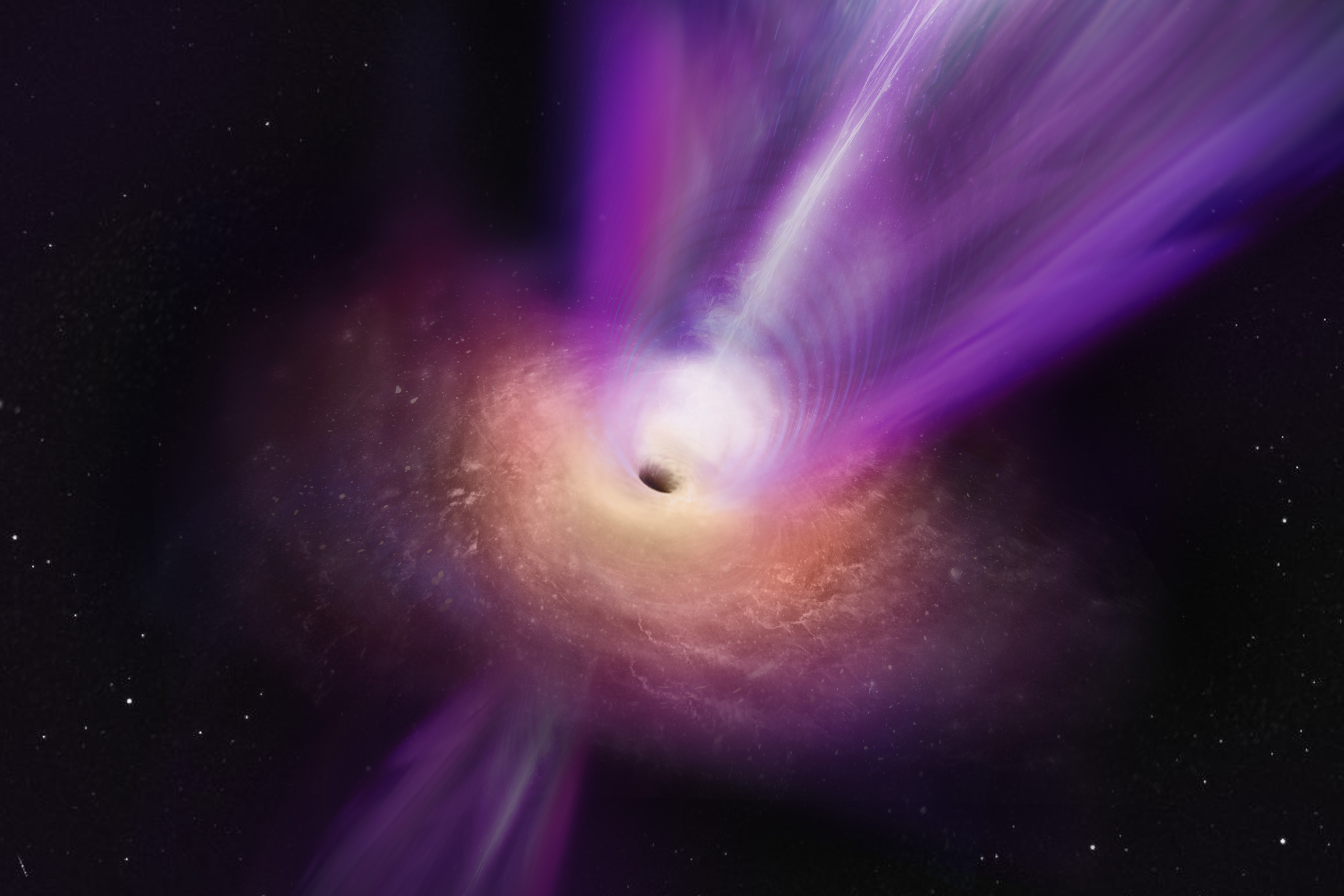
The 2018 data, which benefited from the inclusion of the Greenland Telescope, allowed the team to pin down the location of the ring relative to the relativistic jet blasting out from the center of the Messier 87 galaxy. This connection helps explain how matter is captured and, in some instances, how it manages to escape.
Magnetic Fields and the Dynamics of M87*
Beyond the spectral-index mapping, the Event Horizon Telescope (EHT) collaboration has utilized polarized light to reveal the structure of magnetic fields near the event horizon. These fields are essential for understanding how the black hole “eats” matter and launches energetic jets that extend thousands of light-years into space. Theoretical models suggest that the magnetic fields are strong enough to push back on hot gas, allowing only a portion of it to spiral inward toward the event horizon.
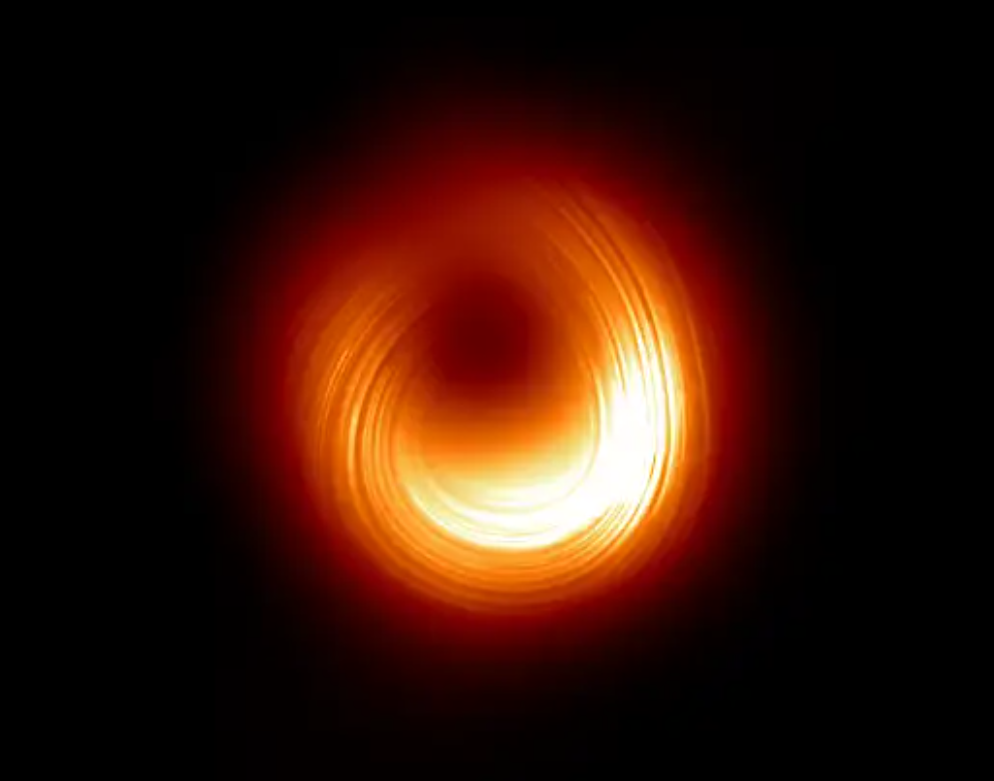
While the ring size has remained consistent over the years, the polarization pattern—the “fingerprint” of magnetism—has shown significant variability.
Future Directions for Multi-Frequency Imaging
The ability to separate gravitational effects from plasma dynamics remains a primary goal for the research teams. As the EHT network incorporates higher sensitivity and time-resolved capabilities, astrophysicists expect to gain deeper insights into how black holes launch high-energy jets.
The ongoing development of the EHT, including the integration of the Greenland Telescope and other global arrays, continues to refine the view of these extreme environments. By observing M87* annually, the collaboration aims to capture new moments in what scientists describe as a long, violent process, testing the limits of theoretical models and general relativity.
Related reading