Spain’s World Cup Champions Return Home to Historic Madrid Celebration
Spain’s men’s football team returned to Madrid on July 20, 2026, to celebrate their second FIFA World Cup title. An estimated 2 million fans lined the streets as the team, led by coach Luis de la Fuente, paraded on an open-top bus following a 1-0 extra-time victory over Argentina in New Jersey on Sunday, July 19. The win marked 16 years since the nation’s maiden title.
Madrid Celebrations and the Royal Reception
The Spanish squad arrived at Adolfo Suárez Madrid–Barajas Airport on Monday, July 20, less than 24 hours after their tournament win. The celebration was a multi-stage event that prioritized national tradition before the public parade. Following this, the 26-man squad proceeded to the Moncloa Palace, the official residence of Prime Minister Pedro Sanchez, for an official reception.
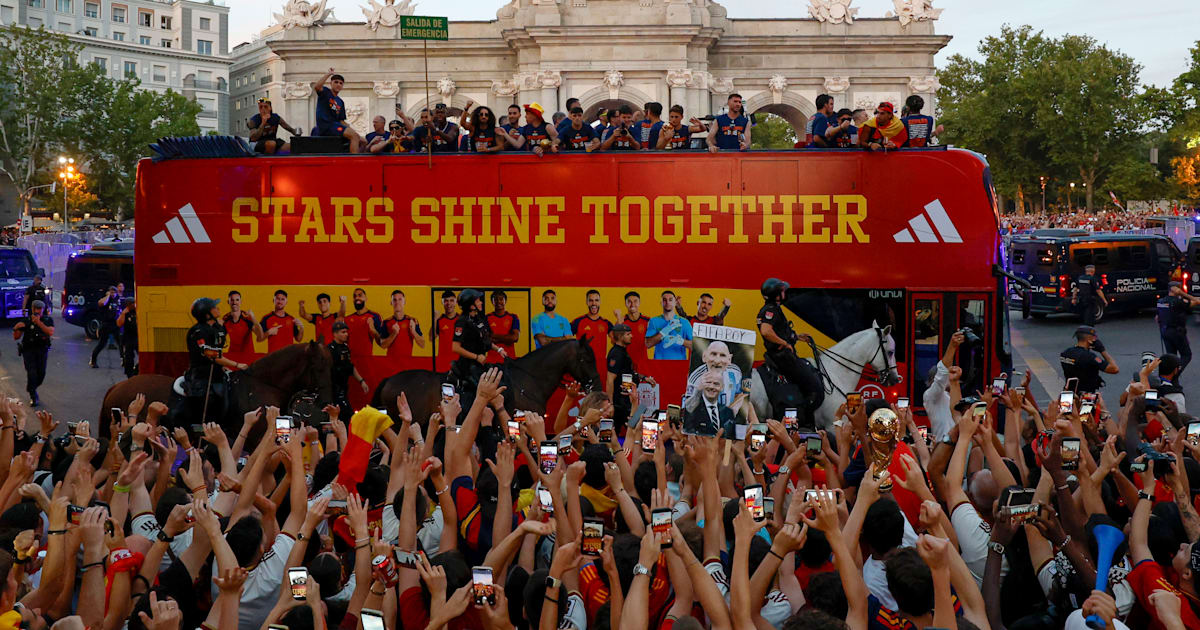
By 7 p.m. local time, the team began their public victory lap. The bus, which read Stars shine together,
commenced its route at the Moncloa transport interchange and traveled down Calle Princesa, cutting across to Alberto Aguilera before reaching the Plaza de Colon. The procession concluded at the Plaza de Cibeles, where the players presented the trophy to the crowd. Fans, many wearing shirts labeled Somos Campeones
(We Are Champions), waved red and gold flags and sang “Eviva España” as the players and coaching staff interacted with the public.
It’s been an emotional and proud experience to represent a wonderful country with such passionate and devoted fans,
said Spain coach Luis de la Fuente before the parade started. We are filled with joy.
For more on this story, see Spain Wins 2026 World Cup With 1-0 Victory Over Argentina in Final.
Tactical Analysis of the 1-0 Final Victory
Spain’s 1-0 win in the New Jersey final was defined by a late extra-time strike from super-sub Ferran Torres. The deciding sequence began with 19-year-old Lamine Yamal laying the ball off to right back Pedro Porro, whose curling, back-post cross found left winger Nico Williams. Williams headed the ball down to Torres, who struck a left-foot half-volley into the roof of the net. The opportunity was created after 19-year-old defender Pau Cubarsi caused a red card for Argentina’s Enzo Fernandez, allowing Spain to play a man up during added time and extra time.
The match was heavily influenced by Spain’s possession-based play, which stifled Argentina’s Lionel Messi. Despite lacking traditional, physical central defenders, the pairing of Cubarsi and Aymeric Laporte relied on finesse and positioning. Goalkeeper Unai Simon also played a critical role, notably short-circuiting a sixth-minute Messi run with an unhesitating willingness to leave his penalty area. For his performance, Cubarsi—whom announcers took to calling “Cubarsito”—was awarded the “Young Player” trophy.
This follows our earlier report, Egypt’s Historic 2026 World Cup Victory: How the Pharaohs Claimed Their First Ever FIFA World Cup Title in Thrilling Fashion.
Midfielder Rodri, who entered the tournament recovering from knee surgery, was noted for his influence on the pitch, controlling the tempo despite recording zero goals or assists across eight games.
Tournament Context and Defensive Dominance
For Spain, the victory solidifies their position in international football, adding a second World Cup title to a trophy case that already includes the Euros, the Olympic Games, and the Women’s World Cup. Throughout the eight-game tournament, La Roja demonstrated defensive dominance, conceding only one goal: a header by Belgium’s Charles De Ketelaere during the quarterfinal.
Read also: 2026 World Cup: Cape Verde Stuns Uruguay in Historic 2-2 Draw.
While the final was decided by the late strike from Torres, the match had earlier tension, including a 96th-minute finish by Williams that was controversially disallowed after he had gone in alone on Argentina goalkeeper Emiliano Martinez.
Weather Conditions During the Madrid Parade
Despite the massive crowds, the outdoor celebrations in Madrid proceeded under clear, high-temperature conditions. Temperatures at the time of the 7 p.m. parade reached approximately 98 degrees Fahrenheit, as fans gathered to see the squad travel from Moncloa Palace to the city center, with celebrations continuing into the early hours of Monday.
Worth a look