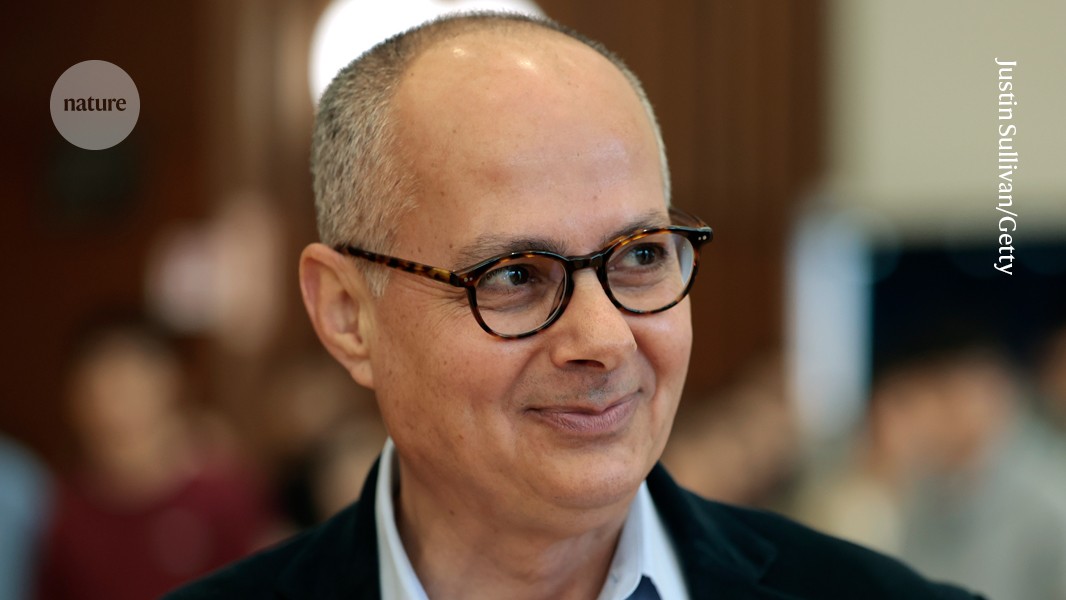
Nobel-winning chemist Omar Yaghi has left the United States to lead an artificial-intelligence materials discovery institute at Tsinghua University in Beijing.
Omar Yaghi Relocates to Tsinghua University to Lead AI Materials Research
Nobel prizewinner Omar Yaghi has accepted a full-time position as a researcher at Tsinghua University in Beijing, where he will lead a new artificial-intelligence-assisted materials discovery institute. The move, first reported by the South China Morning Post, comes as the administration of President Donald Trump continues its attempts to slash US science spending and to limit international research partnerships. Some nations, including China, have responded by trying to lure in US talent with the promise of money and support. Earlier this year, for instance, France announced that it would award funds to dozens of US scientists relocating there. Meanwhile, China has been wooing international researchers with talent-recruitment programmes, and some of its cities and provinces are even offering researchers lump sums and monthly allowances to relocate within their borders.
Born in Amman, Jordan, to Palestinian refugees, Yaghi moved to the United States at the age of 15 and lived there until he moved to China earlier this year. He is best known for developing metal–organic framework (MOF) compounds — highly porous materials with vast internal surface areas that make them capable of storing gases and serving as catalysts for chemical reactions, among other functions. Chemists have created more than 100,000 types of MOF, with an eye towards putting them to use in a range of commercial applications, including harvesting water from the air and delivering drugs into the body.
Yaghi already had a connection to Tsinghua University before the move — he became an honorary professor there in 2022. But he was officially welcomed as a full-time faculty member during a ceremony held on 3 July.
Omar Yaghi stated via Scientific American and Nature that the current state of US science was not so encouraging because of the cutting back on grants, as well as the drop in support from US science agencies.
Yaghi was unavailable to speak to Nature for this story. However, in an interview with Scientific American last month, he also voiced concerns that US researchers were not embracing what he sees as an artificial-intelligence revolution
. Researchers need to engage with AI models, he said, as a matter of survival of the advanced research system in the US.
World Bank to Phase Out Lending to China by 2031
The World Bank will phase out its lending to China by 2031 after years of declining loans, reflecting the country’s rise to become the world’s second-largest economy, three sources familiar with the plan said on Tuesday. The World Bank’s board will review the plan during the week of July 20, although no formal vote is needed, one of the sources said. It was agreed by the World Bank and China as part of its five-year country partnership framework.
The change, first reported by the Financial Times, would limit the multilateral development bank’s lending to Beijing to $2 billion between now and 2031, ending it thereafter.
World Bank lending to China has declined steadily, dropping from $2.4 billion a year in 2017 to $750 million in 2025. China exited eligibility for loans under the World Bank’s International Development Association facility for the poorest countries in 2000. It began contributing to the facility in 2007 and is now the fifth-biggest donor.
China has made significant development advances over the past several decades. Now we are reaching a new phase of our relationship, reflecting that reality. World Bank official familiar with the matter, via Reuters
The U.S. and other countries have long pushed the World Bank to stop lending to China, given its growing economic power. China’s continued borrowing from the World Bank and other institutions has been an irritant for the Trump administration since its first term. The World Bank this month agreed to a similar change for Poland, ending development loans to the country after 2031.
A U.S. Treasury spokesperson called the move a step in the right direction and said Washington looked forward to other institutions following suit. The spokesperson stated that, as the second-largest economy in the world, China should not be receiving handouts from multilateral institutions. A senior U.S. official said China should not be eligible for development funding given the size of its economy, and called for assistance for China from other institutions such as the Asian Development Bank, the International Fund for Agricultural Development and U.N. agencies to end as well.
China’s finance ministry said on Wednesday that the gradual decline in World Bank loans to China is a natural result of changes in domestic demand and the transformation of cooperation between the two sides.
Fields Medals Awarded at the International Congress of Mathematicians
Math’s most prestigious prizes were announced at the International Congress of Mathematicians. Following a lively brass-band performance by the West Philadelphia Orchestra in a massive auditorium at the Pennsylvania Convention Center, the president of the International Mathematical Union bestowed the prizes to four mathematicians for work ranging from the theory of knots to the motion of fluids.
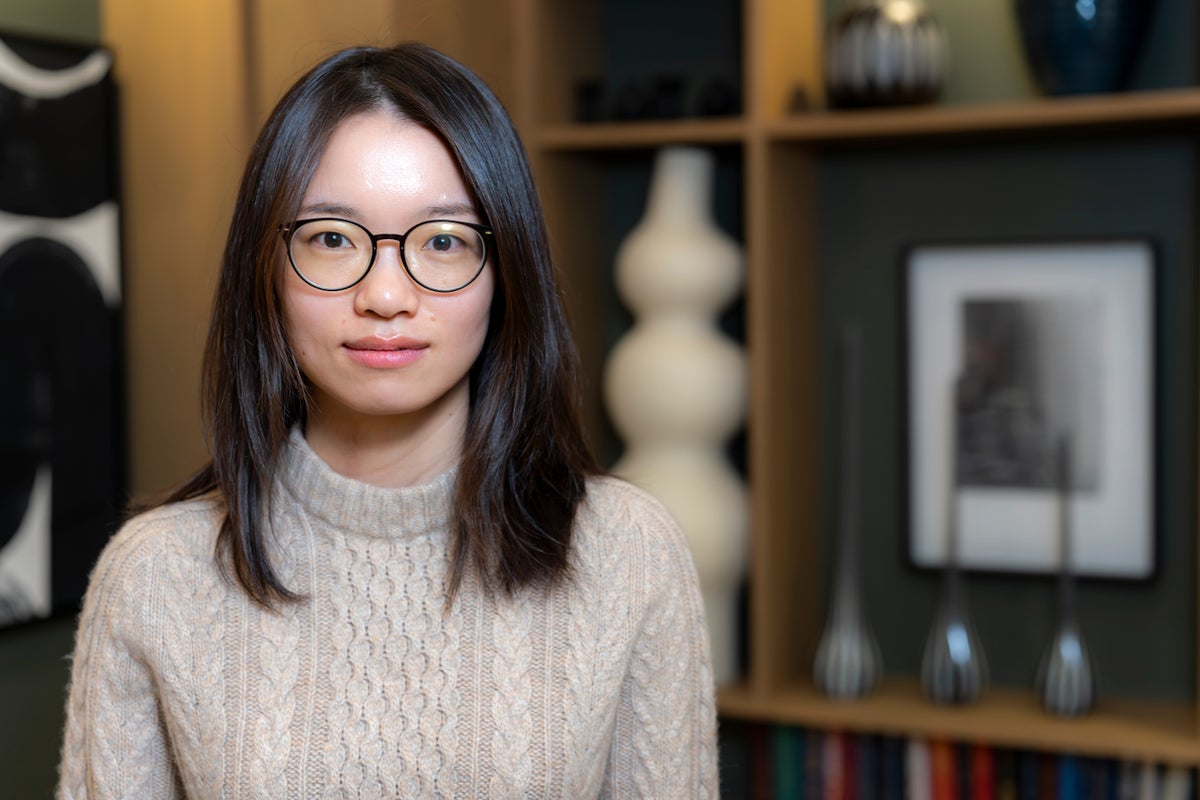
The Fields Medals went to Hong Wang of New York University and France’s Institute of Advanced Scientific Studies (IHES), Yu Deng of the University of Chicago, John Pardon of Stony Brook University and Jacob Tsimerman of the University of Toronto. In the awards’ 90-year history, Wang is only the third woman to win one, after mathematicians Maryam Mirzakhani and Maryna Viazovska in 2014 and 2022, respectively. Wang and Deng represent the prizes’ only Chinese-born recipients besides mathematician Shing-Tung Yau, who won a Fields Medal in 1982.
The awards, often referred to as math’s Nobel Prizes, are named for John Charles Fields, a Canadian mathematician who led the push for their creation in the 1920s as a way to bring the international math community together. But unlike the Nobels, they are only bestowed every four years and, starting in 1966, only go to researchers who are less than 40 years old.

When Wang rose to speak during a symposium at the Institute for Advanced Study in Princeton, N.J., this past February, she opened with a characteristic note of humility. She expressed her gratitude for being invited, calling it a great honor. She added that especially when she saw the speaker list, she had thought she perhaps should not speak. But no one in the rapt audience shared Wang’s opinion. At age 34, her work at the interface of two mathematical fields—taking collections of wavelike equations and using them to explore how shapes fill space—had already transformed both subjects. In particular, a 2025 proof of the three-dimensional Kakeya conjecture that she co-authored with mathematician Joshua Zahl marked a triumphant end to what had been a fervent, field-defining 50-year search. Hong Wang is a mathematician at New York University and the Institute of Advanced Scientific Studies (IHES) in France. She and a collaborator solved the three-dimensional Kakeya conjecture, a major problem. Now Wang possesses the ultimate qualification for any list of mathematical greats.
Worth a look