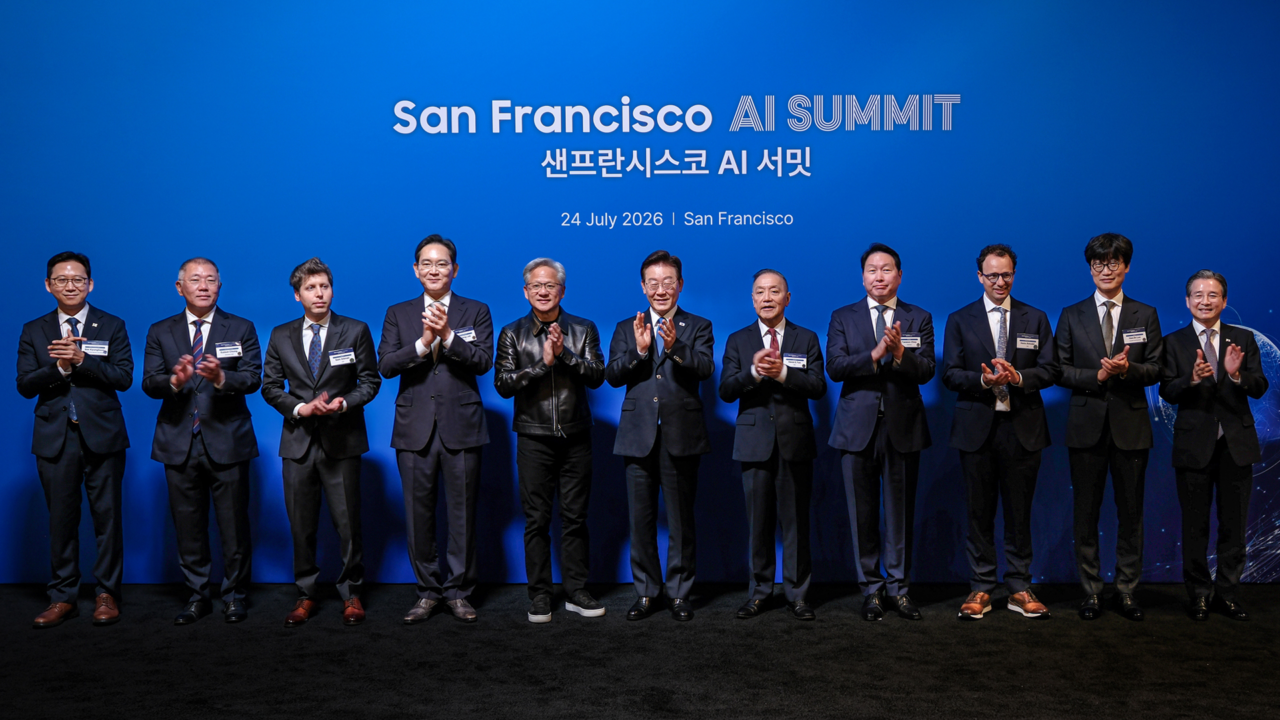
At an influential high-tech gathering in San Francisco this week, South Korean President Lee Jae Myung and a delegation of major industry leaders met with NVIDIA executives and ecosystem partners to cement a massive expansion of national artificial intelligence infrastructure, according to official summit disclosures.
The high-stakes dialogues build directly upon NVIDIA founder and CEO Jensen Huang’s official visit to South Korea last month. Together, the collaborative announcements advance a comprehensive, full-stack strategy designed to scale the nation’s domestic compute capacity, upgrade research programs, and position South Korea as a pivotal global center for artificial intelligence innovation.
Central to these developments, NVIDIA and the Korea Advanced Institute of Science and Technology (KAIST) announced a joint AI research lab at the KAIST Kim Jaechul Graduate School of AI in Seoul. Dedicated to advancing agentic AI for the South Korean market, the initiative represents the first joint artificial intelligence laboratory established between a Korean university and a global technology enterprise.
National AI Factories and Multi-Billion-Dollar Compute Partnerships
During Friday evening announcements at the summit, NVIDIA and its core South Korean ecosystem partners—including NAVER, SK Telecom, Hyundai Motor Group, KAIST, and Seoul National University—committed to constructing national AI factories and physical AI platforms. According to summit announcements, NAVER, Brookfield, and NVIDIA will expand NAVER’s NVIDIA DSX AI factory at the GAK Sejong data center to 200 megawatts, utilizing roughly 100,000 GPUs built on the upcoming NVIDIA Vera Rubin platform and more than tripling the initial buildout announced in June.
Simultaneously, SK Group and NVIDIA disclosed plans for a $500-billion-plus comprehensive partnership to establish robust AI infrastructure capable of handling surging worldwide compute demands. Broadening initiatives first outlined in June, this expanded collaboration will deploy NVIDIA Vera Rubin infrastructure backed by SK hynix HBM4 memory.
In the automotive and robotics sectors, Hyundai Motor Group outlined an extensive physical AI strategy anchored by a robot reference platform developed alongside NVIDIA. The initiative extends an ongoing buildout utilizing 50,000 NVIDIA Blackwell GPUs. Furthermore, Hyundai will integrate the NVIDIA DRIVE Hyperion autonomous vehicle development platform—combining NVIDIA DRIVE AGX in-vehicle computing and the safety-certified NVIDIA DriveOS operating system—directly into its commercial vehicle architectures.
Deepening Academic Ties and Advanced Research Labs
Beyond industrial data centers, NVIDIA is forging deeper bonds with premier Korean academic institutions. NVIDIA and KAIST’s Department of Mechanical Engineering disclosed plans for an NVIDIA AI Technology Center (NVAITC) focused on collaborative research, talent development, and physical AI knowledge exchange, incorporating projects that leverage NVIDIA Nemotron open models.
This academic expansion complements the newly established agentic AI research lab in Seoul, which benefits from a multiyear commitment aimed at funding and training domestic researchers. Additionally, NVIDIA and Seoul National University announced plans for a separate NVAITC facility spanning foundation models, accelerated computing, physical AI, and AI for science, with prospective cooperation on advanced AI infrastructure utilizing NVIDIA Nemotron and NVIDIA Cosmos open world foundation models.
Tech Titans Convene at the Midway for the San Francisco AI Declaration
The collaborative momentum culminated Friday on stage at the Midway event venue in San Francisco’s Dogpatch district. Moderated by Stanford University’s Soh Kim, the high-profile panel brought together global compute leaders alongside South Korea’s industrial vanguard, including Samsung Electronics Chairman Jay Y. Lee, SK Group Chairman Chey Tae-won, Hyundai Motor Group Executive Chair Euisun Chung, and NAVER founder Hae-jin Lee.
Sharing the stage with OpenAI CEO Sam Altman, Broadcom CEO Hock Tan, and Anthropic CEO Dario Amodei, President Lee delivered his “San Francisco AI Declaration.” Drawing a parallel between San Francisco’s recovery after the 1906 earthquake and South Korea’s postwar ascent into a digital powerhouse, President Lee pitched a multitrillion-dollar investment into AI semiconductors, hyperscale facilities, and physical AI, characterizing artificial intelligence as humanity discovering fire anew.
Jensen Huang underscored the deep historical ties between NVIDIA and South Korea, emphasizing the foundational importance of memory technology developed in the country. “If not for the invention of HBM memory in Korea, NVIDIA wouldn’t have been able to invent the supercomputers that power AI today,” Huang stated during the panel discussion.
Sam Altman reinforced this sentiment on stage, noting that the current global AI revolution would not exist without South Korea’s contributions across the technology stack. The summit concluded with commitments from executive leadership to sustain ongoing bilateral dialogues as regional infrastructure projects break ground over the coming months.
Worth a look