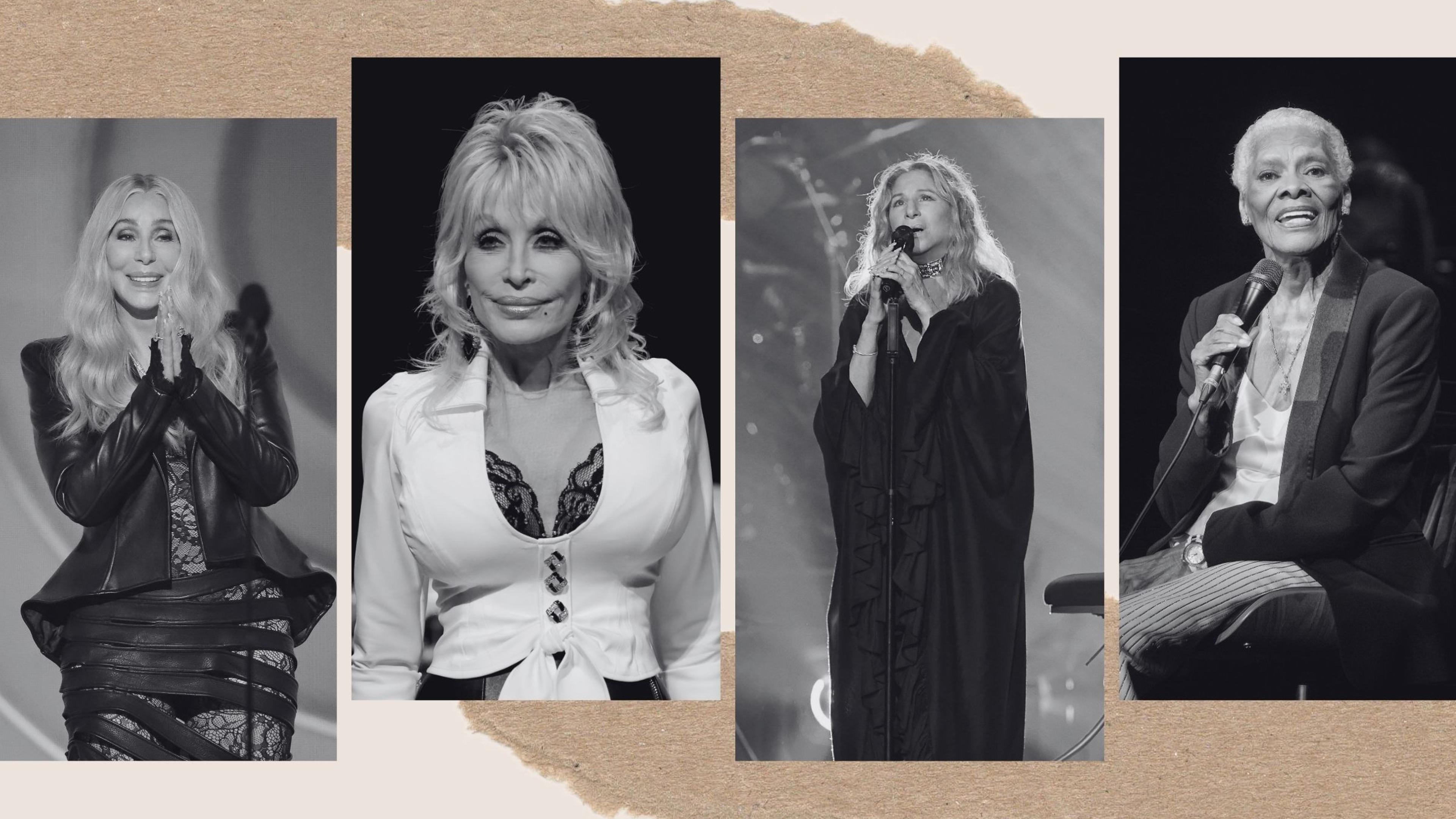
Octogenarian pop divas such as Cher, Dolly Parton, Barbra Streisand, and Dionne Warwick demonstrate that living a long and authentic life requires refusing demands to become smaller, softer, or less fully oneself. Across decades in the global spotlight, these legendary performers transformed the very traits that once drew public criticism into the signatures of their enduring careers, offering a distinct cultural blueprint for aging with conviction.
According to historical and biographical records, Cher marked her 80th birthday on May 20, bringing renewed attention to a career spanning more than six decades across music, television, film, and fashion. As reported by entertainment retrospectives, she has earned a Grammy Award, an Emmy Award, an Academy Award, and three Golden Globes, standing as the only artist to achieve a number-one single on a Billboard chart in seven consecutive decades. Throughout her trajectory, her collaborations with designer Bob Mackie produced theatrical ensembles—such as the headline-making sheer dress worn on the cover of TIME in 1975 and her 1986 Academy Awards feathered headdress—that routinely challenged conventional standards of female public presentation.
The cultural scrutiny intensified as Cher continued to blend glamour and sexuality into her forties and beyond. Her 1989 music video for “If I Could Turn Back Time,” filmed aboard the decommissioned naval vessel USS Missouri and featuring a sheer black bodysuit and fishnets, drew an initial restriction from MTV and caused reported consternation within the United States Navy due to its bold presentation. Rather than softening her public image, Cher met persistent tabloid speculation regarding her appearance with direct defiance, famously asserting ownership over her own physical choices.
Similarly, Dolly Parton, who also reached age 80, built an international empire by subverting how late-night hosts and media interviewers framed her exaggerated mountain-girl persona. Early in her career, figures like Johnny Carson frequently treated her appearance as a comedic punchline on television programs. Parton’s strategic response involved leaning directly into the caricature, encapsulated by her famous quip that “it costs a lot of money to look this cheap.” By taking control of her image, she converted her signature blonde hair, rhinestones, and high-energy branding into a foundation for monumental creative and commercial success.
Parton’s professional footprint extends far beyond her catalog of thousands of recorded compositions, which include classic tracks like “Jolene,” “Coat of Many Colors,” “9 to 5,” and “I Will Always Love You.” According to biographical data from cultural institutions, she has been inducted into the Country Music Hall of Fame, the Nashville Songwriters Hall of Fame, the Songwriters Hall of Fame, and the Rock & Roll Hall of Fame. In Tennessee, her Dollywood theme park serves as a major regional economic engine, directly employing approximately 4,000 people and generating substantial local economic impact. Furthermore, her Dollywood Foundation Imagination Library, established in 1995 to honor her father, has gifted more than 300 million books to children internationally.
Challenging Institutional Expectations and Navigating Public Criticism
For Barbra Streisand, now 84, the starmaker machinery of mid-century Hollywood imposed a narrow definition of beauty and behavior that clashed with her distinct Brooklyn upbringing and uncompromising artistic vision. Memoirs and historical accounts note that she was frequently advised early in her career to undergo cosmetic procedures on her nose and teeth. Fearing that alterations might alter her legendary singing voice, Streisand refused, insisting that her talent alone should suffice.
That artistic insistence came with professional hurdles. When Streisand fought to co-write, produce, direct, and star in the 1983 musical drama film Yentl—which follows a young Jewish woman who disguises herself as a man to pursue scholarly studies—she spent years persuading studio executives of her capability behind the camera. Her rigorous attention to detail and creative control often invited the label of being “difficult,” a double standard that she has frequently addressed when contrasting how assertive male filmmakers are perceived relative to women who maintain exacting professional standards.
Meanwhile, Dionne Warwick, who is 85, established her legacy on composure, elegance, and vocal restraint alongside songwriters Burt Bacharach and Hal David. Biography and music history document that her early career involved navigating complex racial expectations within the global recording industry, including an instance in 1963 where a European album release featured a white model on the cover. Warwick’s artistic self-possession was evident early on; after discovering that a song she intended to record had been given to another artist, she famously told her producers, “Don’t make me over,” inspiring the hit single that launched her solo trajectory.
In recent years, Warwick has captured the attention of younger digital audiences through her unvarnished presence on platforms such as X (formerly Twitter). Her straightforward public inquiries directed toward contemporary artists—such as asking Chance the Rapper why he retained his moniker or questioning the spelling choices of The Weeknd—demonstrated a consistent directness that has defined her public persona for decades. Rather than actively chasing modern trends, Warwick has maintained relevance by remaining entirely confident in her own perspective.
Evolution Without Compromise
While these four cultural icons have continually adapted to shifting industries, their transformations have occurred strictly on their own terms. Cher transitioned seamlessly from folk-pop duo member to television variety star, dramatic actress, dance music innovator, and published memoirist. Parton expanded her foundational Appalachian roots into film, theme parks, children’s literacy programs, and widespread philanthropic efforts. Streisand evolved from Greenwich Village nightclub singer to Broadway phenomenon, international film star, and acclaimed director. Warwick progressed from the Scepter Records era to global pop elegance, acting as an activist, internet commentator, and elder stateswoman of popular music.
Cultural historians observe that women in the public eye are frequently encouraged to age by diminishing—accepting reduced visibility, diminished power, and quieter modes of existence. By resisting these unwritten strictures, Cher, Parton, Streisand, and Warwick have demonstrated that artistic conviction outlasts fleeting industry fashion. Their collective longevity offers a distinct model for contemporary audiences, proving that a well-lived life is measured not by how many expectations one satisfies, but by the courage required to remain unmistakably oneself.
Keep reading