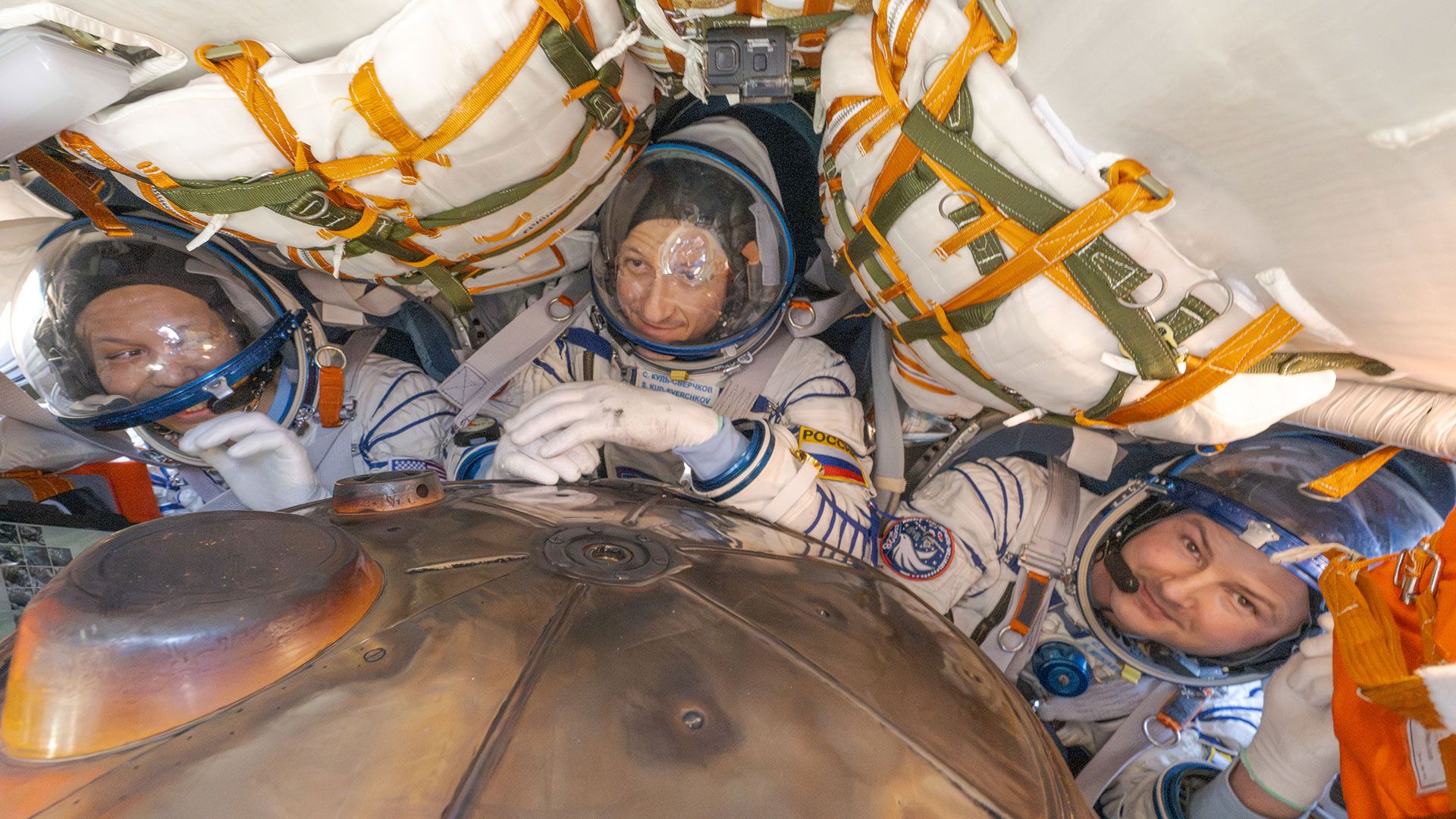
NASA astronaut Chris Williams and Russian cosmonauts Sergey Kud-Sverchkov and Sergei Mikaev returned safely to Earth on Sunday, July 26, 2026, landing in Kazakhstan aboard a Soyuz MS-28 spacecraft after completing a 241-day science mission aboard the International Space Station.
The Soyuz MS-28 capsule made its safe, parachute-assisted landing at 6:27 a.m. EDT (1027 GMT), bringing an end to a journey that began with a Thanksgiving Day liftoff on November 27, 2025.
Soyuz MS-28 Descent and Landing in Kazakhstan
The return trip began when the ferry ship undocked from the station’s Russian Rassvet module at 3:03 a.m. EDT. To fall out of orbit, the crew had to lose speed rather than gain it, firing its engine against its direction of travel in a de-orbit burn that trimmed its speed by roughly 100 meters per second. That maneuver allowed Earth’s gravity to pull the craft back down through a high-velocity re-entry.
As the capsule plunged back into the atmosphere, it compressed the air in front of it to extreme temperatures, creating a glowing wall of plasma reaching 1,500 to 2,000 degrees Celsius before parachutes deployed for the final touchdown. Russian recovery crews stationed nearby quickly raced to the capsule to help the returning fliers out of the cramped module as they began re-adjusting to gravity.
Scientific Investigations and Station Maintenance During Expedition 74
During their 241 days in space, the crew orbited Earth 3,856 times and traveled a total of more than 102 million miles. Commander Sergey Kud-Sverchkov completed his second spaceflight, bringing his career total to 426 days and 9 minutes in space, while the mission marked the first flight into orbit for both Williams and flight engineer Sergei Mikaev.

Williams supported a wide range of scientific investigations, NASA of materials used in high-performance computers and electronics. Outside the hull, Kud-Sverchkov and Mikaev spent six hours in Russian Orlan spacesuits fitting an instrument to measure solar radiation and stripping older physics and microbiology experiments from the station’s exterior. Williams also completed two spacewalks to prepare for power system upgrades and to replace a faulty joint on the Canadarm2 robotic arm.
Re-adaptation to Gravity and Return Logistics
After eight months in weightlessness, the returning astronauts faced the immediate physical challenge of re-adapting to Earth’s pull. Blood that pooled in the chest during weightlessness drops to the legs upon return, leaving many crew members dizzy and requiring rehabilitative support as their muscles adjusted back to full body weight. In line with standard Soyuz recovery procedures, the trio were carried to recliners for initial medical checks, fresh fruit, and satellite phone calls home before heading to recovery teams.
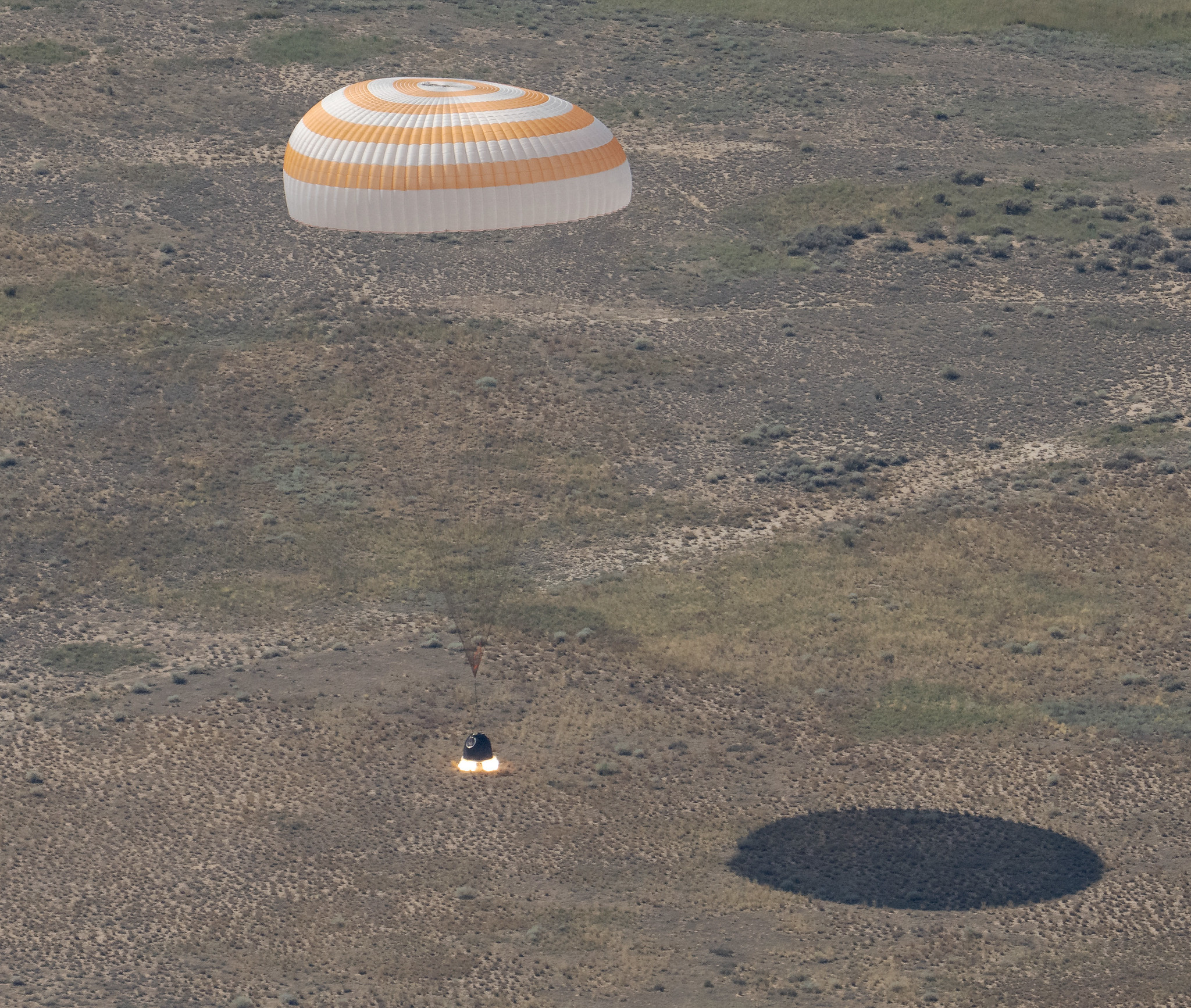
Kud-Sverchkov added, I would like to thank everyone who supported this landing.
Everything was smooth and perfect.
Everything was just excellent.
Following the initial post-landing evaluations, the crew members were flown by helicopter to Karaganda, Kazakhstan.
Expedition 75 Handover and Ongoing Cooperation
Before departing the orbital laboratory, Kud-Sverchkov handed over command of the station to NASA astronaut Jessica Meir during a change-of-command ceremony, marking the formal transition from Expedition 74 to Expedition 75 on Saturday. The departing crew left behind a station already hosting newly arrived personnel, including NASA astronaut Anil Menon and Roscosmos cosmonauts Pyotr Dubrov and Anna Kikina, who arrived on July 14 following a launch from the Baikonur Cosmodrome.
The ongoing joint mission underscores a decades-long partnership in space between Washington and Moscow. Although bilateral ties were strained following Russia’s military action in Ukraine in 2022, civil space cooperation has persisted, with U.S. astronauts and Russian cosmonauts continuing to fly aboard each other’s spacecraft to maintain continuous human presence on the station.
Worth a look