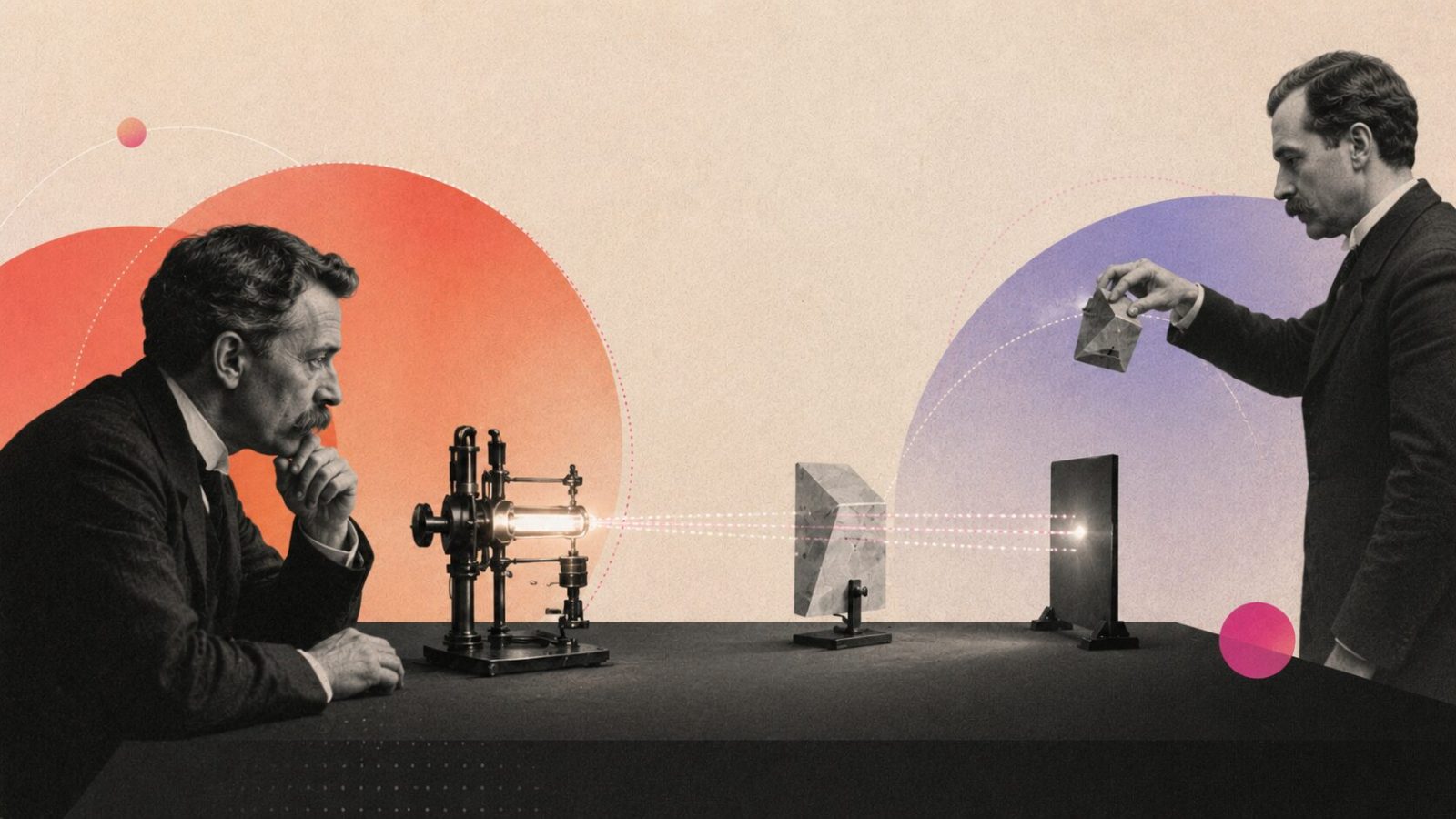
In 1903, French physicist Prosper-René Blondlot announced the discovery of a revolutionary form of radiation that he called N-rays, named after the University of Nancy where he worked. As a respected professor and a corresponding member of the French Academy of Sciences, Blondlot enjoyed a formidable academic reputation. Within months, dozens of papers from various researchers claimed to confirm the existence of these mysterious rays, which allegedly could pass through metals and wood while heightening human visual acuity in dim light.
Yet, the entire phenomenon was an illusion. The N-ray episode stands out in the history of science as one of the most prominent cautionary tales regarding observer bias, self-deception, and the pressures of national prestige in laboratory research. When American physicist Robert W. Wood investigated the laboratory setup in 1904, he revealed that Blondlot and his peers were merely measuring what they desperately wanted to see rather than any physical reality.
Understanding how the scientific community chased an invisible phantom illuminates the psychological frailties that persist inside modern research environments. From misplaced nationalism to subjective measurement techniques, the N-ray debacle provides a permanent lesson in the necessity of rigorous, objective replication.
The Rise of N-Rays and Academic Prestige
Prosper-René Blondlot was investigating X-rays, which had been discovered by Wilhelm Röntgen in 1895, when he began noticing unusual changes in electric sparks and phosphorescent screens. According to accounts from the period, Blondlot used a spectrometer with an aluminum prism to refract what he believed was a novel spectrum of invisible light originating from various sources, including Welsbach burners and heated metals.
The discovery arrived at a sensitive time for French academic pride. Following France’s defeat in the Franco-Prussian War and the rapid industrial and scientific rise of Germany, French researchers felt immense pressure to secure major foundational breakthroughs. When the prominent Parisian journal Comptes Rendus published numerous short papers detailing N-ray observations, French nationalism intertwined with academic ambition, creating an environment where skepticism was quickly dismissed.
By 1904, more than 40 scientists had published roughly 300 papers on the subject. Researchers claimed N-rays were emitted by nearly all substances except green wood and wet bodies, and some asserted that the human body itself glowed with the radiation. Laboratories across France scrambled to map out properties of a spectrum that existed solely in the minds of the observers.
The Investigation and Unraveling by Robert W. Wood
Despite the accumulating literature, foreign laboratories—particularly in Germany and Great Britain—struggled to replicate Blondlot’s findings. Skepticism grew abroad, prompting the influential British journal Nature to send American physicist Robert W. Wood of Johns Hopkins University to Nancy in 1904 to inspect Blondlot’s experimental setup firsthand.
Wood visited Blondlot’s darkroom laboratory to observe the minute shifts in brightness on a tiny calcium sulfide screen that supposedly indicated the presence of N-rays. During the demonstrations, Wood exposed the subjective nature of the measurements. When Blondlot claimed to see N-rays being refracted through an aluminum prism, Wood quietly removed the prism from the spectrometer entirely without Blondlot’s knowledge. Blondlot continued to “see” the exact same readings.
In another test, Wood placed a crucial diffraction grating in his pocket while pretending to adjust the apparatus, yet Blondlot still reported detecting the rays. Wood also switched numbered metallic strips in the dark, asking Blondlot to identify which one emitted radiation; Blondlot failed the blind test completely, guessing randomly.
Upon returning to the United States, Wood published an account of his visit in Nature in September 1904. He described the N-ray experiments as a case of self-delusion, noting that the intensity of the light screen relied entirely on the experimenter’s imagination. The exposé effectively halted international interest in the phenomenon, though Blondlot and a handful of loyalists in France attempted to defend their work for a short time.
Legacy and Lessons for Modern Science
The collapse of the N-ray hypothesis left a lasting imprint on experimental methodology. The episode demonstrated how expectation bias can alter human perception, causing researchers to interpret random background noise or minor fluctuations as definitive proof of a favored hypothesis. It also highlighted the vital role of independent replication and double-blind testing in validating extraordinary claims.

Historians and philosophers of science frequently cite the Nancy experiments when discussing the sociology of science, showing that professional prestige, institutional loyalty, and patriotic fervor can temporarily blind a community to empirical contradictions. Modern laboratories routinely implement strict blinding protocols and rigorous peer review precisely to guard against the psychological traps that ensnared Blondlot and his contemporaries.
While science ultimately corrected its course, the incident remains a striking reminder that even the most accomplished researchers are vulnerable to seeing what they expect to find. Share your thoughts on this historical scientific misstep in the comments below.
Related reading