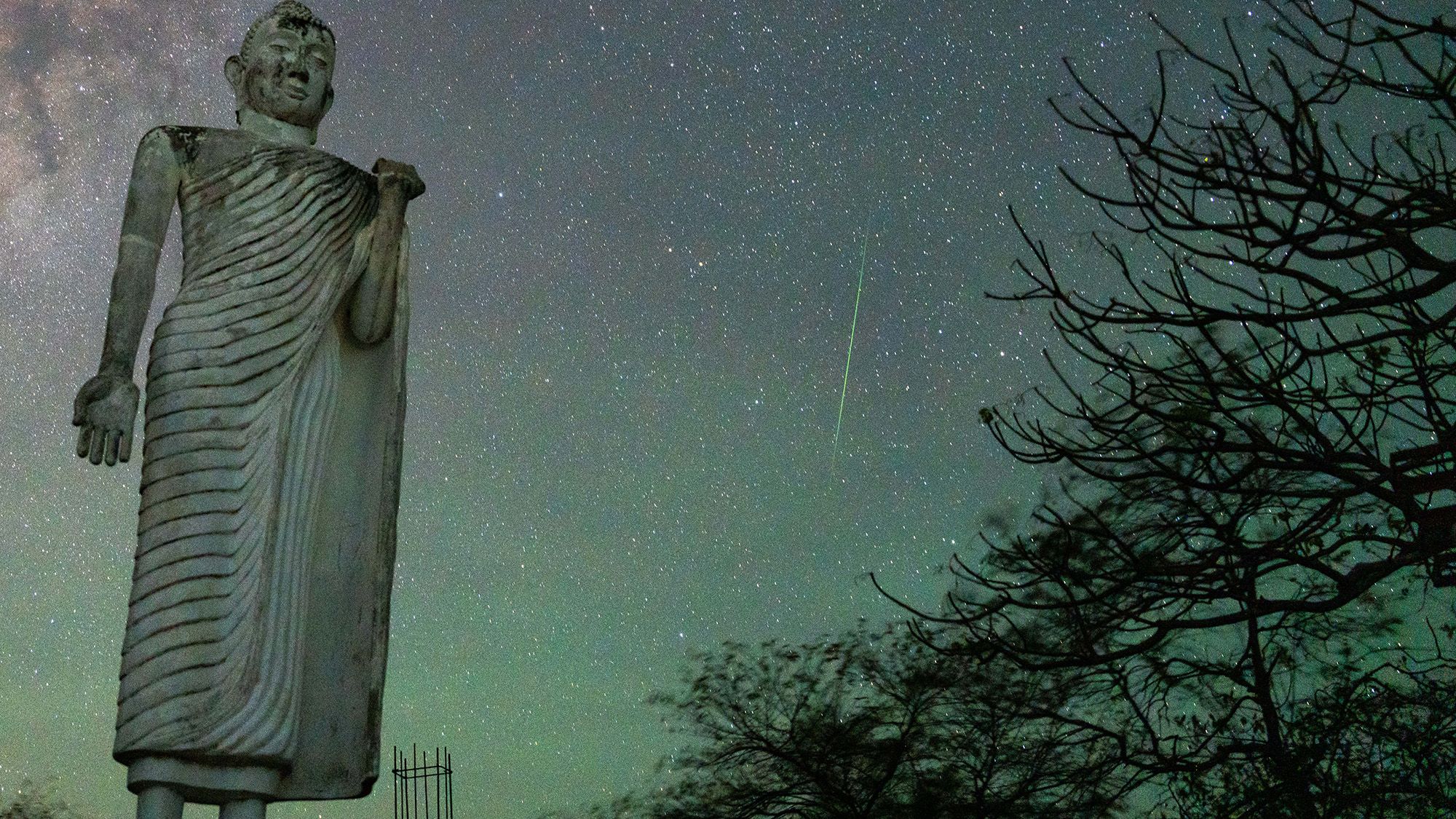
The Southern Delta Aquariids and Alpha Capricornids meteor showers will peak together overnight from Thursday, July 30, into Friday, July 31. However, the American Meteor Society warns that a nearly full moon will significantly hinder visibility, as the moon will remain 98% illuminated during the peak, washing out many of the fainter streaks of light.
Skywatchers facing this lunar interference are advised to look toward the darkest parts of the sky and use natural obstructions, such as trees or buildings, to block the moon’s glare. While the brightness reduces the number of visible meteors, the overlap of two distinct showers provides a unique opportunity to spot both faint streaks and bright fireballs.
The Southern Delta Aquariids are active from July 12 to Aug. 23, with their maximum activity occurring on the night of July 30-31. Under ideal, dark-sky conditions, this shower can produce approximately 25 shooting stars per hour. Because these meteors are typically faint and lack fireballs, they are the most susceptible to the moonlight, according to the American Meteor Society.
Simultaneously, the Alpha Capricornids reach their peak on the same night. This shower is active from July 3 to Aug. 15 and offers a lower frequency of activity, averaging about five meteors per hour. Despite the lower volume, the Alpha Capricornids are noted for producing bright fireballs—larger space rocks that ignite brilliantly and sometimes colorfully as they enter Earth’s atmosphere.
Optimal Viewing Times and Geographic Locations
The most effective window for observation is between midnight and dawn. During these hours, the radiant—the point in the sky from which the meteors appear to originate—for the Southern Delta Aquariids is highest. This radiant is located in the constellation Aquarius.
Geographic location plays a significant role in visibility. Observers in the Caribbean, Mexico, and the southern United States are better positioned for viewing because the constellation Aquarius climbs higher in the sky at lower latitudes. Those further north will see the radiant at a lower angle, potentially reducing the number of visible meteors.
Astronomy experts recommend viewing meteor showers with the naked eye rather than using telescopes or binoculars, as a wide field of vision is necessary to catch the random trajectories of shooting stars across the sky.
Comparing July Peaks with the August Perseids
For those unable to find a clear view during the July peaks due to moon brightness or cloud cover, a more favorable event occurs in mid-August. The Perseid meteor shower is scheduled to peak overnight on Aug. 12-13. Unlike the July events, the Perseids peak shortly after the Aug. 12 new moon, providing the dark skies necessary for maximum visibility.
The Perseids are significantly more active than the July showers, with a peak rate of approximately 100 meteors per hour. This combination of high activity and a moonless sky makes the August window a primary target for global skywatchers.
Solar Eclipse and Rare Astronomical Alignment
According to astronomical data, a total solar eclipse will be visible along a narrow path crossing northern Spain, western Iceland, and eastern Greenland. A partial solar eclipse will also be visible from the northeastern United States and parts of Canada.
Worth a look