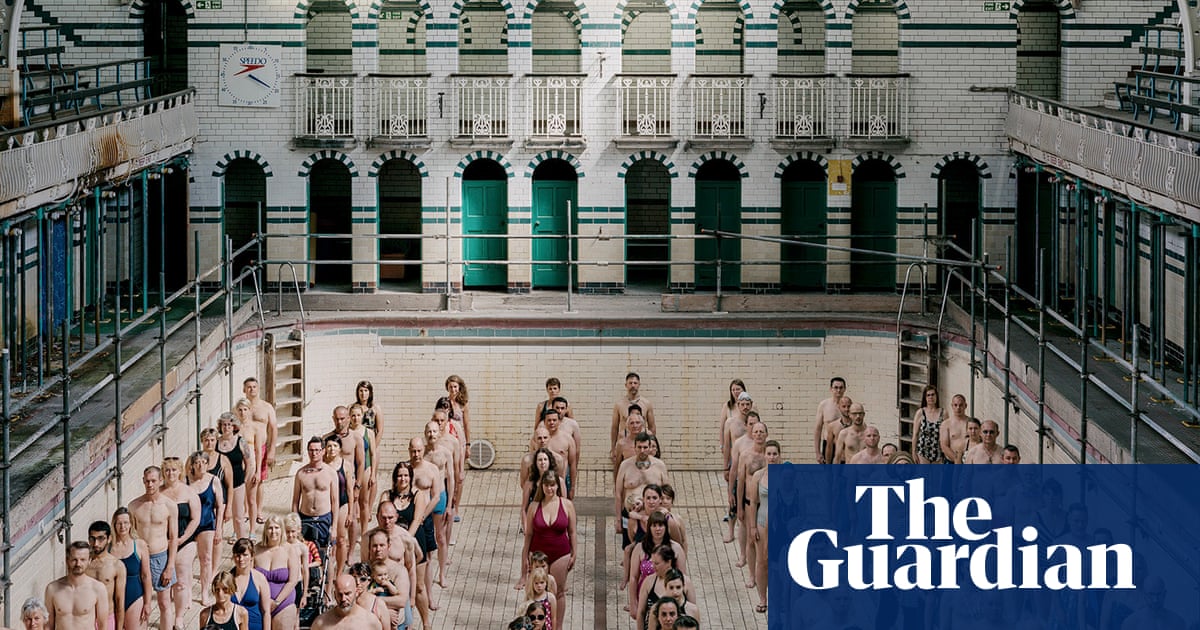
The photograph was not merely a stylistic exercise. At the time of the shoot, the Edwardian-era community bathhouse faced imminent closure due to severe council budget cuts and a lack of restoration funding. Fiumarella, who regularly passed the building on his daily bus commute to the city center, had become captivated by its ornate architectural facade, which still bore three separate stone-carved entrances for first-class, second-class, and women patrons.
Organizing nearly 120 participants in a cavernous, empty indoor pool required meticulous coordination.
History and Architecture of Moseley Road Baths
Before Fiumarella captured his iconic group portrait, the facility had served the local community for over a century. Local archives and community historians note that beyond providing essential swimming instruction to generations of Brummies, the building adapted to shifting municipal needs during times of crisis. During the Second World War, portions of the complex functioned as an emergency casualty station, while other eras saw the pool halls utilized as local dance venues.
By 2014, however, structural deterioration threatened the long-term survival of the landmark. Although the facility’s second pool remained operational at the time, the grand gala pool where Fiumarella staged his photograph had already been decommissioned and drained, leaving a vast, hollow space that highlighted the urgent need for capital investment.
The Artistic Vision Behind the Terracotta Army Composition
Fiumarella’s inspiration for the composition drew directly from the famed underground army of Emperor Qin Shi Huang in Xi’an, China.