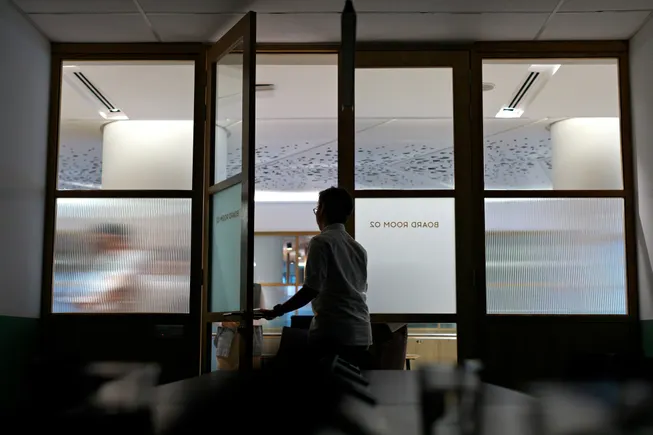
Workplace friction—including the everyday challenges of finding places to sit and meet, coordinating in-person time with teammates, and managing scheduling conflicts—costs the average mid-sized company up to $9 million annually, according to a study by office analytics company Facilitiesdive.
Hybrid Work Coordination Costs Firms Millions Annually
Referred to in related analysis as the office coordination tax,
the losses can reach $14,000 per knowledge worker each year according to Fortune. These figures are based on employee estimates of time spent managing workplace logistics and U.S. Bureau of Labor Statistics compensation benchmarks. Employees are losing roughly 10% of their workweek to these tasks instead of focusing on their core responsibilities.
The Impact of Disjointed Systems and Point Solutions
According to the Robin report, much of the friction in modern workplaces stems from organizations cobbling together isolated point solutions. The report points out that companies often use separate tools for different tasks, noting room booking in one tool, desk reservations in another, services in a third, and visitor management in a fourth. This leaves critical data scattered across systems that do not communicate with each other.

The operational divide affects productivity significantly:
- At organizations where workplace systems work together, only 14% of employees said workplace friction created a noticeable drag on their productivity.
- At organizations with disjointed systems, 63% of employees reported friction as a noticeable drag on productivity.
- Overall, 60% of workplace operations professionals reported that friction had worsened over the past year, compared to just 12% who saw improvement.
Operations professionals view friction as a systemic management problem rather than isolated annoyances. While employees experience each broken booking as an individual event, workplace teams observe every escalation organization-wide. Based on conservative Bureau of Labor Statistics figures, this coordination friction amounts to $4,453 per employee annually. Meanwhile, workplace operators estimate the cost is even higher—closer to $9,000 per employee each year.
Failed Bookings and Counterproductive Workarounds
When office technology and spaces fail to function smoothly, employees resort to various workarounds. According to the Collab Collective-Robin report, the four most common reactions to a failed booking are finding an alternative space, making do with a non-ideal space, moving the meeting online, or postponing the gathering entirely. The report notes that three of these four workarounds actively run counter to the primary purpose of requiring in-person attendance.

Furthermore, digital scheduling disconnects frequently lead to ghost meetings,
a pattern where employees arrive at the office only to find pre-booked conference rooms sitting empty. An anonymous technology sector workplace operations professional highlighted another common hurdle in the report, stating that the biggest frustration is finding available meeting rooms that actually feature working AV equipment.
When the office fails to operate as intended, managers are left attempting to keep spaces usable. Robin notes that managers spend time rebooking spaces and fielding complaints, while neither side measures what the organization loses each time these disruptions occur.
Related reading