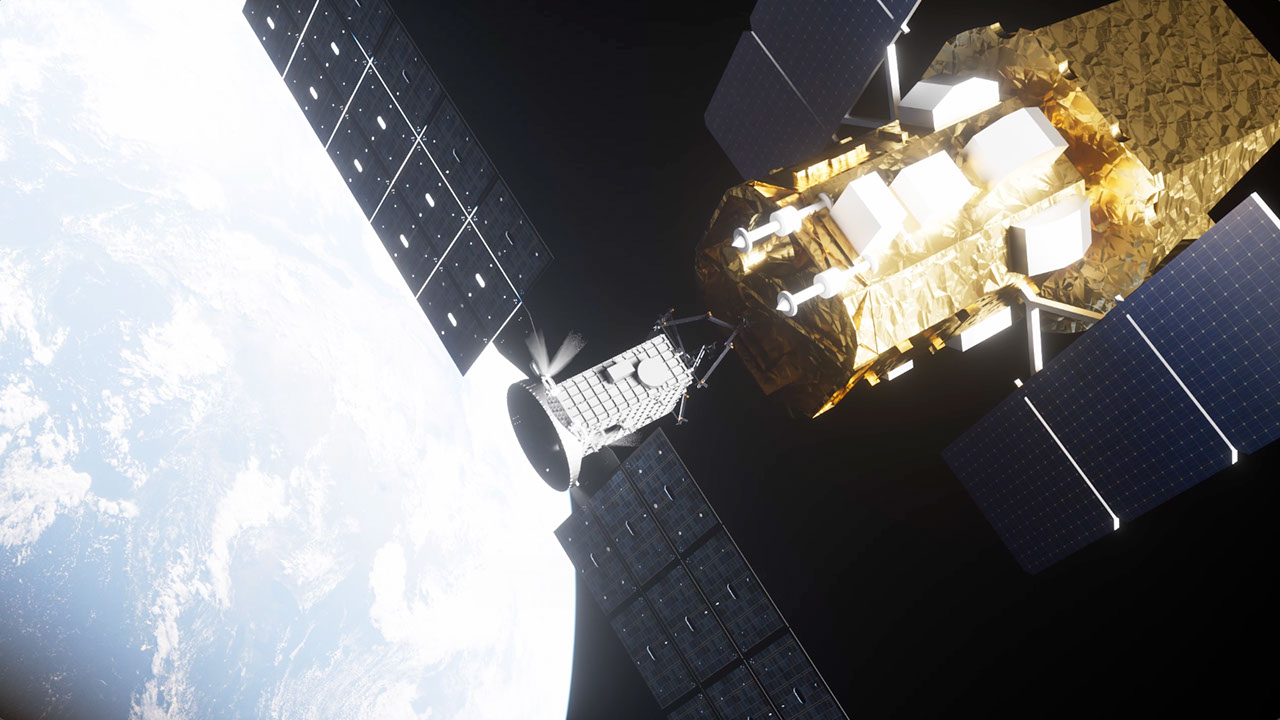
Engineers are working to stabilize Katalyst Space Technologies’ LINK spacecraft after attitude control issues sent the rescue satellite into an uncontrolled spin in orbit.
A high-stakes commercial rescue mission designed to save one of NASA’s most valuable space telescopes hit a major roadblock in late July when the uncrewed servicing vehicle began rotating uncontrollably in orbit.
The target is the Neil Gehrels Swift Observatory, a multiwavelength space telescope launched in November 2004 that has spent more than two decades surveying the cosmos for gamma-ray bursts, black holes, and supernovae.
Thruster Malfunctions and Reaction Wheel Failures Plague LINK Spacecraft
When the anomaly struck during a communications blackout, the refrigerator-sized LINK satellite was rotating on multiple axes. According to Arstechnica, two of the satellite’s three reaction wheels used for pointing stopped working, while sporadic radio contact revealed problems with the cold gas thrusters responsible for finer attitude control.
Despite the tumbling, the company’s ground team operating near Denver confirmed that LINK’s power supply, its three xenon-fueled electric thrusters, and its critical rendezvous and robotics hardware all remained healthy and power positive.
Katalyst Ground Teams Slow Spacecraft Rotation Through Plasma Engine Burns
Engineers worked around the clock from a control center near Denver to arrest the rotation and recover the vehicle. By July 31, science.nasa.gov reported that a series of thruster burns had successfully reduced LINK’s spin rate from approximately 9 degrees per second down to less than 4 degrees per second.
The recovery effort relies on vectoring the thrust from the vehicle’s plasma engines using a two-axis gimbal. While these xenon-fueled electric engines are primarily designed for orbit-raising, engineers pivoted them to tackle attitude control and gradually decelerate the spin.
Katalyst CEO Ghonhee Lee noted in an interview that the team was in a very stable configuration immediately prior to the anomaly. Company executives maintain that the mission remains active and that the spacecraft still has a viable path forward to rendezvous with the sinking telescope.
Solar Storms Accelerate Orbital Decay for the Aging Swift Observatory
The urgency behind the rescue stems from Swift’s rapid orbital decay. Launched on a Boeing Delta II rocket from Cape Canaveral, the observatory was never designed to be serviced in space, lacking standard docking ports or grapple fixtures. To compensate, Katalyst equipped its 880-pound, 5-foot-tall LINK spacecraft with a custom three-armed robotic capture mechanism built to latch onto a specific structural feature.
Solar activity heats Earth’s atmosphere and causes it to expand outward, increasing atmospheric drag on low-Earth-orbit satellites.
In response, NASA temporarily suspended most science operations in February to minimize drag by reorienting the observatory. Bradley Cenko, Swift principal investigator at NASA’s Goddard Space Flight Center, noted that the spacecraft’s average altitude had dropped below approximately 250 miles, well under the 185-mile threshold where a boost mission retains the highest probability of success.
The observatory is valued at roughly $500 million, making the $30 million rescue contract far cheaper than building a replacement.
Next Orbital Milestones for the Unprecedented Commercial Salvage Operation
With spin rates now reduced below 4 degrees per second, mission planners are reevaluating timelines. NASA and Katalyst anticipate that LINK will approach Swift around the end of August, subject to further stabilization progress.
The unprecedented venture marks the first time a commercial robotic spacecraft has attempted to capture and service a government satellite not originally built for maintenance. Success would validate a growing commercial market for orbital servicing, proving that aging assets can be rescued, refueled, or relocated rather than abandoned to burn up in the atmosphere.