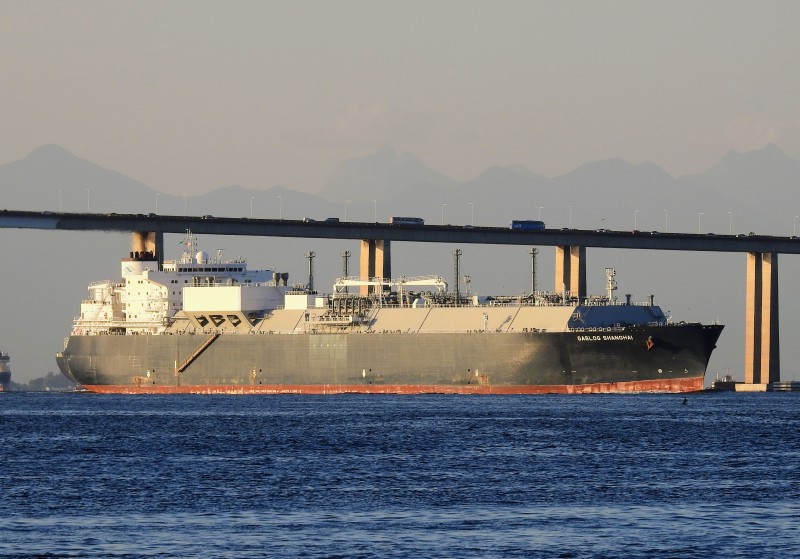
An international liquefied natural gas tanker carrying a cargo from Qatar was struck by an unknown projectile while navigating the Strait of Hormuz, triggering a power outage and an onboard fire that was subsequently extinguished. According to reports from Bloomberg, security consultancies Vanguard Tech and Marisks identified the vessel as the Gaslog Shanghai. The incident has intensified concerns over the security of vital energy transit corridors and triggered sharp upward movements in global energy markets.
The strike on the Gaslog Shanghai highlights the growing vulnerability of maritime trade routes in the Middle East as regional conflicts expand. The Strait of Hormuz handles roughly one-fifth of the world’s supply of super-chilled fuel, making it a critical choke point for international commerce. Energy markets reacted swiftly to the news, pushing crude oil prices to their largest gains since March as traders priced in potential supply disruptions.
Management for the vessel, Greece-based Gaslog, confirmed through a spokesperson that the operator verified the ship was hit by an unverified projectile, resulting in a temporary loss of power. The company stated that no crew members sustained injuries and the resulting fire was successfully put out. Outside of regular working hours, further comments from the firm were unavailable.
Maritime Security Alerts and Vessel Movements
The United Kingdom Maritime Trade Operations (UKMTO) reported that a vessel was targeted overnight in the strait off the coast of Oman, adding that initial assessments recorded no environmental impact from the incident. In a separate advisory released on Saturday, the UKMTO noted that another tanker observed an explosion in adjacent waters but sustained no structural damage.
Ship-tracking information compiled by Bloomberg and Kpler indicates that the Gaslog Shanghai loaded an LNG cargo from Qatar near July 27. The vessel subsequently ceased transmitting its automatic identification system signals on July 31 close to the western entrance of the Strait of Hormuz. Observers noted that the tanker did not appear to be broadcasting its tracking signal when the strike occurred.
This event follows earlier disruptions in the same corridor. In early July, an attack on a different Qatari tanker near the strait led Qatar—the world’s second-largest LNG exporter—to suspend shipments through the crucial waterway for a period of three weeks.
Broader Impact on Global Energy Markets
The convergence of conflicts stretching from the Persian Gulf to the Russian Black Sea has placed sustained upward pressure on global energy prices. Brent crude futures for October settlement rose 1.2% to reach $87.93 a barrel, while September contracts, which expired on Friday, traded at $90.12 a barrel. Meanwhile, West Texas Intermediate (WTI) futures advanced 1.3% to settle at $84.67 a barrel.
Throughout July, energy markets experienced significant volatility, with the global benchmark Brent rising by nearly 24%. Refined products, including diesel and natural gas, also registered substantial price increases. Political tensions have compounded these market pressures; US President Donald Trump stated he has lost faith in Iranian negotiators amid the breakdown of a fragile truce between Washington and Tehran. The United States has enforced a strict naval blockade on vessels calling at Iranian ports, while Iranian authorities have sustained threats against commercial traffic transiting the Strait of Hormuz.
Geopolitical friction has extended across multiple fronts. Yemen-based Houthi forces have engaged in regional hostilities, and Saudi forces have conducted targeted operations against Iran-backed groups in Iraq. Concurrently, attacks on oil-loading infrastructure near the Caspian Pipeline Consortium terminal in the Russian Black Sea have further constrained supply expectations while domestic inventories in the United States continue to decline.
Corporate Earnings and Economic Forecasts
While supply bottlenecks create challenges for consumers and industrial users, major energy corporations have reported substantial financial gains. Shell announced its second-highest quarterly profit on record, driven by robust trading and refining margins tied directly to the Middle East conflict. Similarly, US energy major Chevron indicated it anticipates fuel production margins will remain elevated as global refining capacity struggles to keep pace with widespread supply interruptions.
Despite corporate windfalls, international financial institutions have expressed caution regarding the broader macroeconomic consequences. The International Monetary Fund (IMF) warned that a severe Middle East oil shock carries the risk of pushing the global economy toward a recession, though Managing Director Kristalina Georgieva noted that the economic fallout would likely remain contained if the Strait of Hormuz reopens promptly.
Stakeholders and industry observers continue to monitor official maritime advisories through the United Kingdom Maritime Trade Operations portal for real-time safety updates and security guidance regarding transit through the region. Further developments regarding vessel repairs, trade flows, and diplomatic negotiations are expected as maritime authorities and energy companies release subsequent operational updates.
Keep reading