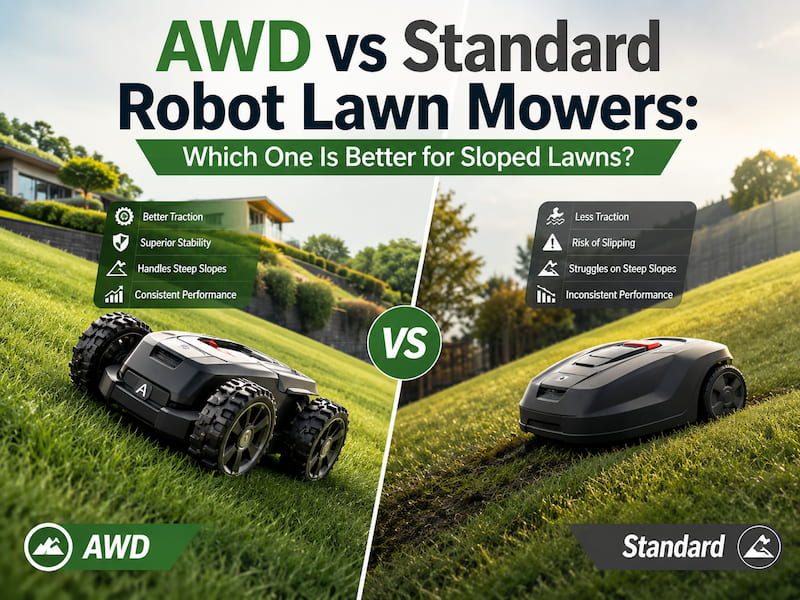
All-wheel drive (AWD) robot mowers are superior for steep or uneven terrain because they use independent motors on all four wheels to maintain traction and prevent sliding. While standard rear-wheel-drive (2WD) models work on moderate inclines up to 45%, AWD systems can handle slopes up to 80%, according to technical specifications for high-performance automated mowers.
The choice between drive systems depends on the physics of weight transfer. On a slope, gravity shifts a machine’s mass, which can strip traction from drive wheels or cause steering loss. For homeowners, this means a standard mower may scuff the soil or trigger emergency shutdowns on steep banks, while AWD models use torque-vectoring to divert power to wheels with the firmest grip.
Understanding the specific gradient of a property is the first step in selecting hardware. Industry standards measure incline in two ways: percentage gradient, which is the ratio of vertical rise to horizontal run, and angular degrees, the geometric angle from a horizontal plane. A 100% slope represents a 45-degree angle, where the mower rises 10 feet for every 10 feet of horizontal distance.
Comparing 2WD and AWD Traction Mechanics
Standard rear-wheel-drive robotic mowers typically feature dual-motor rear axles and front caster wheels. These units are designed for flatter lawns or gentle rolling hills. However, when these machines travel uphill, the downhill weight shift often causes the drive wheels to break traction, especially on damp grass or uncompacted soil.
AWD systems solve this by deploying independent electric hub motors to every wheel. This configuration prevents the mower from sliding downhill during lateral cross-slope cuts, which is a common failure point for 2WD models that lack directional torque in the front. This allows for straighter, more uniform cutting paths on complex topography.
Beyond slope angle, AWD models are generally better equipped for “rough-terrain” navigation. This includes managing root swells, soft depressions, and heavy ground contours. These machines often utilize more aggressive tread patterns and higher ground clearance to ensure constant contact with the turf.
| Specification | Standard Rear-Wheel Drive | Advanced All-Wheel Drive (AWD) |
|---|---|---|
| Maximum Incline | Up to 45% (approx. 24°) | Up to 80% (approx. 38.6°) |
| Drivetrain | Dual rear motors + casters | Four-wheel independent drive |
| Cutting System | Standard single-disc | Dual-disc options available |
| Ideal Terrain | Medium yards, moderate hills | Complex and extreme terrain |
Navigation Systems for Complex Landscapes
Sloped properties often include environmental obstacles like heavy tree canopies and retaining walls. Traditional robotic mowers relying on RTK-GPS (Real-Time Kinematic) satellite guidance can suffer from signal dropouts under dense foliage, leading to missed patches or system freezes.
To mitigate this, newer models integrate 3D LiDAR (Light Detection and Ranging). This technology emits thousands of laser pulses per second to build a three-dimensional map of the yard. Because LiDAR is independent of satellite signals, it maintains steady navigation regardless of tree cover or proximity to tall structures.
AI vision systems further enhance safety and efficiency on slopes. These systems can recognize and navigate around common yard obstacles, such as garden tools, toys, and exposed roots. This removes the need for homeowners to manually clear the lawn before a scheduled mow, which is particularly useful on steep banks where manual inspection is physically demanding.
Selecting the Right System for Your Property
The decision between a standard 2WD unit and an AWD flagship depends on the severity of the gradient and the layout of the land. For uniform, medium-sized lawns up to 0.5 acre with moderate inclines (under 45%), a rear-wheel-drive unit is typically the most economical and efficient choice.
Properties characterized by steep banks, sudden elevation changes, or multi-zone layouts require the climbing force of AWD. These flagship models often include additional features such as dual-disc cutting systems for increased speed and specialized trimming technology to handle edges more closely.
When evaluating a mower, homeowners should check the manufacturer’s rated maximum incline. If the property exceeds a 45% gradient, a 2WD machine is likely to fail or cause turf damage. In these cases, the investment in an AWD system is necessary to ensure the machine can complete its circuit without human intervention.
For the most current safety guidelines and operational standards for automated lawn equipment, homeowners can consult the U.S. Consumer Product Safety Commission or regional agricultural extensions for soil-specific traction advice.
Related reading