Fixing poor posture after age 50 relies less on conscious daily reminders to sit up straight and much more on targeted muscular conditioning, according to fitness experts. As adults reach their fifth decade and beyond, physical alignment is frequently compromised by decades of prolonged sitting, desk work, and screen time. Rather than relying on temporary skeletal manipulations or chiropractic adjustments, fitness experts emphasize that restoring natural posture requires rebuilding the deep postural muscles that support the spine and hips.
By age 50, the structural impact of everyday habits often becomes pronounced. The head typically shifts forward of the shoulders, the upper back rounds, and the shoulders roll inward while the pelvis tips forward, creating an exaggerated curve in the lower back and pushing the abdomen outward. This postural slump stems primarily from years of sedentary behavior. Spending six to eight hours a day seated for decades causes the hip flexors and chest muscles to shorten, while the opposing muscles between the shoulder blades stretch and weaken from lack of use. Furthermore, age-related muscle loss diminishes the capacity of deep postural stabilizers, causing the body to gradually sag under gravity.
While chiropractic care can offer temporary relief by adjusting joint alignment, specialists note that bones ultimately follow the pull of surrounding muscles. If shortened muscles pull the skeleton out of alignment, adjustments alone cannot maintain a permanent correction. Strengthening exercises directly target these imbalances by building endurance in weakened upper-back and core muscles while restoring length to tight areas. Committing just ten to fifteen minutes several times a week to specific movements provides a sustainable path to lasting postural change.
Five Bodyweight Moves for Posture Re-education
Reversing a forward slump does not require heavy gym equipment. Five specific bodyweight exercises target the exact muscle groups affected by prolonged sitting.
Wall Angels help open the chest, mobilize the thoracic spine, and engage the rhomboids between the shoulder blades. To perform this move, stand with your head, upper back, and glutes against a wall with your feet positioned roughly a foot forward. Gently press your lower back toward the wall to flatten the spine’s natural curve. Raise your arms to shoulder height with your elbows bent at 90 degrees and palms facing forward. Slowly slide your arms up the wall while attempting to keep the backs of your hands, wrists, and elbows in contact with the surface. Complete 8 to 10 slow repetitions, ensuring your lower back does not arch away from the wall to force extra range of motion.
Doorway Chest Opens counteract the tight chest muscles caused by continuous desk and screen work. Stand inside a doorway with your forearms resting on the frame and elbows at shoulder height. Step one foot forward through the opening and allow your chest to drift gently forward until a stretch is felt across the front of the chest. Hold this position for 30 seconds while breathing steadily, then step back and repeat once. Avoid pressing excessively hard or arching the lower back to fake a deeper stretch.
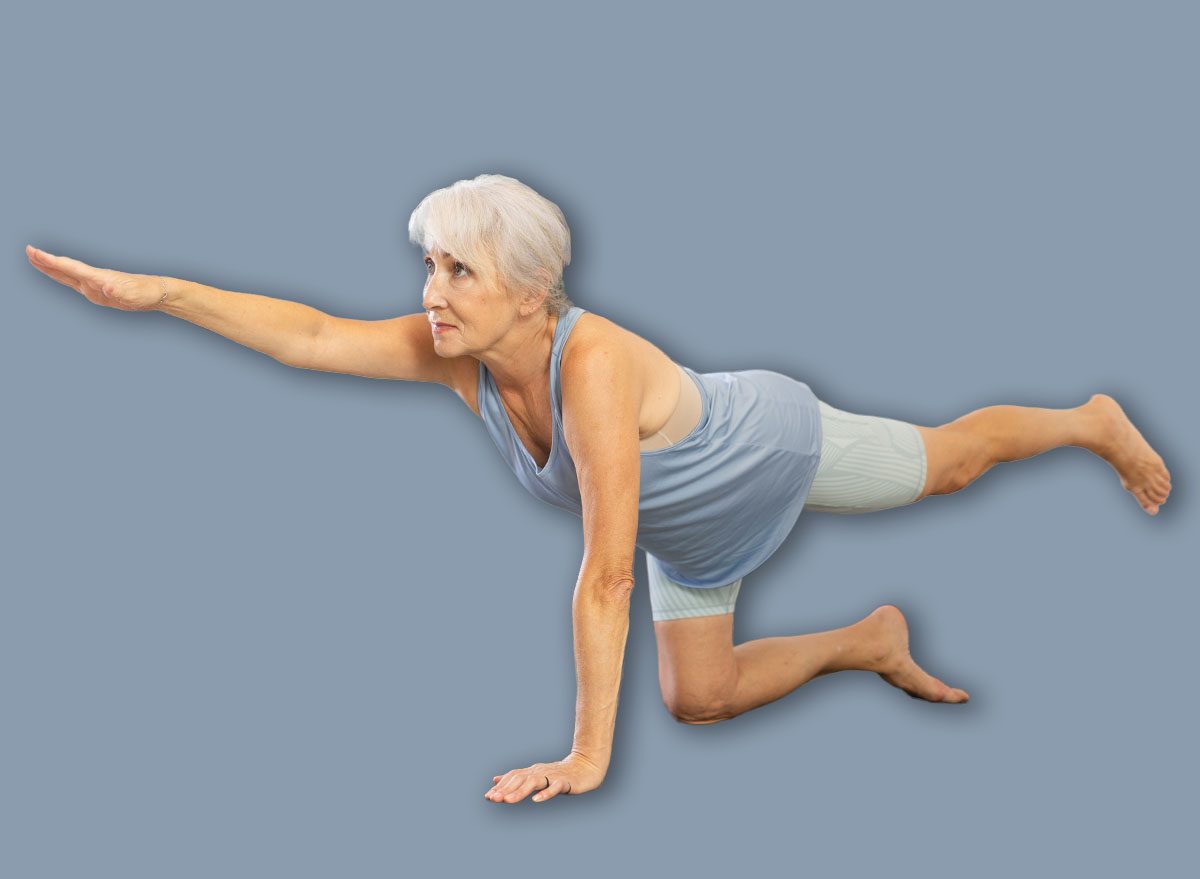
Bird Dogs reactivate the deep spinal stabilizers that switch off during prolonged sitting. Position yourself on all fours with your hands directly under your shoulders and knees under your hips. Keeping your spine neutral and long, slowly extend your right arm forward and your left leg backward until both align horizontally with your trunk. Hold this position for three seconds without letting your torso twist or your lower back arch, then return to the starting position under control. Perform 8 repetitions per side.
Glute Bridges target dormant gluteal muscles and help restore a neutral pelvic tilt, which directly reduces the forward-tipped pelvis often linked to a protruding belly. Lie on your back with your knees bent and feet flat on the floor, spaced hip-width apart. Squeeze your glutes and lift your hips toward the ceiling until your body forms a straight line from your shoulders to your knees. Hold the top position for 3 seconds before lowering with control. Complete 12 to 15 repetitions, focusing the effort in your glutes rather than your lower back.
Prone Y-T-W Raises strengthen the entire upper back and rear shoulders to pull the shoulder girdle down and back. Lie face down on a firm surface or bed with your forehead resting on a folded towel. Reach your arms into a Y shape above your head with thumbs pointing upward, lift them a few inches off the surface, hold for two seconds, and lower. Repeat this lift-and-hold pattern for 8 repetitions each in a Y position, a T position with arms out to the sides, and a W position with elbows bent at 90 degrees. Keep your shoulders drawn away from your ears throughout to avoid overactive trapezius muscles.
Establishing a Sustainable Routine
Consistency is essential for structural retraining. Performing two rounds of these five exercises three to four days a week takes approximately 15 to 18 minutes. Experts recommend pairing this routine with a daily 20- to 30-minute walk on alternate days, as walking helps integrate new postural habits into everyday movement patterns.
Progress typically unfolds in predictable phases. Within the first fortnight, individuals often notice an increased self-awareness regarding how they stand. By four weeks, visible improvements emerge in photographs and mirrors as the head realigns over the shoulders and the pelvis shifts toward neutral. At six to eight weeks, improved posture begins to feel automatic rather than requiring conscious effort. Readers interested in structured physical therapy evaluations or personalized fitness plans should consult a qualified physician or licensed physical therapist before beginning any new exercise regimen.
Worth a look