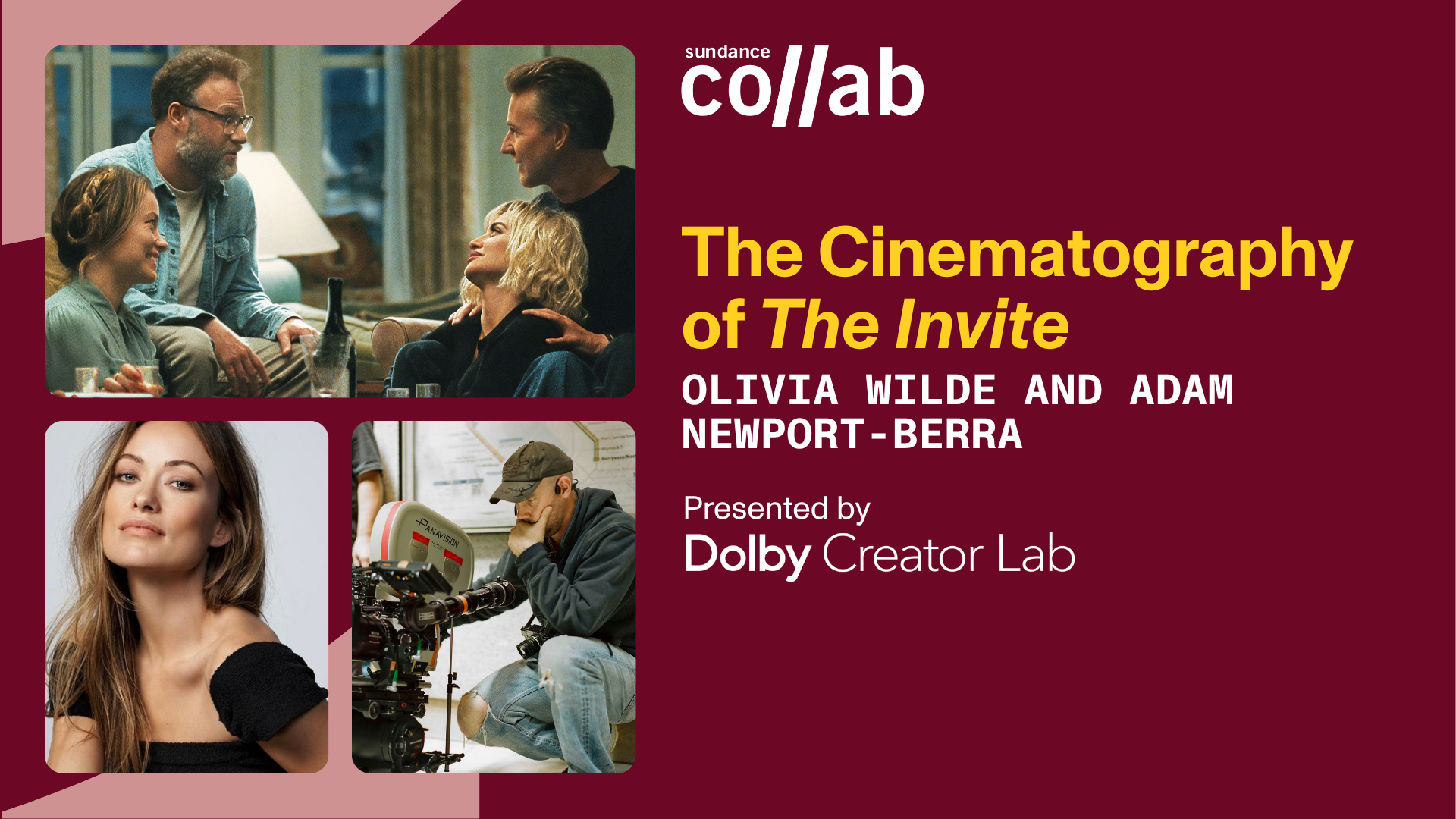
When director Olivia Wilde and cinematographer Adam Newport-Berra set out to define the visual identity of their chamber dramedy The Invite, they skipped contemporary mood boards and instead immersed themselves in classic cinema. Before a single camera rolled on the soundstage, the creative team revisited Mike Nichols’ Who’s Afraid of Virginia Woolf?, Agnès Varda’s Le Bonheur, Woody Allen’s Hannah and Her Sisters, and works by Éric Rohmer and Michelangelo Antonioni. Rather than mimicking these foundational films, they searched for a shared through line in composition, lighting, and texture to inform their own production.
The resulting film, which premiered at the 2026 Sundance Film Festival, marks Wilde’s third feature as a director. Set over the course of a single evening, The Invite follows a married couple experiencing marital strain—played by Wilde and Seth Rogen—who host their neighbors, portrayed by Penélope Cruz and Edward Norton, for a dinner party that gradually unravels. Despite being confined to one primary location, the production achieved a striking visual richness rooted in deliberate photographic choices.
During a recent Sundance Collab conversation, Wilde and Newport-Berra discussed the intricate filmmaking decisions behind the project, shedding light on their approach to shooting on 35mm film, blocking, framing, and production design. Newport-Berra, whose previous credits include The Last Black Man in San Francisco, The Bear, Euphoria, and The Studio—for which he earned an Emmy Award for Outstanding Cinematography for a Series (Half-Hour)—emphasized the importance of establishing visual rules early in prep. “You want to ingest them often and early in the prep,” Newport-Berra noted of their cinematic influences. “And then at a certain point, you want to forget about them.”
Why Shooting on 35mm Film Shaped the Performances
Choosing to shoot The Invite on 35mm film was a deliberate decision driven by both texture and narrative tone. Newport-Berra explained that celluloid is exceptionally forgiving and generous when capturing skin tones and facial nuances across a small ensemble. Because the narrative focuses intensely on four principal actors with varied complexions and hair colors, the physical medium helped capture subtle emotional shifts.
“For me, film was a way to smooth out the edges and, at the same time, rough it up a little bit,” Newport-Berra said, noting that it gave the built soundstage environment a more organic, grounded feel.
Wilde added that working with a finite, valuable physical resource altered the energy on set, particularly given the heavy emphasis on improvisation. While comedies often abandon film stock due to fears that it will restrict spontaneous discovery, Wilde found the opposite to be true. The physical presence of the camera rolling raised the stakes, encouraged thorough preparation, and fostered a heightened collective focus among the cast.
“When you can hear the film roll out, it changes something,” Wilde said. “You come out of disillusion. And so it makes the acting better. Everything looks better… I think it forces people to be probably a little bit more prepared.”
Framing and Blocking to Evoke Discomfort
Because the story unfolds entirely within a single evening and a restricted setting, framing and blocking served as primary tools for charting the characters’ shifting relationships. Drawing inspiration from Haskell Wexler’s cinematography in Who’s Afraid of Virginia Woolf?, the filmmakers aimed to construct a visceral viewing experience that mirrored the escalating tension of the dinner party.
This approach dictated how characters were introduced. While viewers spend the opening stretch intimately aligned with Joe and Angela—Wilde and Rogen’s characters—the neighbors Piña and Norton’s Hawk are intentionally kept at a distance. Wide compositions shot over Joe’s shoulder visually emphasize his reluctance to bridge the gap between the couples.
“There were many choices in terms of blocking and framing that were designed to make the audience feel uncomfortable,” Wilde explained, referencing a later confrontation where the four characters stand on opposing sides of the room like figures in a standoff. “The way we’re using close-ups there and cutting between them is really designed so that you feel a little bit out of sorts as an audience member, and you’re kind of just discombobulated a little bit.”
Newport-Berra added that the production relied heavily on physical architecture, geometry, and lensing to convey psychological distance. The crew established strict visual rules, avoiding shots featuring Joe and Angela together while frequently pairing Hawk and Piña in shared frames to signify their effortless comfort within the space.
Contrasting Character Dynamics Through Lensing and Camera Movement
Camera placement and lens selection further reinforced the distinct psychological profiles of the characters. Newport-Berra and Wilde sought to portray Piña and Hawk as effortlessly cool and seductive, contrasting sharply with the more untethered energy of their hosts.
Edward Norton’s character is introduced via a subtle low-angle shot using a 29mm or 35mm lens, an intimate focal length that creates a heroic perspective. Penélope Cruz’s character, meanwhile, is captured using a Steadicam—marking the primary use of the equipment in the film—to imbue her movements with an exploratory, boundary-testing energy.
Conversely, Joe and Angela are framed within flat, straight-on compositions characterized by a dominant horizontal line and generous headroom, signaling their lack of grounding. When the camera cuts to close-ups of Wilde’s character, longer compressed lenses are employed to produce a claustrophobic effect, visually framing her under microscopic examination.
Architecture as a Character Through Production Design
The visual language of The Invite extends directly into the physical set designed by Jade Healy. Built with layered walls featuring subtle color variations, the apartment interior was constructed to generate spatial depth and reinforce the thematic presence of boundaries.
“The kind of mantra from the beginning with her was frames within frames,” Wilde said of Healy’s design. “We obviously knew we wanted to use the structure as a kind of representation of boundaries and barriers and all these things. But we didn’t want it to feel overly self-conscious.”
By carefully choreographing revealing angles and shifting perspectives by the story’s conclusion, the production design ensures that the physical space itself evolves alongside the narrative, leaving audiences with a shifting understanding of the characters who inhabit it.
The complete conversation between Olivia Wilde and Adam Newport-Berra is available to stream through Sundance Collab, offering further insight into the creative choices shaping The Invite ahead of its wider release.
Keep reading