Ukrainian forces launched long-range drone strikes hitting deep into Russian territory, targeting major energy and industrial infrastructure including facilities in Tatarstan and the Bashkortostan region, according to reports verified across multiple outlets. The operations struck several key industrial installations more than a thousand kilometers from the front lines, marking another wave of coordinated assaults on Russia’s refining and processing sector.
The strikes underscore an ongoing strategy by Kyiv to disrupt fuel supplies and logistical networks supporting Russian military operations. Ukrainian President Volodymyr Zelenskyy publicly acknowledged the precision of the missions, expressing gratitude to the Special Operations Forces of the Armed Forces of Ukraine and the Security Service of Ukraine for executing the deep-strike operations.
According to regional reports and monitoring groups, the targets included critical primary processing units at major petroleum facilities. The sustained campaign has prompted heightened air defense responses across multiple Russian regions as authorities grapple with securing vast industrial perimeters far from the active combat zones.
Attacks Target Major Refining Complexes in Russia
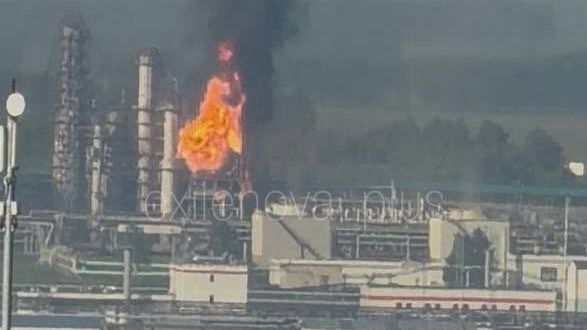
Among the targeted sites, a significant strike hit a facility operated by Gazprom Neftechim Salavat in the republic of Bashkortostan, located roughly 1,400 kilometers from the Ukrainian border, as reported by the Kyiv Independent via Cas.sk. Local eyewitnesses reported hearing a series of loud explosions, while footage shared widely on social media networks showed thick columns of dark smoke billowing over the sprawling petrochemical complex.
The Gazprom Neftechim Salavat facility ranks as one of the largest petrochemical manufacturing and refining complexes in the Russian Federation. Data cited by The Moscow Times and reported through regional media indicates that the plant processed 7.2 million tons of crude oil in 2024, accounting for approximately 2.7 percent of Russia’s total oil refining volume. Ukrainian drones had previously targeted the same Salavat installation twice in September of the prior year.

Simultaneously, monitoring by the Russian Telegram channel Astra confirmed a separate drone strike hitting the Lukoil-Nizhegorodnefteorgsintez refinery in the city of Kstovo, as detailed by Novinky.cz. The analysis indicated that the southwest portion of the facility sustained damage, likely impacting an ELOU-AVT primary crude distillation unit, which serves as foundational processing machinery in petroleum refineries. Media reports noted that the Kstovo plant typically processes around 17 million tons of crude annually, turning out significant volumes of gasoline, diesel fuel, fuel oil, and road asphalt.
Explosions and Fire Reported at Industrial Sites
The coordinated overnight raids extended beyond petroleum refineries to chemical manufacturing plants utilized in military supply chains. According to Novinky.cz citing independent tracking, a drone strike hit the Nevinnomysskij Azot chemical plant in the Stavropol Krai, owned by EuroChem. The facility supplies essential chemical inputs for the manufacture of explosives used in artillery ammunition, and has faced at least seven reported Ukrainian attacks since the start of the full-scale conflict.
In his public remarks regarding the campaign, President Zelenskyy emphasized that these successful operations are designed to bring the realities of the war back to the territories from which hostilities originated. “This war must end, and all reasonable diplomatic proposals are on the table,” Zelenskyy stated, while highlighting the technological precision demonstrated by military and security units.
Meanwhile, retaliatory Russian strikes continued to impact urban areas across Ukraine. Local authorities in Dnipro and Odesa reported civilian casualties and structural damage following overnight bombardments. Serhij Lysak, head of the Odesa military administration, confirmed that residential properties and vehicles sustained heavy damage, with a single-story building completely destroyed during the strikes.
Broader Strategic Impacts on Fuel Production
The systematic campaign against Russian energy infrastructure represents a concerted effort to constrain Moscow’s domestic fuel market and export revenues. Industry analysts note that strikes targeting primary distillation units force prolonged shutdowns for specialized repairs, which are complicated by international sanctions restricting access to Western refining technology and proprietary components.
Russian federal agencies have consistently reported intercepting large numbers of incoming unmanned aerial vehicles during these mass raids, though independent verification often relies on local satellite imagery, social media analysis, and open-source intelligence groups like Astra. The persistence of deep strikes demonstrates the evolving range and capability of Ukrainian long-range aerial systems.
As international diplomatic efforts and monitoring continue, further updates regarding repair timelines and the exact scale of structural damage at the Kstovo and Salavat facilities are expected from industry regulators and corporate disclosures. Readers seeking ongoing updates can monitor official defense ministry briefings and verified international news wires for developments concerning regional air defense measures.
Related reading