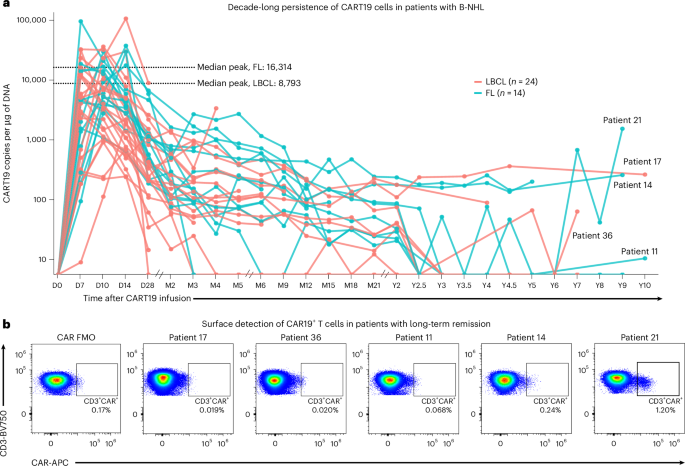
Long-term clinical monitoring has revealed that CD19 chimeric antigen receptor (CAR) T cells can persist in the human body for at least 10 years following treatment for B cell lymphomas. This evidence of decade-long cellular longevity suggests that the modified immune cells maintain a functional presence in patients long after the initial therapeutic intervention, according to longitudinal research published in Nature Medicine.
I have followed the evolution of immunotherapy closely. The ability of these engineered cells to survive and potentially remain active for such an extended period provides significant insight into the durability of CAR T cell therapy. This finding shifts the medical community’s understanding of how these “living drugs” interact with the patient’s immune system over the long term, moving beyond the initial period of acute clinical response.
Decade-Long Persistence and Cellular Phenotype
The study, which tracked longitudinal blood samples from patients treated for B cell malignancies, confirms that CAR T cells are detectable a full decade after infusion. Deeper molecular profiling conducted on a specific patient revealed that these long-term survivors primarily exhibit a “double-negative” activated effector-memory-like phenotype. In clinical immunology, this phenotype is significant because it suggests the cells have transitioned into a state that balances long-term persistence with the ability to respond to potential antigen re-exposure.
This long-term presence is not merely a marker of survival; it represents a specialized cellular state. The cells identified in the decade-post-treatment samples were not quiescent but instead retained an activated, memory-like profile.
Clinical Significance and Immune Surveillance
The discovery that CAR T cells can persist for 10 years has implications for how clinicians approach patient follow-up.
The research highlights a shift in focus from short-term remission to long-term cellular ecology. By profiling the dominant phenotype of these persistent cells, researchers are gaining a clearer picture of what makes a successful “memory” CAR T cell. For patients and oncologists, this provides a biological basis for the durable remissions observed in a subset of the lymphoma population.
Future Directions for Immunotherapy Research
The identification of a double-negative activated effector-memory-like phenotype as a driver of long-term persistence offers a target for future engineering efforts. This research underscores the importance of longitudinal studies in understanding the true potential and limitations of cellular therapies.
The next checkpoint for this research involves broader cohort studies to determine if the phenotype observed in the single-patient deep profiling is consistent across diverse patient populations.
We welcome your questions and insights on this evolving field of oncology. Please feel free to share your thoughts or join the discussion in the comments section below as we continue to track these important developments in medical science.
Worth a look