Confronted with soaring summer temperatures that pushed ground readings to 64°C, the southern French town of Cuers has transformed itself into a climate adaptation model. Since 2022, the 13,000-resident municipality has invested in shaded playgrounds, cool-surface paving, unconditioned green schools, and urban forestry to combat intensifying heatwaves.
What started with a thermometer placed on sun-baked asphalt has evolved into an urban laboratory for local climate resilience. In June 2022, an inspection team from the television network TF1 recorded a ground temperature of 61°C in front of the local college according to regional reporting. Similar measurements in the area touched 64°C, forcing municipal officials to rethink how public spaces handle extreme heat as reported by Franceinfo. That wake-up call prompted the town to adopt an official slogan and structural framework titled Low-Temperature Summer City as documented in local coverage.
Targeted Cool Zones and Shaded Playgrounds Across Cuers
Tucked between wooded hills and vineyards in the Toulon hinterland, Cuers relies on a wide-ranging catalog of localized cooling interventions. In public parks and play areas where unshaded slides once sat impassable under the midday sun, the municipality has erected protective shade sails according to on-the-ground reporting. Mayor Bernard Mouttet noted in an interview with Agence France-Presse that while exposed ground temperatures reach 60°C, readings drop by nearly half beneath the canvases.
A local resident explained via Franceinfo that the slide sat in direct sunlight, making it burning hot and impassable.
Journalistic field checks demonstrate the immediate impact of these installations. While ambient air temperatures hover around 33°C to 35°C, asphalt measured beneath protective shade sails registers roughly 30°C, marking a clear five-degree reduction as observed by reporting crews. Beyond fabric awnings, the town plants approximately thirty trees annually—including ash, elm, and plane trees—while equipping municipal day camps with water misters to keep children outdoors during summer programs noted the outlet.
A 13-Million-Euro School Built Without Air Conditioning
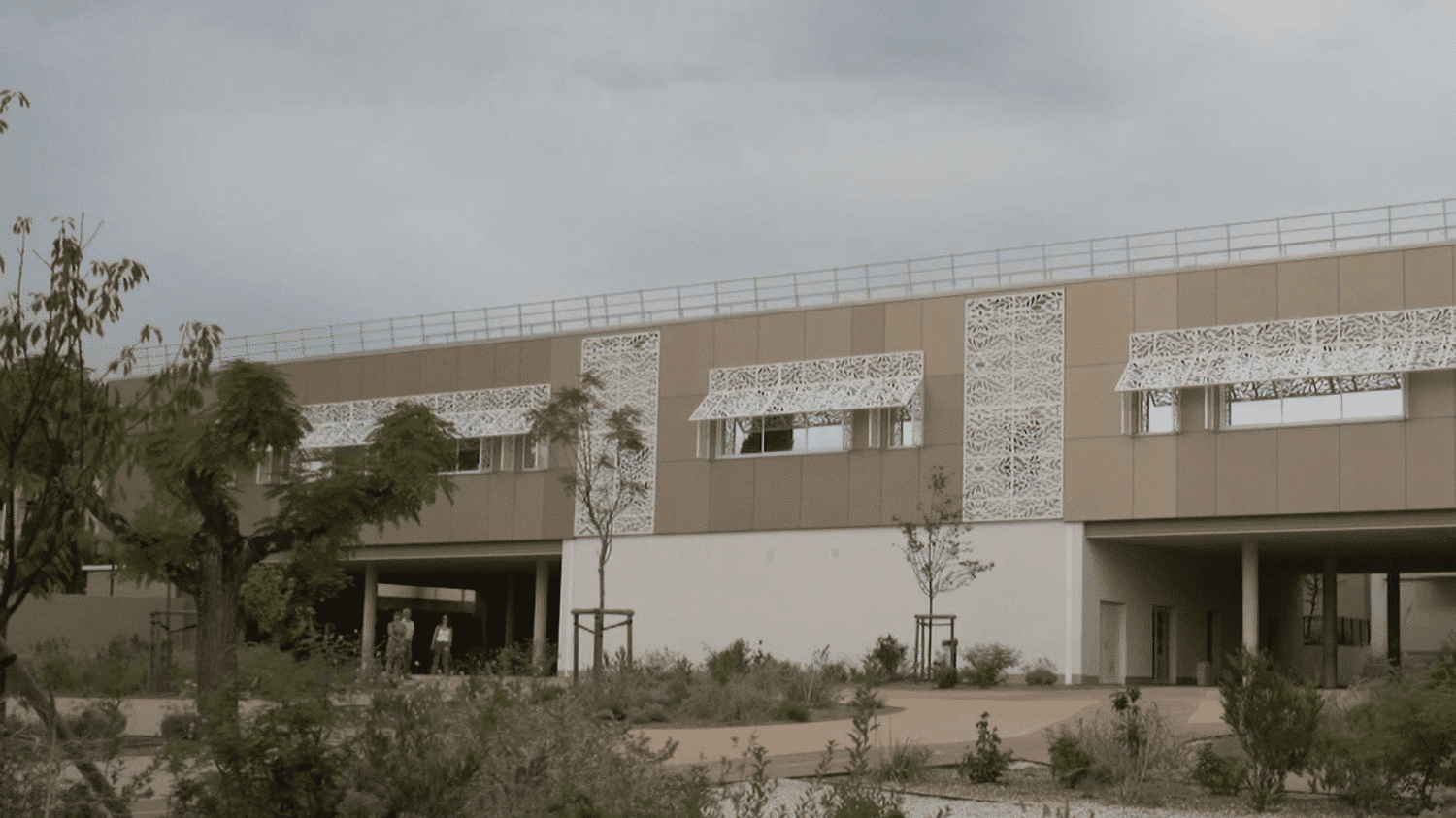
The centerpiece of the town’s municipal strategy is a newly constructed 22-class primary school complex built at a cost of 13 million euros according to municipal records. Certified under the Sustainable Mediterranean Building standard, the facility avoids traditional air conditioning entirely reported regional journalists. Instead, engineers utilized wood-fiber insulation, false ceilings, and traditional moucharabieh screens on windows to filter direct sunlight as detailed in source coverage.
The traditional asphalt courtyard was replaced with a draining substrate that permits water infiltration, surrounded by pockets of greenery and lavender according to published findings. To maintain comfortable indoor conditions, a specialized misting system sprays micro-droplets of water across cooling panels, allowing the school to achieve temperature reductions of nearly 10 degrees inside classrooms stated town officials.
Budgetary Commitments and Private Sector Planning Mandates
Executing these infrastructural transformations requires dedicated municipal financing. Jean-Jacques Roux, the town’s Director General of Services, explained Franceinfo that outside of major capital projects, the commune dedicates between 200,000 and 300,000 euros annually—representing roughly 5% of its total investment budget—to improve thermal comfort across one to three sites each year according to supplementary administrative accounts.
The municipal strategy extends beyond public property. On December 11, 2025, the municipal council approved an amendment to the local urban development plan explicitly tailored to the Low-Temperature Summer City framework actu.fr. This regulatory shift directs private developers toward specific building orientations, sustainable materials, and natural ventilation designs noted the outlet.
Regional Replication Amid Shifting National Funding
Cuers has also experienced practical setbacks alongside its successes. An eco-friendly light-colored pavement made from plant pitch rather than petrochemicals was applied to sidewalks with claims of substantial surface cooling, but when tested on roadways, the material darkened under vehicle tires and canceled its thermal benefits according to accounts published by regional journalists.
Despite such experimental trials, neighboring jurisdictions are adopting similar strategies. The nearby town of Carnoules installed shade sails across its nursery and primary school courtyards, achieving indoor classroom temperature drops of roughly seven degrees according to statements made by Mayor Christophe Cortes to Agence France-Presse. However, Carnoules also installed conventional air conditioning in four rooms and its cafeteria actu.fr.
Bernard Mouttet, Mayor of Cuers, stated via Agence France-Presse that at the beginning of the initiative, many mayors laughed about it.

Mayor Bernard Mouttet, who won reelection in the first round of voting in March 2026, noted that inquiries have arrived from municipalities as distant as a 50,000-resident city near Bordeaux reported Agence France-Presse. Cuers is scheduled to host the third edition of its professional exhibition dedicated to the initiative on September 23, 2026, following a 2024 inaugural event that drew over 300 attendees according to municipal scheduling details.
This municipal self-reliance unfolds against a backdrop of shrinking national support. Data from the Ministry of Ecological Transition indicates that the Green Fund—the principal financial instrument used by the French state to assist local authorities with climate adaptation—dropped from 2.5 billion euros in 2024 to 837 million euros in 2026 according to reporting by Agence France-Presse. Guillaume Pouyanne, a researcher and lecturer at the University of Bordeaux, told the wire service that public action remains hindered by overlapping jurisdictional competencies, emphasizing that localized heatwaves preview the broader climate reality of the future noted published coverage.
Worth a look