Global financial markets moved in diverging directions as crude oil and gold prices climbed higher, while Wall Street pulled back further from record highs set the previous week. Investors across major exchanges monitored crucial domestic inflation readings in the United States alongside stalled diplomatic talks aimed at ending the ongoing conflict involving Iran.
International benchmark Brent crude climbed 0.9% in early trading to reach $89.67 per barrel, according to market data, while U.S. benchmark West Texas Intermediate added 0.9% to trade at $83.98 per barrel. Precious metals also saw upward momentum, with gold rising 0.8% to hit 4.400.44 دولار per ounce and silver gaining 1% to reach $65.30 per ounce.
The upward pressure on energy commodities follows heightened geopolitical tensions in the Middle East. Conflict in the region, which intensified after joint U.S. and Israeli military strikes in late February, caused disruptions including the closure of the Strait of Hormuz and left significant portions of global crude supplies stranded. Additional supply concerns emerged after a maritime attack by Houthi forces targeting a vessel near the Bab el-Mandeb Strait off the southern coast of Yemen.
Energy Costs and U.S. Inflation Pressures
Rising crude prices have directly impacted consumer costs, pushing the average price for a gallon of regular gasoline in the United States to $4.01, up from less than $3.14 a year prior, according to data from AAA. These mounting expenses have intensified focus on U.S. economic data releases, specifically the monthly inflation report published by the government.
Economists surveyed ahead of the data release projected that the headline inflation rate would ease slightly to 3.4% for July, down from 3.5% in June. A cooling inflation rate could potentially alleviate pressure on the U.S. Federal Reserve regarding further interest rate hikes designed to curb price growth.
Higher borrowing costs help cool economic demand but simultaneously weigh on the broader economy by increasing expenses for households and businesses while dampening equity valuations. Treasury yields have experienced upward pressure since the onset of the conflict with Iran, driving long-term U.S. mortgage rates to their highest levels in a year.
Mixed Performance Across Global Stock Exchanges
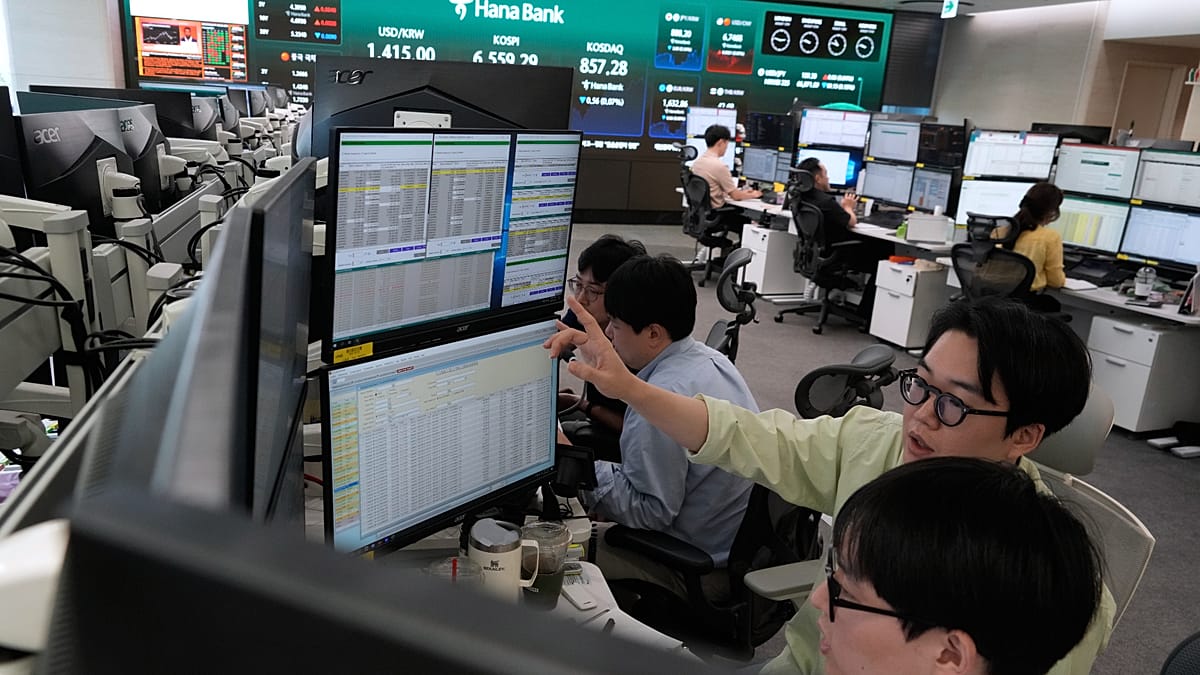
Equity markets outside the United States displayed varied results. In Tokyo, the Nikkei 225 index advanced 0.6% to finish at 67.334.94 نقطة. South Korea’s Kospi index surged more than 4% to 6.597.90 نقطة, propelled by strong buying momentum in semiconductor manufacturing shares. Samsung Electronics shares rose 7.7%, and memory chip producer SK Hynix gained 7.1%.
Elsewhere in Asia, Taiwan’s Taiex index edged up 0.8%, and the Shanghai Composite added 0.3% to reach 3.946.51 نقطة. Conversely, Hong Kong’s Hang Seng index declined 1.2% to 25.352.13, and Australia’s S&P/ASX 200 dropped 0.6% to 9.197.00. In currency markets, the U.S. dollar strengthened slightly against the Japanese yen to 159.41, while the euro softened against the dollar to 1.1535.
On Wall Street, major indexes retreated following record closes on Friday. The S&P 500 slipped 0.3%, the Dow Jones Industrial Average dropped 184 points or 0.3%, and the Nasdaq Composite lost 0.6%.
Next Steps and Market Watchpoints
Market participants will continue to monitor official economic releases from the U.S. government alongside updates regarding diplomatic channels in the Middle East. Investors are encouraged to share their perspectives on global market trends and central bank policy expectations in the comments section below.
Worth a look