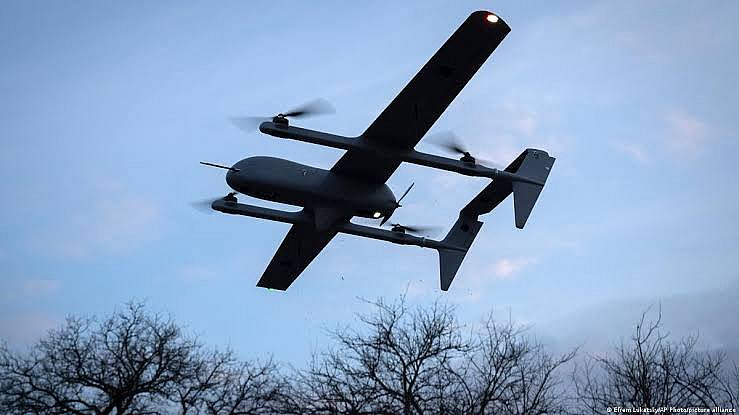
Ukraine has sharply accelerated its long-range drone strikes inside Russia since the spring, utilizing massive deployment strategies and expanded flight ranges reaching up to 3,400 kilometers to bypass air defenses. According to an analysis by Le Monde, the campaign relies on manufacturing volume and autonomous navigation.
Extended Range and Redesigned Wings Defeat Long-Distance Logistics
The operational reach of Ukraine’s long-range unmanned aerial vehicles has expanded significantly. Denis Shtillerman, one of the founders of the Ukrainian drone manufacturer Fire Point, reported that the flight distance of the FP-1 models has increased from 1,600 to 3,400 kilometers. Company engineers achieved this extension by modifying the wing design to improve lift and reduce fuel consumption, which in turn allows the aircraft to carry larger fuel tanks.
Despite this extended range, the aircraft remain ultra-lightweight. Their payload capacity scales inversely with distance, ranging from 50 to 120 kilograms depending on how far the drone must travel to reach its target. These long-range assets have repeatedly struck major Russian oil refineries, establishing themselves as a core strategic capability for Kyiv.
Manufacturing Volume and the Strategy of Saturation
Production scale has emerged as a decisive factor in the effectiveness of the campaign. According to data from the General Staff of Ukraine, the FP-1 and FP-2 drones accounted for 59% of deep strikes and 54% of successful hits during the summer of 2025. Fire Point has scaled its output to reach production levels of up to 200 units per day, or roughly 3,000 per month, by keeping the design deliberately simple to minimize manufacturing costs.
“Quantity in itself is a quality”
Elena Kryzhanowska, member of the Canadian NATO Association, via Unian
That phrase translates to the principle that quantity transforms into quality on its own. Analysts note that while the vast majority of these drones are intercepted—much like the 80-90% of Russian Geran drones shot down over Ukraine—the sheer volume of the saturation strategy overwhelms defensive positions.
Vulnerabilities in Russian Air Defense and Corridor Creation
Russia's vast geographic expanse makes comprehensive air defense an immense operational challenge.
“No air defense system in the world can guarantee absolute protection”
Elena Kryzhanowska, member of the Canadian NATO Association, via Novosti-N
To compound these defensive gaps, Ukrainian military forces executed a targeted campaign in late winter and early spring to destroy Russian air defense installations. This effort successfully established corridors that allowed subsequent waves of drones to reach their designated targets with fewer interruptions.
Computer Vision and Resistance to Electronic Jamming
Beyond sheer numbers and physical routing, technological adaptations help the aircraft maintain course in heavily contested airspace. Russian press reports analyzing captured Lyutyi drones indicate that the vehicles are equipped with Skynode S modules that provide computerized vision capabilities.
These autonomous visual navigation systems allow the drones to adjust their routes without relying on GPS signals, rendering them resistant to electronic jamming countermeasures. Even so, experts emphasize that drones with lighter payloads often cause limited localized damage, leaving high-explosive conventional missile strikes distinct in their destructive capacity compared to unmanned systems.