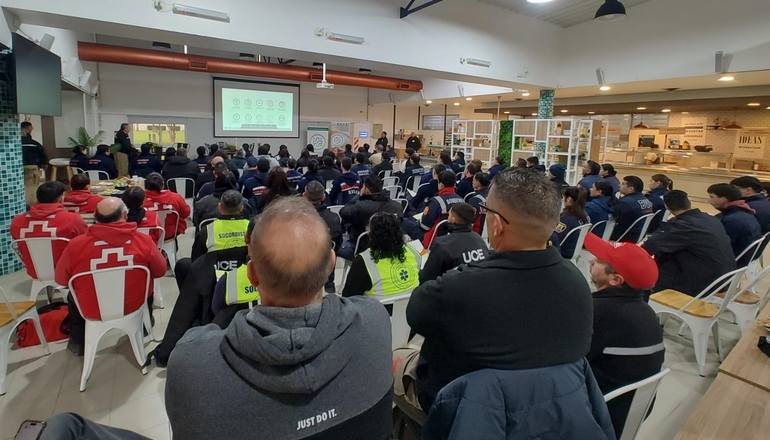
Bayer recently hosted the 6th Regulatory Update Seminar on Road Transport and Hazardous Substances at its Zárate plant, convening more than 100 participants from across the region to strengthen industrial emergency response and community safety coordination, according to reports from El Campanense Diario and Enlace Crítico. The gathering operated under the framework of the Plan de Alerta Comunitario para Emergencias Industriales (PACEI), an initiative spearheaded by the Zárate-Campana Zonal Health and Safety Committee.
Industrial safety officials, emergency responders, and regional organizations gathered at the facility to align protocols for handling hazardous materials during transit. The training program paired classroom instruction with hands-on exercises inside the plant’s specialized training grounds, utilizing resources from the company’s internal emergency response unit.
Victor Ponce, president of the Zonal Committee, emphasized the collaborative nature of the initiative. According to El Campanense Diario, approximately 85 firefighters, Red Cross volunteers, company personnel, and other regional actors participated directly in coursework focused on hazardous material transport risks, safety data sheet interpretation, and hazard pictogram recognition.
Multi-Agency Participation Across the Region
The seminar drew a broad coalition of public safety and institutional stakeholders, reflecting the scale of regional coordination required under the PACEI framework. Attendees included representatives from volunteer fire departments spanning Zárate, Campana, Los Cardales, Presidente Derqui, Exaltación de la Cruz, Pilar, San Antonio de Areco, San Martín, José C. Paz, Del Viso, and Luján, as reported by Enlace Crítico.
Additional participants included Zárate Civil Defense, the Argentine Naval Prefecture, the Argentine Red Cross Campana branch, universities and training institutions, industrial and transport companies, and specialized emergency response organizations.
Classroom Instruction and Regulatory Frameworks
The academic portion of the seminar focused on safety standards governing chemical transport. Instructors covered the United Nations transport identification numbering system, the Globally Harmonized System (GHS) for chemical classification and labeling, and the proper reading of Safety Data Sheets (SDS), as detailed by El Campanense Diario.

Participants also reviewed the practical application of the 2024 Emergency Response Guidebook (ERG2024). The curriculum provided attendees with methodologies for identifying substances involved in transit incidents and interpreting available information to ensure a safe response during emergencies.
Field Drills at the Zárate Training Facility
Moving from theory to practice, the seminar utilized Bayer’s dedicated training grounds to simulate real-world incident scenarios. For these exercises, the host company deployed the specialized equipment and resources of its internal chemical emergency response brigade (BEDE), according to Enlace Crítico.

Carolina Brondi, safety lead at Bayer Zárate, underscored the value of pre-incident coordination during field operations. “An emergency is not the time to start getting to know each other or to figure out how each organization works,” Brondi stated, as cited by El Campanense Diario. She highlighted the importance of opening industrial training infrastructure to municipal firefighters, civil defense units, Red Cross, and regional neighbors to build operational trust.
Future Coordination and Community Preparedness
Related reading