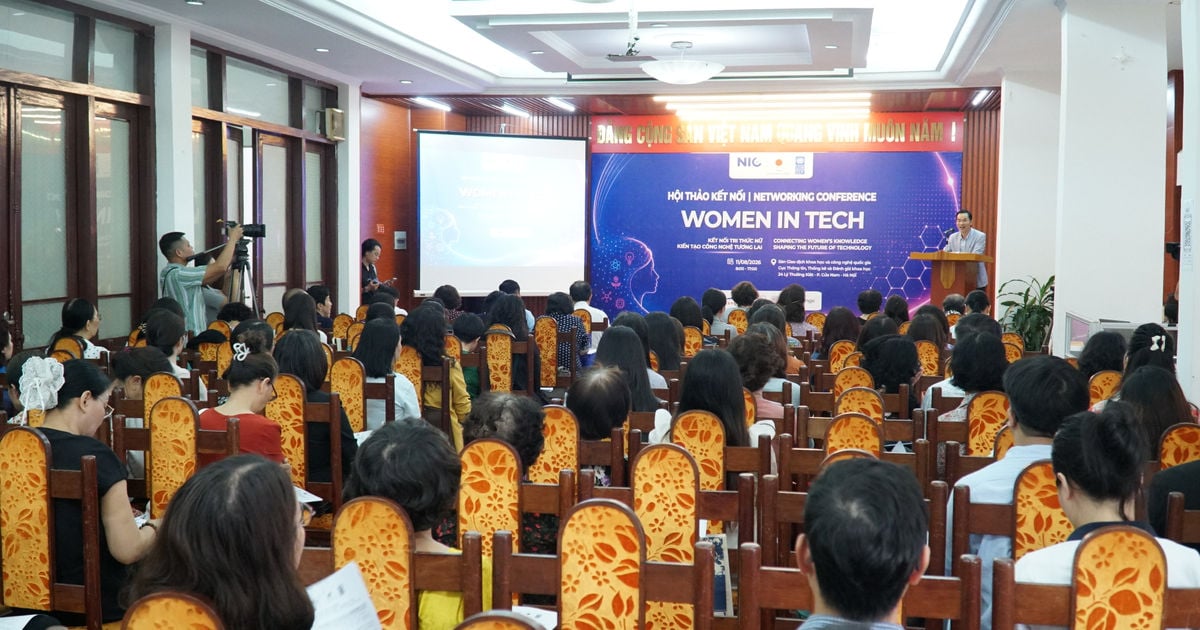
To bridge the gap between academic laboratories and commercial production lines, the National Innovation Center (NIC) organized the “Women InTech Technology Connection” workshop in cooperation with multiple national and international organizations. Held to support Vietnamese women scientists in bringing home-grown research to the marketplace, the event focused on enhancing productivity, driving digital and ecological transformation, and commercializing endogenous technology across key economic sectors.
According to the organizers, the workshop forms part of a broader project aimed at strengthening the innovation promotion capacity of the National Innovation Center, an initiative funded by the Japanese government and jointly carried out by the UNDP and the NIC.
During the workshop, researchers introduced a wide array of practical technologies ready for transfer. Featured innovations included fuel-saving products, industrial cultivation techniques for nutrient-dense microalgae, medicinal mushroom compounds, plant-based nanosystems and silver nanoparticles for medical applications, JEVA fruit juice concentration technology, and electromagnetic wave and ultrasonic processing methods for agricultural goods and medicinal herbs.
A central challenge highlighted during the sessions was the disconnect between theoretical academic output and commercial reality. Do Tien Thinh, deputy director of the NIC, noted that many high-value scientific projects lack the direct connections to businesses and manufacturing facilities required to scale production and distribution.
“Many projects have a high scientific value, but until now have neither had the opportunity to be brought to market nor been connected with enterprises or facilities that have the capacity and resources to produce, distribute, and put scientific and technological products into practice,” Mr. Do Tien Thinh stated during the opening sessions. “For this reason, today’s workshop is themed ‘Connecting Technology’—connecting the intellect and dedication of women scientists with the practical needs of the economy, research and market, laboratory and production line.”
Echoing these remarks, Dr. Tran Van Tung, president of the Vietnam Association for Scientific and Technological Information (VASTI), pointed out that the divide between information confined to laboratories and actual market requirements remains a formidable hurdle. Scientists require commercial avenues to validate their ideas, while businesses urgently need high-quality domestic technology to boost their market competitiveness.
The workshop addressed this challenge by offering direct networking opportunities. Alongside technology exhibitions, corporate participants articulated specific technical requirements in healthcare, green materials, food processing, agriculture, and manufacturing equipment. Intellectual property experts, enterprise valuation specialists, and technology transfer facilitators guided attendees through direct discussions to explore potential cooperation and shape application-oriented projects.
Empowering Women Leaders in Science and Technology
While women scientists actively contribute to Vietnam’s expanding innovation ecosystem, organizers emphasized that significant untapped potential remains, particularly regarding leadership in STEM disciplines, intellectual property ownership, and research commercialization.
Dr. Huynh Thanh Dat, deputy head of the Central Propaganda and Mass Mobilization Department, observed that diverse and inclusive academic environments consistently foster sustainable creativity. The active participation of women researchers broadens research perspectives and strengthens an academic culture anchored in collaboration and shared responsibility.
Francesca Nardini, deputy representative of the UNDP in Vietnam, stressed that expanding leadership and commercialization opportunities for women is a core economic driver rather than solely a matter of gender equity. “Therefore, creating more opportunities for women scientists to lead research projects, own intellectual property, connect with businesses, and commercialize innovations is not just about gender equality. It is also a way to enhance innovation capacity, improve business competitiveness, and drive future growth,” Ms. Francesca Nardini emphasized.
Expanding Access Through Digital Platforms
To sustain these collaborative networks beyond the workshop, delegates explored digital infrastructure designed to streamline technology transfers. Participants were introduced to the Techmart Vietnam Platform, which grants access to a comprehensive catalog of inventions and technologies prepared for transfer by universities, research institutes, and technology companies across Vietnam via https://sanphamkhoahoc.vn/.
Keep reading