Google has launched its newest hardware lineup, positioning its Pixel smartphones not merely as standalone consumer gadgets, but as core delivery vehicles for its Gemini artificial intelligence ecosystem. During an event in New York hosted by comedian Trevor Noah, company executives detailed a suite of proactive software features designed to manage multi-application workflows entirely in the background.
The company announced that its latest smartphone models are built specifically for Gemini intelligence, offering proactive assistance across dozens of applications. According to Rick Osterloh, who oversees Google’s hardware division, the AI assistant has evolved from a retrieval tool into an active task manager. Gemini can coordinate social outings by drafting emails with dates and locations, tracking attendee RSVPs, booking restaurant tables through chat interfaces, and securing transport options without requiring manual intervention from the user.
While the hardware showcase highlighted these software capabilities, Google faces significant headwinds regarding global market penetration. Data from the web traffic analysis group Statcounter indicates that Google’s Pixel devices hold less than a two percent share of the worldwide smartphone market. In contrast, Apple maintains a dominant position with over 30 percent global market share, though Google achieves stronger regional footholds with more than five percent in Germany and over ten percent in Japan.
Advanced AI Integration and Privacy Frameworks
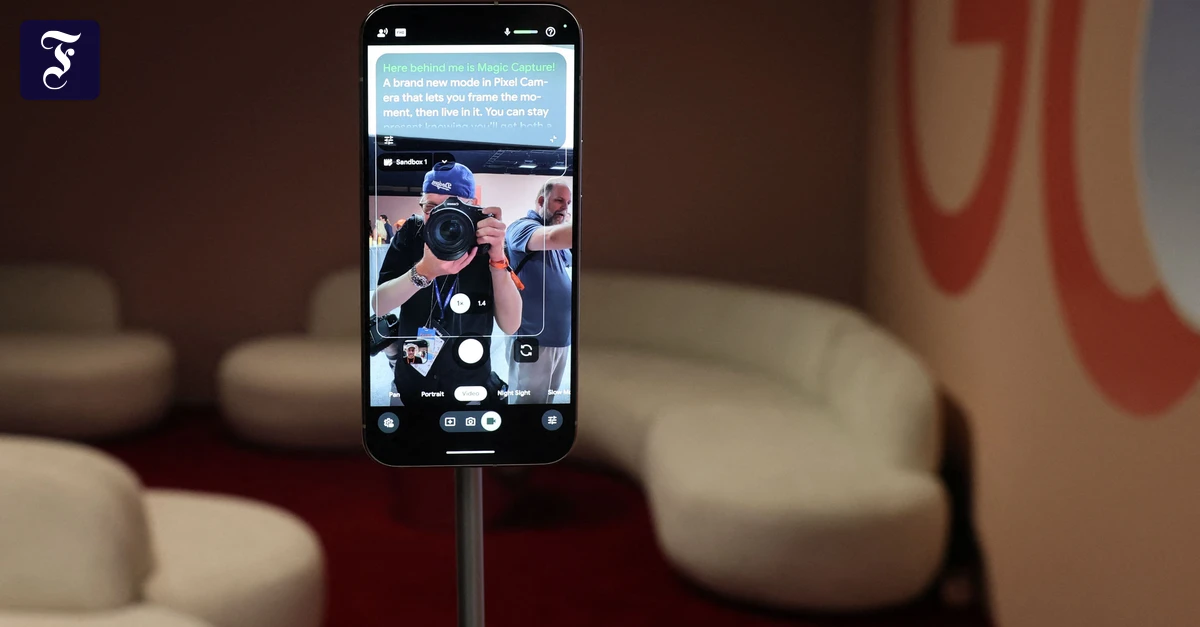
Google’s strategy relies heavily on embedding generative intelligence directly into core device functions, including camera technology. The newly introduced Magic Capture tool allows users to record simultaneous photos and videos with a single press of the shutter button while performing automated edits on the fly. Osterloh characterized these capabilities as a “Game Changer” for mobile users, even while acknowledging that widespread adoption of advanced automated task management remains in its early stages.
To address growing consumer scrutiny regarding personal data, Google asserted that its Pixel hardware incorporates extensive privacy safeguards. The company stated that its devices feature more built-in security instruments than any other smartphone, restricting data sharing unless explicitly requested by the user. Furthermore, the company noted that individual artificial intelligence features can be disabled entirely by the user, setting up a competitive contrast with rivals like Apple, which frequently advertises its own device security measures.
Hardware Pricing and Industry Context
Google has increased entry-level pricing for its standard smartphone lineup, with the base model starting at 899 euros compared to 799 euros for the previous generation. Pro-tier variants have similarly risen by 100 euros. Industry analysts attribute these adjustments to climbing global prices for memory chips, though the base models now feature double the storage capacity of their predecessors.
Market watchers anticipate that competitor Apple will follow a similar pricing trajectory as it prepares to unveil its upcoming iPhone generations, which market speculation suggests may include the company’s first foldable smartphone. Google has maintained an active presence in the foldable device category since introducing its folding Pixel device in 2023, setting the stage for direct hardware and software rivalry as both firms attempt to define the next generation of mobile computing.
Worth a look
- PS5 Emulator SharpEmu Boots Astro’s Playroom on Steam Deck and Android
- Caravan SandWitch is Available for Free on Epic Games Store
- Google adds insulin resistance tracking to Pixel Watch 5 and Fitbit Air (time.news)
- Dawn of War 4 Release Date Delayed: What to Expect from the Refining Process – Warhammer 40k Strategy Game Update” “Dawn of War 4 Launch Delayed: How the Game’s Delay Will Affect Fans – Warhammer 40k Strategy Game News” “Warhammer 40k Strategy Game Dawn of War 4 Delayed to Refine Experience Ahead of Release – Gaming News Update” “Dawn of War 4 Delayed: What the Delay Means for the Upcoming Warhammer 40k Game – Strategy Game Release News (archyworldys.com)