Mistral AI has launched a sweeping regional infrastructure expansion, introducing regional inference endpoints and third-party open models while seeking enterprise commitments to reach a 1 gigawatt European compute target by 2030, according to industry announcements.
The strategy addresses a growing regional compute crunch in Europe, where demand for artificial intelligence workloads increasingly outpaces local data center capacity. According to Timothée Lacroix, Mistral’s co-founder and chief technology officer, speaking in an exclusive interview with Venturebeat, the expansion focuses heavily on strengthening the inference component of the company’s stack as enterprise demand accelerates toward 2027 and 2028.
To meet these capital-intensive infrastructure demands without relying solely on venture capital, Mistral is assembling a coalition of European enterprises to underwrite multi-year compute commitments. These financial agreements convert into European Compute Units, or ECUs, which grant participating organizations long-term access to Mistral-built infrastructure, as reported by Bankinfosecurity.
Infrastructure Expansion and Regional Inference
Mistral’s infrastructure rollout centers on three key operational pillars designed to give corporate and governmental clients strict control over data residency and latency requirements. The company introduced Mistral Regional Endpoints, allowing customers to choose whether their AI workloads execute within Europe or the United States, according to Bankinfosecurity.
Alongside regional routing, Mistral rolled out a Priority Tier in public preview, providing dedicated uptime guarantees and custom rate limits for mission-critical deployments. Many commercial AI labs throttle rate limits to manage server loads, which frequently triggers errors for enterprise agents and workflows; Mistral’s priority tier aims to eliminate these bottlenecks, as detailed by Bankinfosecurity.
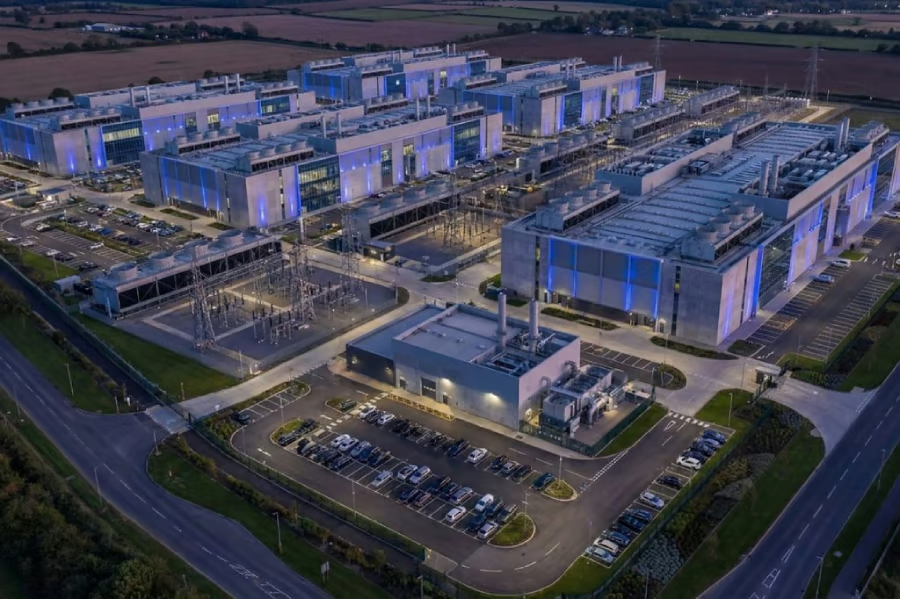
The physical foundation for this network currently spans multiple facilities. Mistral operates less than 200 megawatts of total capacity, anchored by three primary sites: a 44-megawatt facility near Paris that opened in the second quarter, a 23-megawatt installation in Sweden built alongside EcoDataCenter utilizing renewable power and advanced cooling, and a 10-megawatt site in Les Ulis, France, that came online in the third quarter, according to Venturebeat.
Financing a One-Gigawatt Vision Through European Compute Units
Scaling existing facilities to hit the 1 gigawatt target by 2030 requires substantial capital expenditure. Independent analysis from Epoch AI indicates that constructing a typical one-gigawatt AI data center requires approximately $38 billion in upfront capital, with servers and graphics processing units driving the bulk of the expenses. Furthermore, Goldman Sachs Research estimates next-generation facility costs between $15 million and $20 million per megawatt before accounting for specialized silicon.

To underwrite this expansion, Mistral is forming an anchor group of prominent European corporations capable of financing infrastructure through multi-year agreements. Initial participants committing to the coalition include travel technology provider Amadeus, semiconductor equipment manufacturer ASML, and shipping conglomerate CMA CGM, according to Bankinfosecurity.
These corporate financial commitments translate directly into European Compute Units (ECUs), functioning as a multi-year claim on Mistral’s growing infrastructure network. Enterprises can draw down their ECU balances across various products as their operational needs evolve, mitigating the risk of regional supply shortages highlighted by McKinsey projections, which estimate global AI data center expenditures could reach $5.2 trillion by 2030.
Hosting Third-Party Open Models
In a departure from its traditional focus on proprietary and open-weight models trained entirely in-house, Mistral announced it will begin hosting third-party open models on its platform. The initiative launches with GLM-5.2 from Z.ai, the Chinese artificial intelligence laboratory formerly known as Zhipu, according to Venturebeat.

The integration of external open-weight models provides enterprises with deeper visibility into model architecture, allowing technical teams to inspect code, adapt behaviors, and retain internal intelligence. This transparency addresses critical security demands for mission-critical deployments, particularly as organizations seek alternatives to closed systems with rigid guardrails, as reported by Bankinfosecurity.