
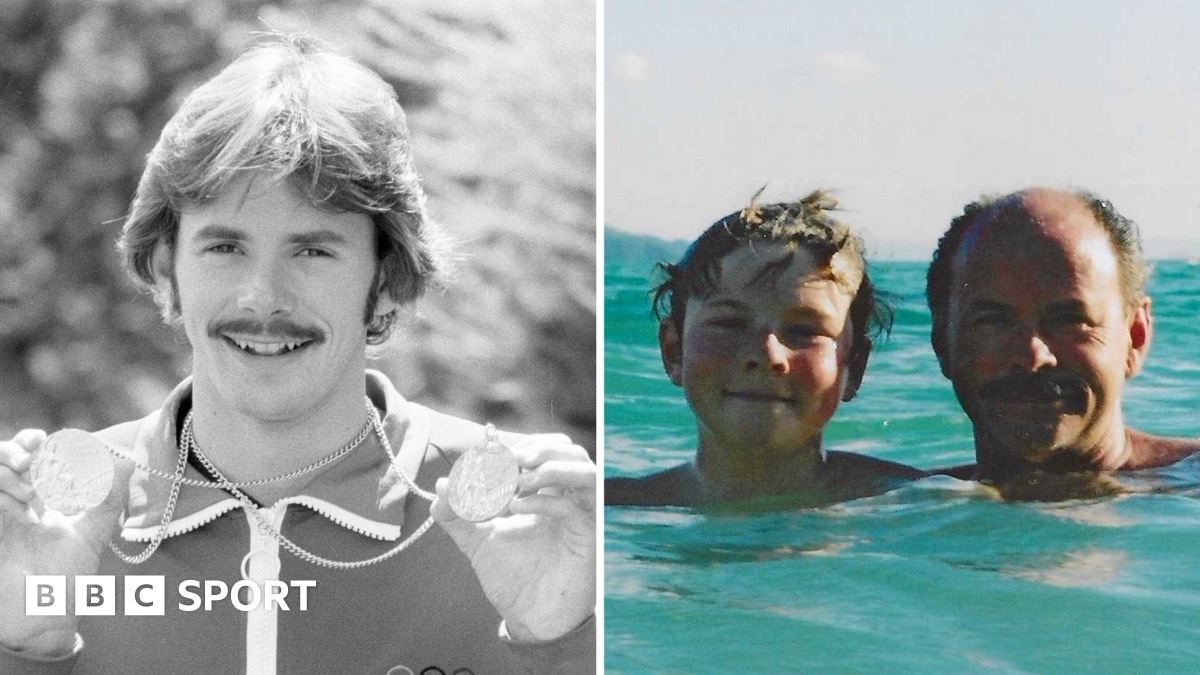
In the world of elite athletics, the shadow of a parent’s legacy can either be a suffocating weight or a powerful catalyst. For Adam Wilkie, a marketing manager by profession, the legacy is a specific number etched into the history books of international swimming: 2:14.23.
That was the world-record time set by his father, David Wilkie, during the 200-meter breaststroke at the 1976 Montreal Olympics. It was a victory that did more than just secure a gold medal; it ended a 68-year drought for British men’s swimming gold, marking one of the most significant moments in the nation’s aquatic history.
Now, decades later, Adam Wilkie is embarking on a deeply personal journey to match that historic mark. While he does not possess the professional training of an Olympic champion, his quest is less about the pursuit of a podium and more about a profound connection to his father’s memory and the enduring spirit of competition.
As a veteran sports editor who has covered the intersection of legacy and performance for over a decade, I have seen many athletes struggle with the expectations of their lineage. However, Wilkie’s approach is distinct. By framing this as a personal challenge rather than a professional career pivot, he transforms a daunting athletic goal into a narrative of resilience and familial tribute.
The Weight of Gold: David Wilkie’s 1976 Triumph
To understand the magnitude of Adam Wilkie’s ambition, one must first appreciate the impact of David Wilkie’s performance in Montreal. In 1976, the 200-meter breaststroke was a test of extreme endurance and technical precision. David Wilkie didn’t just win; he dominated, shattering the world record and delivering Britain its first men’s swimming gold medal since the 1908 London Games.
The International Olympic Committee records highlight the 1976 Games as a turning point for several sporting nations, but for Great Britain, Wilkie was the standout. His victory was a masterclass in the breaststroke—a stroke often cited by coaches as the most technically difficult to master because of the precise coordination required between the pull and the kick to maintain momentum.
For Adam, growing up with this history meant living in the presence of a sporting legend. Yet, the transition from being the son of a champion to becoming a competitor in his own right requires a shift in mindset. The 200-meter breaststroke is an grueling event that demands not only cardiovascular strength but a specific kind of mental fortitude to handle the “wall” that typically hits swimmers at the 150-meter mark.
From Marketing Management to the Pool Deck
Adam Wilkie’s daily life is far removed from the sterile, chlorine-scented environment of an Olympic training center. As a marketing manager, his professional world is defined by strategy, KPIs, and consumer engagement. However, the discipline required for high-level corporate management often mirrors the discipline needed for athletic training: consistency, incremental improvement, and the ability to analyze failure to find a path to success.
Matching a world record—even one from 1976—is a staggering goal for a non-professional athlete. In the modern era, swimming times have plummeted due to advancements in sports science, nutrition, and hydrodynamic swimwear. While David Wilkie’s 2:14.23 was a world record in the 1970s, today’s elite swimmers often dip well below the 2:10 mark.
Despite this, for a recreational or semi-professional swimmer, breaking the 2:15 barrier in the 200-meter breaststroke is an elite achievement. It requires a level of fitness that exceeds standard gym routines, necessitating structured interval training and a rigorous focus on stroke efficiency. Adam’s journey is a testament to the idea that “athleticism” is not reserved solely for those who compete for a living, but is accessible to anyone willing to endure the grind of the training pool.
The Technical Challenge of the 200m Breaststroke
The breaststroke is unique among the four competitive strokes because it is the slowest and most susceptible to drag. To match a time like 2:14.23, a swimmer must minimize resistance at every turn. Key areas of focus for someone in Adam’s position typically include:
- The Glide Phase: Maximizing the distance traveled per stroke to reduce the total number of movements required.
- The Kick: Ensuring the whip-kick is powerful and symmetrical to maintain forward propulsion.
- Turn Efficiency: Reducing the time spent on the wall during the flip and push-off, where precious tenths of a second are often lost.
- Lactate Threshold: Training the body to handle the buildup of lactic acid in the legs, which causes the “heavy” feeling in the final 50 meters.
The Psychology of Chasing a Legacy
There is a significant psychological component to Adam Wilkie’s quest. Chasing a father’s record is rarely just about the clock; it is about seeking a shared experience. By pushing his body to the limits his father once reached, Adam is engaging in a form of silent dialogue with the past.
In my experience interviewing Olympic athletes, the most enduring stories are often those where the goal is internal. When an athlete competes for a medal, the pressure is external. When they compete to honor a parent, the motivation is intrinsic. This shift often allows the athlete to enjoy the process of training more deeply, as the “win” is defined by the effort and the tribute rather than the official ranking.
This pursuit also highlights a broader trend in modern sports: the rise of the “legacy challenge.” From sons attempting to run their fathers’ marathon times to daughters chasing their mothers’ collegiate records, these endeavors humanize the legends of the past. They remind us that behind every world record is a human being who worked, suffered, and eventually triumphed.
What So for the Sporting Community
Adam Wilkie’s story serves as an inspiration for the “everyday athlete.” In an era where sports are increasingly dominated by hyper-specialized professionals, there is immense value in the pursuit of excellence for its own sake. The fact that a marketing manager is dedicating his time and energy to match a 50-year-old world record underscores a fundamental truth about sport: the drive to improve is universal.

this story brings renewed attention to the history of European Aquatics and the evolution of the sport. By revisiting David Wilkie’s 1976 achievement, we are reminded of the era of “pure” swimming—before the advent of high-tech polyurethane suits and sophisticated underwater cameras—where victory was won through raw talent and sheer willpower.
| Feature | 1976 Era (David Wilkie) | Modern Era (Elite) |
|---|---|---|
| Swimwear | Standard Lycra/Nylon | Hydrodynamic Compression Suits |
| Training | High Volume, Basic Intervals | Data-Driven, Biometric Analysis |
| Recovery | Basic Rest and Nutrition | Cryotherapy, Physiotherapy, Precise Diet |
| World Record Trend | Breaking 2:15 was the frontier | Pushing toward the 2:05-2:07 range |
Looking Ahead: The Path to the Record
The road to 2:14.23 is long and fraught with physical hurdles. For Adam Wilkie, the journey involves balancing the demands of a professional career with the grueling requirements of swim training. Success will not be measured solely by whether the clock stops at the exact second of his father’s record, but by the discipline he maintains and the legacy he honors along the way.
As he continues his training, the sporting world watches not for a new world record, but for the completion of a personal circle. The quest to match David Wilkie’s time is a reminder that while records are meant to be broken by the next generation of professionals, they can be chased and honored by those who love the athletes who set them.
The next checkpoint for this journey will likely be a timed trial or a sanctioned masters-level competition where Adam can officially log his progress toward the 2:14.23 mark. We will continue to monitor his progress as he navigates the challenging waters of the 200-meter breaststroke.
Do you believe that chasing a family legacy helps or hinders an athlete’s performance? Share your thoughts in the comments below and let us know if you have a personal sporting goal you’re pursuing.