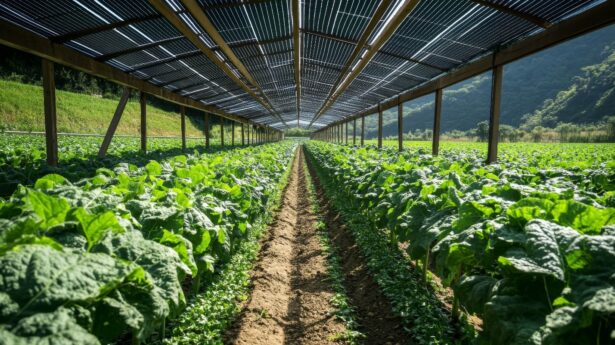
In the sun-drenched plains of western New South Wales, a quiet revolution is reshaping how land is used for both energy and agriculture. At a solar farm near Dubbo, approximately 400 kilometres west of Sydney, farmer Tom Warren tends to a flock of Merino sheep that graze contentedly beneath rows of photovoltaic panels. This practice, known as agrivoltaism, combines solar power generation with livestock grazing, and is gaining traction across Australia as farmers seek resilient, dual-income models in the face of climate volatility.
Warren, who partnered with renewable energy company Neoen to host over 30,000 solar panels on 50 hectares of his property, initially viewed the arrangement as a way to secure stable income independent of weather or wool prices. “The rent I receive is now greater than what I could earn from farming alone in this region,” he said in a February 2026 interview with AFP. But the benefits soon extended beyond financial stability. He observed that the sheep’s wool improved in quality and cleanliness, attributing the change to microclimatic effects created by the panels.
“The wool produced is of better quality and cleaner,” Warren explained, noting a 15% increase in income from his sheep enterprise since integrating solar grazing. “The ground stays moister, and we’ve seen greener strips of grass form along the panel edges where rainwater runs off and nourishes the soil.” These observations were echoed in a February 2026 RFI report, which highlighted how condensation on panels overnight drips to form linear patches of vegetation, enhancing forage availability even during dry periods.
The concept of agrivoltaism — co-locating solar arrays with agricultural activity — is not new globally, but its application in Australia is evolving rapidly. According to France Inter’s February 2026 podcast, interest is growing among pastoralists who see potential in mitigating land-use conflicts between energy expansion and food production. Unlike traditional solar farms that often require vegetation clearing or herbicide use, agrivoltaic systems maintain ground cover, reduce soil erosion, and can support biodiversity when managed thoughtfully.
Research cited in the Connaissance des Énergies article from February 2026 reinforces these advantages. It notes that sheep naturally seek shade under panels during hot hours, reducing heat stress, while the panels themselves benefit from vegetation underneath, which can lower ambient temperatures through evapotranspiration — potentially boosting panel efficiency. This symbiotic relationship creates what experts call a “microclimate advantage,” where both energy yield and agricultural output can exceed those of isolated systems.
Neoen, the French renewable energy firm overseeing the Dubbo installation, has emphasized that such projects are designed with agricultural compatibility in mind. Panels are mounted higher than standard to allow livestock movement, and spacing is adjusted to ensure sufficient sunlight reaches the ground for pasture growth. Warren confirmed that his sheep continue to graze freely, resting in the shade during midday and returning to sunlit strips at the panel edges where moisture accumulates.
While precise national statistics on agrivoltaic adoption in Australia are not yet publicly aggregated, anecdotal evidence from multiple regional reports suggests a growing trend. Similar trials have been reported in Victoria and South Australia, where researchers are studying impacts on soil health, water retention, and livestock behavior. Even though, experts caution that outcomes depend heavily on local conditions — including rainfall, soil type, panel height, and grazing density — meaning results from one site may not be directly transferable.
The Australian government has not yet introduced specific federal incentives for agrivoltaism, though state-level programs supporting renewable energy on farmland may indirectly encourage such initiatives. Farmers interested in exploring the model are advised to consult with agricultural extension services and renewable developers experienced in dual-use projects. As of April 2026, no major policy changes have been announced that would alter the regulatory landscape for grazing under solar arrays.
For Tom Warren, the decision to integrate sheep into his solar farm has proven both economically and ecologically sound. “I wouldn’t head back,” he stated firmly. “The land works harder now — it feeds my flock, powers the grid, and keeps the soil healthy.” His experience reflects a broader shift toward regenerative land practices that prioritize multifunctionality over single-use optimization.
As climate pressures intensify and demand for renewable energy grows, models like agrivoltaism offer a pathway to reconcile competing land needs. While not a universal solution, its success in places like Dubbo demonstrates that innovation often lies not in inventing something entirely new, but in reimagining how existing systems can work together.
For updates on renewable energy developments in rural Australia, readers can follow announcements from the Australian Renewable Energy Agency (ARENA) or monitor project registries through the Clean Energy Regulator.
What are your thoughts on combining solar farms with agriculture? Share your perspective in the comments below, and facilitate spread awareness by sharing this article with others interested in sustainable land use.
Related reading
- Since the provided input is only an image link and contains no text or context about the article’s content, it is impossible to create a specific SEO title. However, based on the source (Times of India), if this is a general news piece, a high-performing SEO template would be: [Main Subject/Keyword]: Latest Updates, News, and Key Highlights
- Armed Clashes Erupt in the Libyan City of Zawiya