Predicting Your Osteoarthritis Future: How AI is Revolutionizing Knee Care
Osteoarthritis (OA) impacts over 500 million people worldwide, representing a significant and growing global health challenge. For decades, managing this degenerative joint disorder has relied on reactive treatment – addressing symptoms after they arise. Now, a groundbreaking artificial intelligence system developed at the University of Surrey is poised to shift this paradigm, offering a proactive glimpse into the potential future of your knee health. This isn’t just about numbers and risk scores; its about seeing the potential progression of the disease, empowering both patients and clinicians to intervene earlier and more effectively.
How Does AI Predict Osteoarthritis Progression?
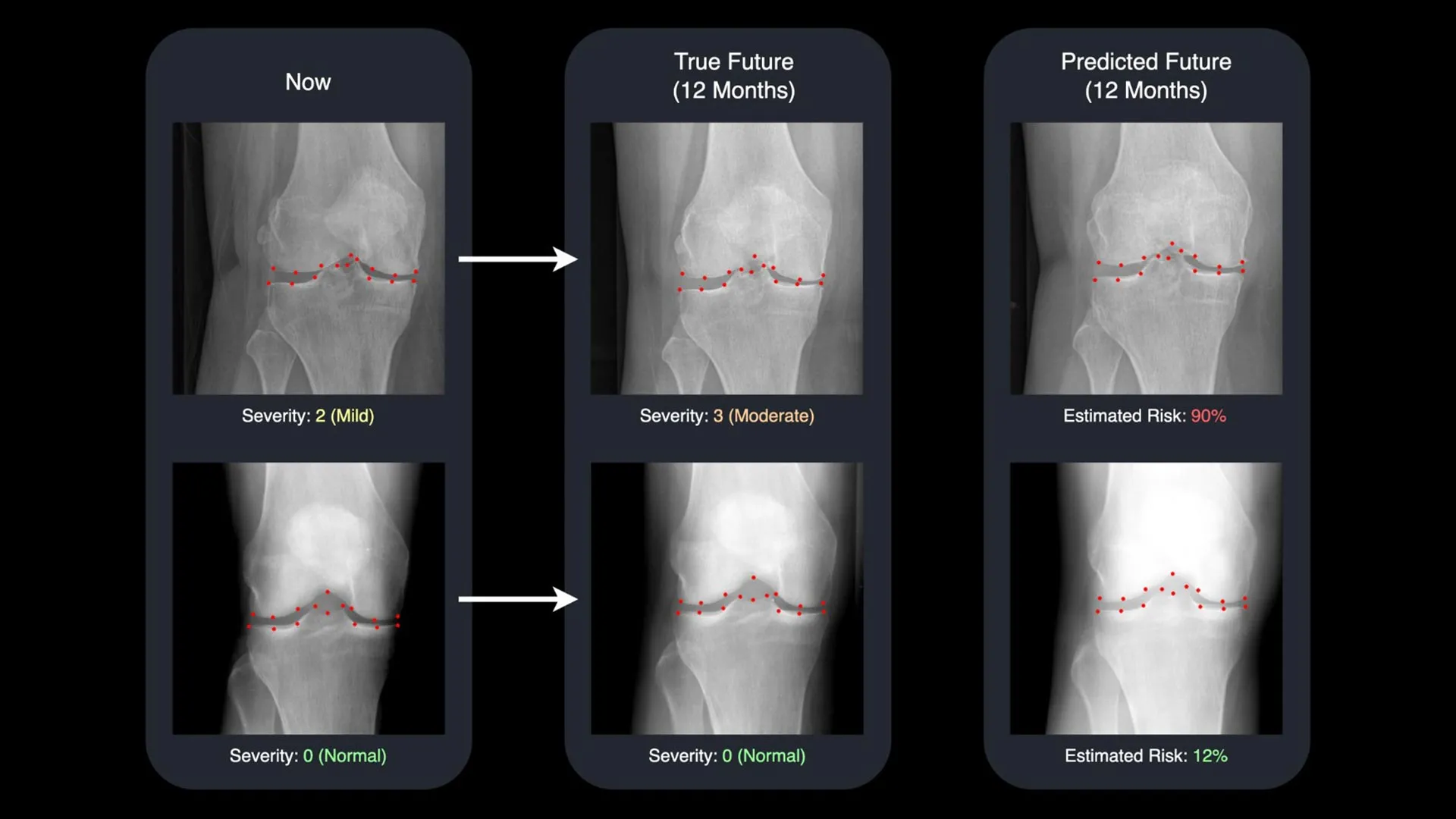
The core innovation lies in the AI’s ability to generate realistic “future” X-rays, paired with a personalized risk assessment.This isn’t speculative imaging; it’s a data-driven prediction built upon a massive dataset of nearly 50,000 knee X-rays from approximately 5,000 patients - one of the largest of its kind. The system utilizes a complex generative model called a diffusion model, which learns the subtle patterns of OA progression from this extensive data.
Unlike previous AI tools that often provided only numerical risk estimates, this system offers a crucial visual component. It doesn’t just tell you if your knee might worsen; it shows you what that worsening could look like. This visual representation, comparing a current X-ray to a predicted future image, is a powerful tool for fostering understanding and motivating proactive care.
Beyond Prediction: Enhanced Clarity and Clinical Utility
The Surrey system doesn’t operate as a ”black box.” A key feature is its ability to pinpoint 16 specific anatomical landmarks within the knee joint. By highlighting these areas, the AI demonstrates where it’s focusing its analysis and predicting change.This transparency is critical for building clinician trust and facilitating informed decision-making.
“Earlier AI systems could estimate the risk of osteoarthritis progression, but they were frequently enough slow, opaque and limited to numbers rather than clear images,” explains Professor Gustavo Carneiro of surrey’s Center for Vision, Speech and Signal Processing (CVSSP). “Our approach takes a big step forward by generating realistic future X-rays quickly and by pinpointing the areas of the joint most likely to change. That extra visibility helps clinicians identify high-risk patients sooner and personalize their care in ways that were not previously practical.”
Why is this AI Different? Speed, Accuracy, and Impact.
The Surrey AI isn’t just visually informative; it’s also demonstrably more efficient and accurate. researchers report it can predict disease progression roughly nine times faster than comparable AI tools. This speed is crucial for real-world clinical integration,making it feasible to incorporate the technology into routine patient care.
David Butler, lead author of the study, emphasizes the motivational power of the visual prediction: “Seeing the two X-rays side by side – one from today and one for next year – is a powerful motivator.It helps doctors act sooner and gives patients a clearer picture of why sticking to their treatment plan or making lifestyle changes really matters.” This patient-centric approach is a significant departure from customary, often abstract, risk dialog.
Frequently Asked Questions About AI-Powered Osteoarthritis Prediction:
1. how accurate is this AI in predicting osteoarthritis progression? While pinpoint accuracy varies based on individual patient factors, the system was trained on a significant dataset and demonstrates significantly improved speed and precision compared to existing AI tools.The visual component allows clinicians to assess the AI’s predictions in context with their own clinical expertise.
2. What data is used to create the “future” X-ray prediction? The AI analyzes a patient’s current X-ray,leveraging patterns learned from nearly 50,000 previous X-rays and associated patient data. It identifies subtle indicators of progression and extrapolates potential changes.
3. Is this technology only useful for diagnosing osteoarthritis? No. While currently focused on knee osteoarthritis, the underlying technology – advanced generative AI models – has the potential to be adapted for predicting progression in other chronic diseases, such as lung disease or heart disease.
4. How does this AI system improve patient engagement in their own care? by providing a clear, visual representation of potential future outcomes, the AI empowers patients to understand the importance of adherence to treatment plans and lifestyle modifications. Seeing the potential consequences of inaction can be a powerful motivator.
5. Will this AI replace the need for a doctor’s assessment? Absolutely not. This AI is designed to be a tool for clinicians, augmenting their expertise and providing additional insights. A doctor’s clinical judgment remains paramount in diagnosis and treatment planning.
6. What are the next steps for bringing this technology to patients? The Surrey team is actively seeking collaborations with hospitals and