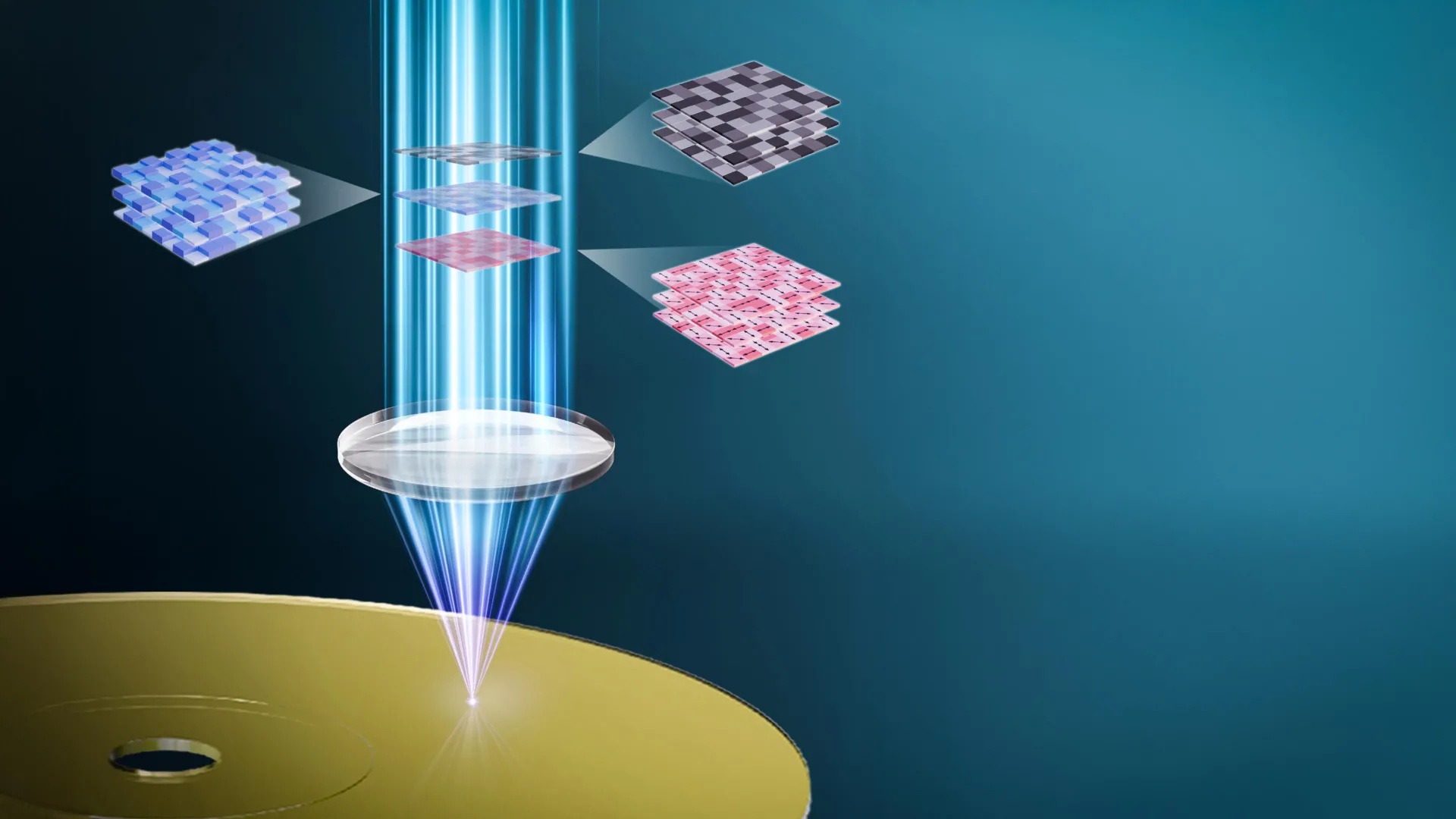
Scientists have developed a new holographic data storage method that records and retrieves information in three dimensions by combining three key properties of light — amplitude, phase and polarization. This approach allows much more data to be stored within the same space, offering a potential solution to the growing global demand for data storage. The technique was detailed in a March 29, 2026 release from Optica, highlighting research led by Xiaodi Tan from Fujian Normal University in China.
Traditional storage systems write data onto flat surfaces such as hard drives or optical discs. In contrast, holographic data storage embeds information throughout the volume of a material using laser light. This creates multiple overlapping light patterns within the same space, which significantly increases storage capacity and enables faster data transfer. By using amplitude, phase and polarization together, the method stores data in three dimensions rather than just one or two, dramatically boosting how much information can be held in a given volume.
An AI model then reconstructs the data from the light patterns, simplifying the retrieval process. This integration of artificial intelligence with holographic techniques reduces the complexity traditionally associated with reading stored information from interference patterns. Researchers say this could pave the way for faster, denser, and more efficient data storage systems, particularly as AI-driven applications continue to fuel unprecedented growth in digital data.
How the Three-Dimensional Light Storage Works
The new method builds on conventional holographic storage by adding polarization as an independent information dimension. In conventional approaches, data encoding typically uses only one light property — such as amplitude or phase alone — or at most combines two of these dimensions. By incorporating all three — amplitude, phase and polarization — researchers can store multiple data layers in the same physical space without interference.
Each property of light contributes to the data encoding process: amplitude affects the brightness of the light wave, phase controls the timing of the wave’s oscillations, and polarization refers to the orientation of the light’s electric field. Together, these three properties create a richer set of variables that can be modulated to represent digital information. When laser beams intersect inside a photosensitive material, they form a stable interference pattern that encodes the data throughout the material’s volume.
During retrieval, a reference beam is shone onto the material, diffracting off the stored pattern to reconstruct the original light wave. An AI-trained model then interprets the resulting light signal to decode the stored data with high accuracy. This AI-assisted reconstruction reduces the necessitate for precise optical alignment and complex signal processing, making the system more practical for real-world use.
Addressing AI’s Growing Storage Demands
The development comes at a time when artificial intelligence systems are generating and consuming vast amounts of data, straining existing storage infrastructures. Magnetic tape, long used for archival storage due to its low cost and longevity, struggles to keep pace with the speed and accessibility demands of modern AI workflows. Solid-state drives and hard disk drives, while faster, face physical limits in how much data can be packed into a given surface area.

Holographic storage offers a path forward by utilizing the entire volume of the storage medium rather than just its surface. This volumetric approach allows data density to scale with the cube of the material’s dimensions, rather than the square, potentially enabling orders-of-magnitude increases in capacity. For data centers facing space and energy constraints, such technology could reduce the physical footprint of storage arrays while improving access speeds.
Researchers note that the technique is not limited to any single type of material. Photosensitive polymers and crystals commonly used in holography have been tested, though ongoing work focuses on finding materials that offer better stability, sensitivity, and rewritability. The ability to erase and reuse storage volumes will be critical for commercial adoption, particularly in applications requiring frequent updates.
Challenges and Future Development
Despite its promise, practical holographic data storage still faces several technical hurdles. One challenge is the sensitivity of the recording material to environmental factors such as temperature and humidity, which can degrade stored patterns over time. Another is the need for precise laser control during both writing and reading processes, which requires stable, high-quality optical components.
The use of AI to assist in data reconstruction helps mitigate some of these issues by compensating for minor distortions or noise in the retrieved signals. However, researchers emphasize that further advances in materials science, laser technology, and machine learning algorithms will be necessary to achieve long-term durability and cost-effectiveness.

As of March 2026, the technology remains in the laboratory demonstration phase. No commercial products based on this specific amplitude-phase-polarization holographic method have been announced. Researchers from Fujian Normal University and their collaborators continue to refine the system, with future work focused on improving data transfer rates, reducing power consumption, and exploring compatibility with existing data center architectures.
For now, the breakthrough represents a significant step forward in the pursuit of next-generation storage solutions. By leveraging the full dimensionality of light and combining it with AI-driven readout, scientists are opening new possibilities for how humanity stores and accesses the ever-growing digital record of our world.
Related reading