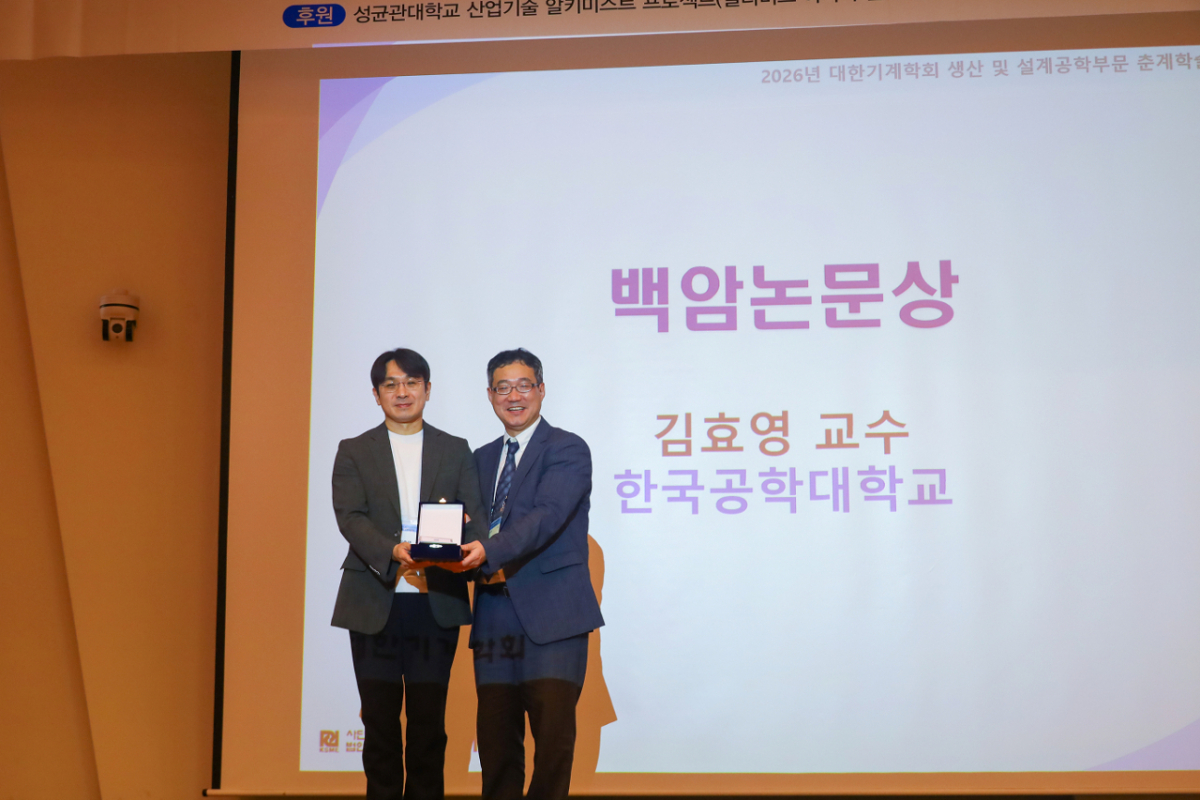
Professor Hyo-Young Kim of the Technical University of Korea (TU Korea) has been awarded the prestigious Baek-Am Paper Award, recognizing his significant contributions to the integration of artificial intelligence and advanced manufacturing technologies. The award, which honors excellence in engineering research, highlights Kim’s work in developing practical solutions for complex industrial manufacturing environments.
The academic recognition focuses on Kim’s interdisciplinary approach to engineering, specifically his efforts to bridge the gap between theoretical AI models and factory-floor applications. According to university records, his research trajectory has consistently prioritized the synthesis of robot control systems, precision machining, and manufacturing data analytics to resolve persistent inefficiencies in domestic industrial sectors. The award serves as a benchmark for his ongoing efforts to modernize manufacturing protocols through data-driven decision-making.
Integrating AI into Smart Manufacturing
At the core of Kim’s research is the application of machine learning to real-world manufacturing challenges. By utilizing manufacturing data analytics, his work aims to increase precision in high-tolerance machining—a critical requirement for the automotive and semiconductor industries. The Technical University of Korea has emphasized that his methodology moves beyond lab-scale experiments, focusing instead on the scalability of these systems within existing production lines.
The transition toward “smart manufacturing” requires more than just automation; it demands a synchronization of hardware and software. Kim’s research addresses this by refining robot control algorithms that can adapt to varying material properties and environmental conditions in real time. This adaptability is often cited as a primary hurdle in the adoption of autonomous systems in small-to-medium-sized manufacturing enterprises, where high-mix, low-volume production is common.
The Significance of the Baek-Am Award
The Baek-Am Paper Award is granted to researchers who demonstrate not only academic rigor but also the potential for tangible industrial benefits. By selecting Kim for this honor, the committee has signaled a shift in focus toward “applied engineering” that directly supports national industrial competitiveness. The award acknowledges the difficulty of merging diverse engineering disciplines, such as mechanical precision and software-heavy AI, into a single, cohesive framework.
This recognition follows a period of increased national investment in South Korea’s smart factory initiatives. According to the Ministry of Trade, Industry and Energy, the integration of AI into manufacturing is a pillar of the country’s strategy to maintain its global standing in high-tech exports. Researchers like Kim are essential to this strategy, as they provide the intellectual foundation for domestic firms to adopt predictive maintenance and AI-assisted quality control.
Future Directions for Smart Factory Research
Currently, Kim continues his work at the Technical University of Korea, where he is involved in developing next-generation control systems. Future phases of his research are expected to focus on the interoperability of manufacturing data across different platforms—a challenge known as “data silos” in industrial engineering. By creating unified data architectures, researchers hope to allow machines from different manufacturers to communicate effectively within a single smart factory.
The academic community and industrial partners are watching these developments closely, as the success of these models could dictate the pace of digital transformation in manufacturing sectors globally. For students and practitioners in the field, Kim’s recent work serves as a case study in how interdisciplinary engineering can solve the persistent problems of modern production. Further updates on his research and the implementation of these technologies are expected to be presented at upcoming industry-academic forums throughout the next calendar year.
We invite our readers to share their thoughts on the role of AI in industrial automation in the comments section below. Stay tuned to World Today Journal for further developments on engineering breakthroughs and their impact on global markets.
Worth a look