
Beyond Traditional Catalysts: How Ultra-Thin Materials are Revolutionizing Sustainable Ammonia Production
(Published November 6, 2025)
For decades, the production of ammonia – a cornerstone of modern agriculture and a potential future fuel source – has relied on the energy-intensive Haber-Bosch process. This century-old method, while effective, contributes significantly to global carbon emissions. Now, a team of researchers is pioneering a new approach, leveraging the extraordinary properties of ultra-thin, two-dimensional (2D) materials to unlock cleaner, more sustainable pathways for ammonia synthesis. This breakthrough promises not only to reshape fertilizer production but also to accelerate the development of renewable energy technologies.
The Promise of MXenes: A New Frontier in Catalysis
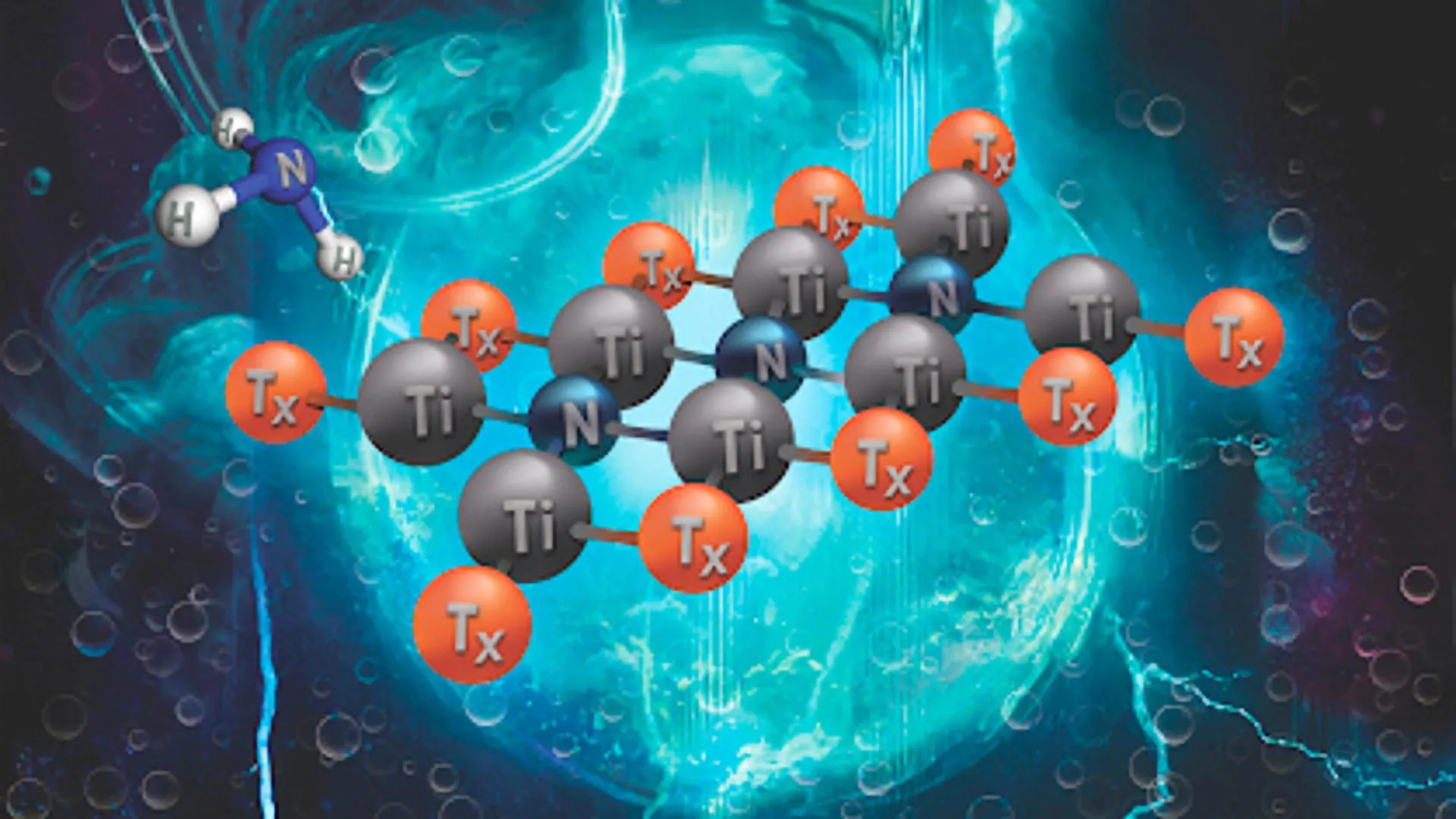
At the heart of this innovation lies a family of materials known as MXenes. These low-dimensional compounds, possessing a unique layered structure, exhibit remarkable potential for converting atmospheric components directly into ammonia.Unlike traditional catalysts,MXenes offer an unprecedented level of tunability. Their chemical composition can be precisely adjusted, allowing scientists to tailor their properties and optimize performance for specific applications.
“We’re moving beyond simply identifying what materials work as catalysts,to understanding why they work,” explains Dr. Abdoulaye Djire, a chemical engineering professor leading the research. “Traditionally, the focus has been on the type of metal within a catalyst.Our work aims to expand that understanding, identifying the critical components and mechanisms that drive efficient chemical and fuel production from readily available resources.”
This research, recently published in the prestigious Journal of the American chemical Society, is a collaborative effort spearheaded by Drs. Djire and Perla Balbuena, alongside Ph.D. candidate Ray Yoo. Their findings are poised to redefine catalyst design and accelerate the transition to a more sustainable chemical industry.
Deconstructing the Catalyst: The Role of Lattice Nitrogen Reactivity
The team’s research delves into the subtle yet powerful influence of nitrogen atoms within the MXene structure. By modifying how these nitrogen atoms interact – a phenomenon termed “lattice nitrogen reactivity” – they can influence the vibrational properties of the material. These vibrations, at the atomic level, are fundamentally linked to the material’s catalytic efficiency.
“Think of it like tuning an instrument,” explains Yoo. “By adjusting the nitrogen arrangement,we can fine-tune the material’s ‘vibrational signature’ to maximize its ability to catalyze the desired chemical reaction.”
This level of control is especially important. MXenes offer a compelling alternative to expensive and often scarce electrocatalyst materials currently used in renewable energy applications. “MXenes are ideal candidates as transition metal-based alternatives,” Yoo emphasizes.”Nitride MXenes, in particular, demonstrate superior performance compared to their carbide counterparts, showcasing their potential to significantly improve electrocatalytic processes.”
Computational Modeling and Spectroscopic Analysis: A multi-Faceted Approach
To gain a deeper understanding of these complex interactions, the researchers employed a combination of cutting-edge techniques. Hao-En Lai, a Ph.D.student working with Dr. Balbuena, utilized elegant computational modeling to simulate the behavior of MXenes at the molecular level. These simulations revealed crucial insights into how energy-relevant solvents interact with the MXene surfaces, quantifying the molecular interactions vital for ammonia synthesis.
Complementing these computational studies, the team leveraged Raman spectroscopy – a non-destructive analytical technique – to analyze the vibrational behavior of titanium nitride.This allowed them to directly observe and quantify the impact of lattice nitrogen reactivity.
“Raman spectroscopy is a game-changer in this field,” says Yoo. “It allows us to ‘see’ the subtle changes in the material’s structure and bonding, providing invaluable data on how nitrogen reactivity influences catalytic performance. This reshapes our understanding of the entire electrocatalytic system involving MXenes.”
Towards Atom-by-Atom Control of Energy Conversion
The implications of this research extend far beyond ammonia production. The team’s work demonstrates the feasibility of achieving electrochemical ammonia synthesis through the precise control of protonation and nitrogen replenishment within the MXene lattice.
“Our ultimate goal is to achieve an atomistic-level understanding of how the atoms within a material’s structure contribute to its function,” explains Djire.”This knowledge will pave the way for the rational design of materials with tailored properties for a wide range of energy conversion applications.”
This research was supported by the U.S. Army DEVCOM ARL Army Research Office Energy Sciences Competency, Electrochemistry Program (award # W911NF-24-1-0208). The views and conclusions presented are solely those of the authors and do not necessarily reflect the official policies of the U.S. Army or the U.S. Government.
**Looking Ahead: A Greener Future Powered by





