
It’s tempting to refer to the founder of the Eugene O’Neill Memorial Theatre Center as a visionary. But George C.White didn’t intend to be.
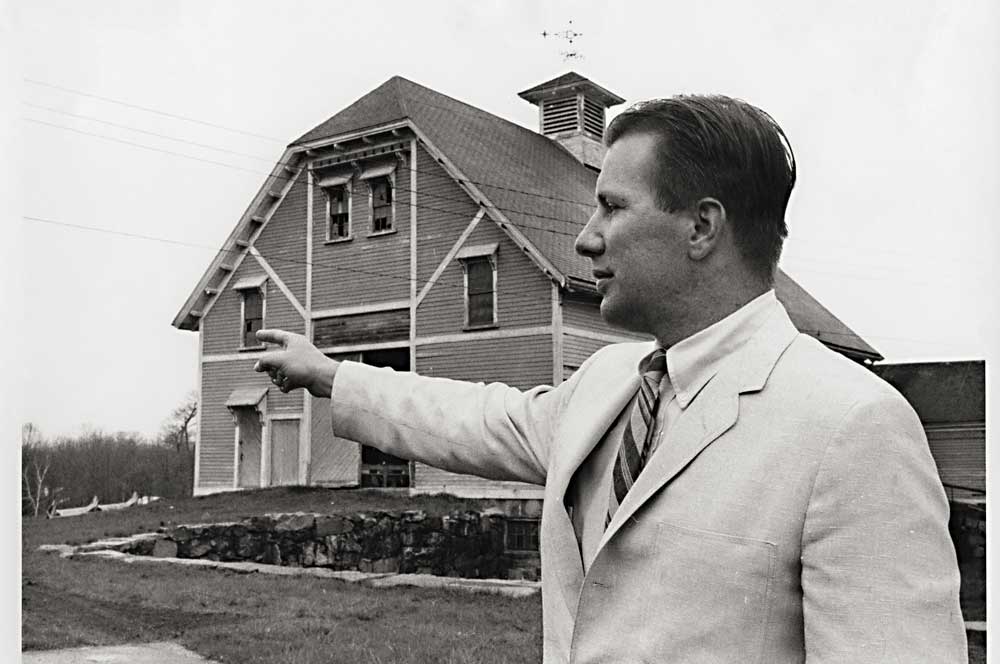
His initial goal was modest: He wanted to open a theatre. A piece of land that the town of Waterford, Connecticut, owned—the Hammond Estate—had a nice beach, but up the hill was a ramshackle mansion unsafe to enter, and an empty barn that could have been brought down by a good sneeze. The authorities thought that the mansion might serve a purpose for the fire department: If someone put a match to it, the department could practice a little.
George,who had grown up in Waterford,thought the house and the land around it might very well be put to a more constructive use. A graduate of the Yale School of drama, his initial idea was that it might make a good home for a summer theatre for his alma mater. He proposed the idea to Yale. yale passed.
Meanwhile, he had persuaded the Waterford authorities to give him a 30-year lease at a dollar a year to try to launch something at this place he had named for Eugene O’Neill (because the famous playwright had spent much of his youth in the area). But he didn’t have the money to put up anything. A playwright friend, Marc Smith, suggested he might put together a playwrights’ conference: Invite a bunch of young playwrights up and organize panels with established theatre professionals and see if something useful might happen out of the conversations that followed.
White found his initial playwrights by contacting New dramatists and Edward Albee. New Dramatists had been founded in 1949 specifically to encourage the growth of new writers. Edward Albee, in association with producers Richard Barr and Clinton Wilder, had created an outfit called the Playwrights Unit to put up bare-bones presentations of works by developing writers that were too experimental or unruly for commercial managements to touch. Between New dramatists and Albee and other recommendations, George and his helpers had an notable initial cohort, among them John Guare, Sam Shepard, lanford Wilson, Sally ordway, Frank Gagliano, Lucy Rosenthal, and Joel Oliansky. Waterford and New London residents were persuaded to offer them guest rooms. And up they came,by car,bus,and train in 1965.
It turned out, as George later told me, that some of these writers behaved like “crazies.” They were mostly broke and angry at being ignored or dismissed, and the last thing some of them wanted was to be lectured at by figures from the establishment on how to write for Broadway. when one panelist mentioned Shakespeare, Sam Shepard shouted, “Fuck Shakespeare! It’s not about him anymore!” and left the conference. A session featuring José Quintero directing two actors in a scene from A Moon for the Misbegotten brought a measure of peace to the final evening, but the week had hardly been a roaring success.
George asked the writers what he could do better. The second summer was the product of what he gleaned.He put up full productions of two new plays and arranged for readings of new scripts. The plays he selected for full production didn’t go over so well, but one of the scripts that was read on the porch of the mansion, the first act of John Guare’s The House of Blue Leaves, created a stir. The finished play went on to become an Off-Broadway hit.
It’s worth mentioning that George was a sailor. One of the things a sailor learns is how to tack with the wind. That is to say, when the wind shifts, you respond by repositioning your sails.George felt the wind shifting at the O’Neill. The summer of 1967, the session was entirely devoted to staged readings. Several of the plays presented were picked up for notable productions in New york: Summertree by Ron Cowen, Muzeeka by John Guare, Father Uxbridge Wants to Marry by Frank Gagliano, and It’s Called the Sugar Plum (on a bill with Indian Wants the Bronx) by Israel horovitz. These found critical support and won awards.
Had George found the formula? Not quite. The following summer, 1968, the participants over-reached. The readings became more elaborate,some of the actors attempted to play off-book,and a toxic spirit of competitiveness had entered paradise. The summer was a sour one.
So George tacked again. He recognized that he didn’t possess the necessary skills and experience to run this by himself any longer. He felt particularly simpatico with one of the directors, lloyd Richards. Richards had made history as the first Black director on Broadway when he staged Lorraine Hansberry’s A Raisin in the Sun. His dramaturgical skills were legendary, and his quiet air of authority was invaluable for a project in which, by definition, work was constantly in flux. George offered Richards the position of director of the National Playwrights Conference.Under the White-Richards team, the O’Neill swiftly hit its stride, regularly discovering new playwrights who started getting produced on stages around the country.
George began to look around and see to whom else the O’Neill might be useful. In the years that followed, he oversaw the creation of conferences for musical theatre, puppetry, and cabaret, as well as providing the initial home for the National Theater of the Deaf. He even thought that critics could use a little help. This led to the founding of the National Critics Institute. (My association with the O’Neill began with my summer with the NCI in 1970.)
One cannot overlook the fact that George was raised among the gentry of New England. His family business was painting pictures of rich people, and George grew up playing ball and sailing and roistering with them. There is a reason the town of Waterford so casually gave him a 30-year lease for one buck a year. An outsider certainly wouldn’t have gotten such a deal.
There was another side to George’s upbringing that factored into his ability to get things done in that corner of Connecticut. His mother, Aida—the daughter of an Italian immigrant—came to the White household as a temporary upstairs chambermaid. The son of the master of the house fell in love with her and proposed. The marriage scandalized many in society circles. But George grew up traveling easily between the patrician class of his father’s family and his mother’s working-class relatives. He had a wider frame of reference and wider sympathies than many of those with whom he had been raised.
Still, there is no getting around the fact that George grew up privileged.These days we have ample cause to be suspicious of the privileged. Too many in thier ranks use their prerogatives to bully and exploit those with less power and fewer assets. George, however, used his privilege to create a place that empowered others.
August Wilson became the leading African American dramatist. Wendy Wasserstein led the way among feminist playwrights. david Henry Hwang was the first Asian American dramatist to reach celebrity. Chris Durang was one of the most notable of a generation of gay playwrights. It’s unlikely that any of them would have found their way through the portals of the traditional commercial theatre. All were discovered at the O’Neill.
George’s contributions extended beyond work at his own institution. At a time when there were few female artistic directors, he threw his support behind a young director named Lynne Meadow as she attempted to create the Manhattan Theatre Club, and he introduced her to an O’Neill alum named Barry Grove who became her longtime managing director. Together they went from Off-Off-Broadway to Off-Broadway to producing both Off-Broadway and on.
When Bartlett Giamatti, the president of Yale, offered George the job of head of the Yale Drama School and artistic director of Yale Rep, George demurred (the O’Neill was his baby and he was going to stick with it) and recommended Lloyd Richards. Richards became the first Black dean in an Ivy League university, turning Yale Rep into a powerhouse center for new writing, sometimes producing plays that had been whipped into shape at the O’Neill. (Richards continued to work at the O’Neill in the summer; that was part of the deal he made with Giamatti.)
George also inspired others.Robert Redford wanted to start an organization that could be as useful to new filmmakers as the O’Neill was to new playwrights. He visited the O’neill,took detailed notes,and built an organization in frank imitation he called Sundance. He enlisted George as one of the early board members. Within the theatre world, one doesn’t have to look far to see how many play development programs share DNA with the O’Neill in their organizational structures and working methods.
All this was a good distance from george’s original idea. Rather of building a summer theatre to put up productions of O’Neill, with the very active collaboration of his wife Betsy, he had instead created a place that had launched hundreds of major careers and scores of the key plays and musicals of the last 60 years. For someone who had no pretensions of being a visionary,he accomplished what few visionaries could claim. By any measure, he was one of the key architects of modern American theatre.
I have been referring to him as George. I was privileged to know him for something like 50 years. when I first met him, he was in his 30s, and I was impressed by his unflagging energy and idealism. He was constantly a-bubble with projects and humor. The last time I saw him,when my wife and I spent a weekend with him and Betsy,he was in his 80s.His energy had abated a bit, but the enthusiasm was undimmed. I could easily imagine the boy he must have been.
He died a few days shy of his 90th birthday, just months after the National Endowment for the Arts, under pressure from the Trump administration, rescinded a ample and crucial grant to the O’neill Center. A few days before George’s death, Betsy, who shared his life and helped realize his plans for 67 years, donated a million dollars to the center. More is needed. Supporting the O’Neill would be a fine way to celebrate George’s life.
Jeffrey Sweet is the author of The O’Neill (Yale University Press). A former resident playwright of chicago’s Victory Gardens Theater, he has more than two dozen produced plays to his credit. He recently directed a production of his play, The Value of Names, in London, and is scheduled to have a new play, A Change of Position, premiere this season at New Jersey Rep. He would love to find a new theatre to call home.


