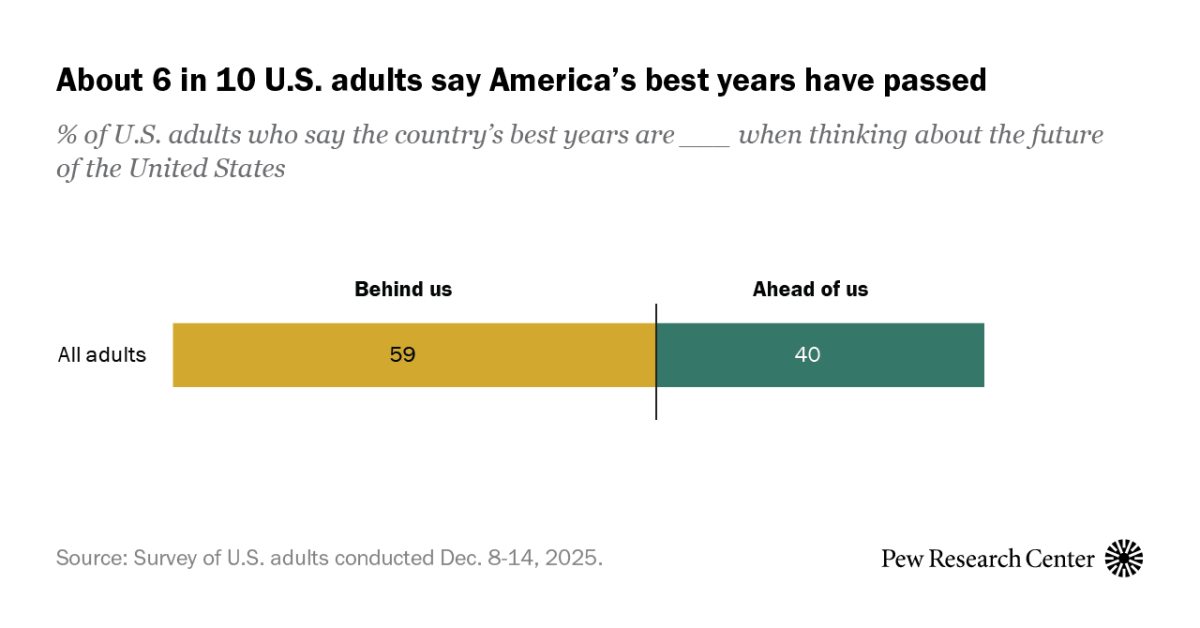
As the United States approaches its 250th anniversary, a significant portion of the population believes the nation has already passed its peak. A recent comprehensive analysis reveals a prevailing sense of decline, with a majority of Americans stating that the country’s best years are now behind it.
The data highlights a stark divide in national sentiment, reflecting deep-seated concerns about the trajectory of the U.S. Over the coming decades. While a minority remains hopeful, the overarching mood is one of caution and pessimism, particularly when looking toward the mid-century mark.
This shift in public perception comes at a critical juncture for the American identity. For those of us reporting on global affairs from London, these trends often mirror broader anxieties seen in other Western democracies, yet the specific demographic splits within the U.S. Suggest that the experience of “national decline” is not felt equally across the population.
A Nation Divided on Its Future
According to a survey of 3,560 adults conducted by the Pew Research Center between December 8 and 14, 2025, 59% of Americans believe the country’s best years are in the past, while 40% maintain that the best is yet to come.

The pessimism extends beyond immediate concerns, stretching into a long-term outlook for the next half-century. When asked to project the state of the U.S. 50 years from now, 44% of respondents expressed pessimism, compared to 28% who felt optimistic. Another 27% remained neutral, neither optimistic nor pessimistic about the long-term future.
This discrepancy suggests that while some Americans may be optimistic about short-term recoveries or specific political cycles, there is a profound lack of confidence in the structural longevity and stability of the nation’s current path.
Demographic Disparities in Optimism
The belief that the U.S. Has already seen its finest days is widespread, but it is most pronounced among minority communities. The data indicates that the sense of lost prosperity or missed potential is more acute for Black and Hispanic adults than for their White or Asian counterparts.
Specifically, 66% of Black adults and 64% of Hispanic adults say the country’s best years are behind it. Among White adults, the figure stands at 57%, while 53% of Asian adults share the view that the nation’s peak has passed.
These figures point to a fragmented national experience. The “American Dream”—the notion of continuous upward mobility and improvement—appears to be fading more rapidly for those who have historically faced systemic barriers to that progress. For these groups, the “best years” may not have been a shared national peak, but rather a period of relative stability that is now eroding.
The Economic Divide: Wealth and Hope
Financial security remains one of the strongest predictors of how an American views the future of their country. There is a clear correlation between income level and the likelihood of believing that the U.S. Still has its best years ahead.

For those in lower and middle-income brackets, the outlook is decisively bleak, with 61% in both groups stating that the country’s best years are behind it. This suggests that inflation, housing costs, and wage stagnation may be driving a perception that the economic engine of the U.S. Is no longer capable of delivering the prosperity it once did.
In contrast, upper-income adults are evenly split. Half of those in the highest income bracket believe the best years are in the past, while the other half believe the nation’s best years are still to come. This 50/50 split suggests that for the wealthy, the future is viewed less as a systemic decline and more as a volatile variable.
Summary of Public Sentiment by Group
| Demographic Group | Percentage (Best Years Behind) |
|---|---|
| Black Adults | 66% |
| Hispanic Adults | 64% |
| Lower/Middle Income | 61% |
| White Adults | 57% |
| Asian Adults | 53% |
| Upper Income | 50% |
What In other words for the 250th Anniversary
The timing of this sentiment is particularly poignant as the United States prepares for its semiquincentennial—the 250th anniversary of its founding. Historically, such milestones are used to galvanize national pride and project a vision of future greatness. However, when nearly 60% of the population feels the peak has passed, the celebratory nature of the anniversary may clash with a grounded sense of national mourning or frustration.
From a political analysis perspective, this trend indicates a “crisis of confidence.” When a majority of a population views the future as worse than the past, it often leads to a shift in political priorities, moving away from growth and innovation toward preservation, protectionism, or radical systemic overhaul.
The 27% of the population that remains neutral suggests a significant “wait-and-see” cohort. These individuals are not yet convinced of a decline, but they lack the evidence or confidence to embrace optimism. This group represents the critical middle ground where future policy shifts or economic recoveries could potentially swing the national mood.
The Global Context of National Decline
This American trend is not happening in a vacuum. Across the globe, many developed nations are grappling with similar feelings of stagnation. Whether it is the aging populations of East Asia or the political polarization in Europe, the feeling that “the golden age” is over has become a common theme in the 21st century.
However, the U.S. Case is unique because of its historical role as the “leader of the free world.” A decline in internal confidence often precedes or mirrors a decline in global influence. If Americans themselves no longer believe in the upward trajectory of their nation, the soft power the U.S. Exerts globally may diminish, as the “American model” becomes less attractive to others.
For those tracking these developments, the key will be whether the upcoming anniversary celebrations can act as a catalyst for renewal or if they will merely highlight the gap between the nation’s founding ideals and its current reality.
The next major checkpoint for national sentiment will be the official series of 250th-anniversary events scheduled for July 2026, which will likely serve as a litmus test for whether the administration can successfully pivot the national narrative from one of decline to one of rebirth.
We want to hear from our global readers: Do you believe the United States is in a period of permanent decline, or is this a temporary dip in a longer cycle of growth? Share your thoughts in the comments below.
Worth a look