Unlocking the Secrets of Ancient Viruses within Us: HERV-K and the Future of Medicine
For decades, scientists have known that remnants of ancient viral infections are embedded within our DNA – these are called Human Endogenous Retroviruses (HERVs). Once considered “junk DNA,” these viral fragments are now revealing themselves as surprisingly influential players in human health and disease. A recent breakthrough from the La Jolla Institute for Immunology (LJI) has shed unprecedented light on one HERV in particular, HERV-K, and its potential to revolutionize diagnostics and therapies for cancer and autoimmune diseases.
A deep Dive into HERV-K’s Structure
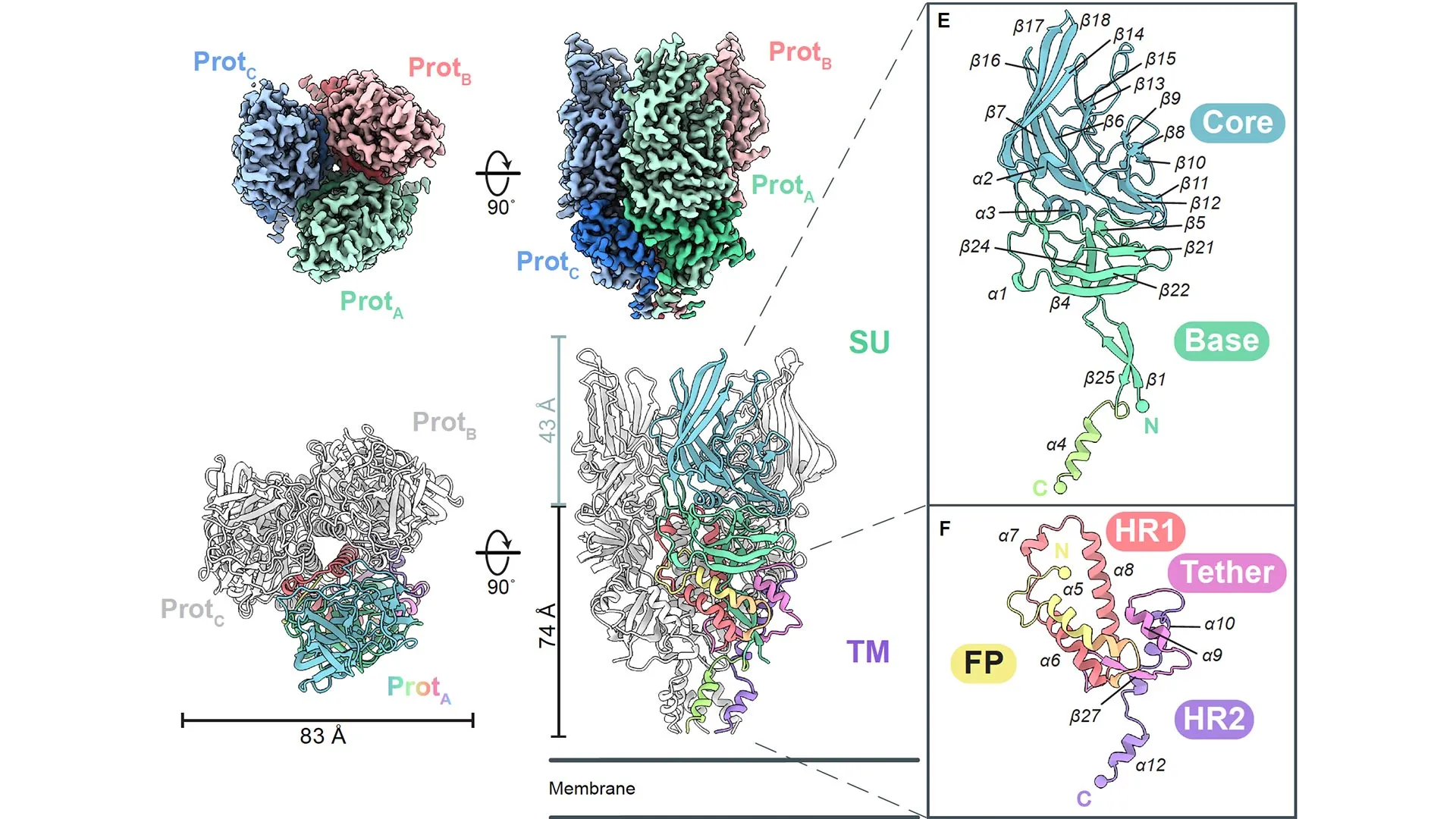
The LJI team, led by Dr. Erica Sun and Dr. Aaron Saphire, focused on the HERV-K envelope protein (Env), the part of the virus responsible for infecting cells. Previous attempts to understand HERV-K Env were hampered by its instability. The researchers overcame this hurdle by cleverly using diffrent stabilizing mutations, allowing them to finally visualize the protein’s complex structure.
Using cryo-electron microscopy, a powerful imaging technique, they captured detailed 3D images of HERV-K Env in various states: on the cell surface, during infection, and when bound by antibodies. What they discovered was remarkable. Unlike the common trimer structure seen in viruses like HIV, HERV-K Env is uniquely tall and lean, with a protein “fold” unlike anything previously observed in retroviruses. This structural difference is key to understanding how the protein functions and how our immune system recognizes it.
HERV-K: A Cancer Biomarker and Potential Immunotherapy Target
The implications of this structural understanding are far-reaching. Crucially, HERV-K Env is frequently found on the surface of cancer cells – breast, ovarian, and others - but is largely absent from healthy cells. This makes it an ideal target for diagnostic tools and,potentially,a powerful immunotherapy approach.”We can use it as a strategy to specifically target cancer cells,” explains Dr. Sun. Antibodies designed to recognize HERV-K Env coudl act like guided missiles, delivering therapies directly to tumors while sparing healthy tissue.
Unraveling Autoimmunity: HERV-K and the Immune System’s Missteps
The story doesn’t end with cancer. HERV-K Env also appears on cells in autoimmune diseases like lupus and rheumatoid arthritis. Scientists hypothesize that the immune system mistakenly identifies these viral proteins as foreign invaders, triggering an autoimmune response.
The LJI team tackled the challenge of studying this interaction by creating a custom panel of antibodies. These antibodies revealed how the immune system attacks different parts of the HERV-K Env molecule. by understanding these attacks, researchers hope to develop interventions that can calm the harmful inflammation characteristic of autoimmune diseases.
New Diagnostic Tools on the Horizon
The team successfully used their antibodies to detect HERV-K Env on neutrophils – a type of immune cell involved in inflammation – in samples from patients with rheumatoid arthritis and lupus. Importantly, they didn’t find this aberrant HERV-K expression in healthy individuals.This suggests these antibodies could become valuable tools for diagnosing autoimmune conditions.
A Growing Field with Limitless Potential
The interest in HERVs is rapidly expanding, with researchers discovering links to an increasing number of diseases. “We can really pick whatever disease we’re interested in and go down that route,” says Dr. Shek, highlighting the versatility of this research.
This work isn’t just about treating disease; it’s about fundamentally understanding our own biology. as Dr. Sun aptly puts it, “We’re all part virus.” By embracing this reality and unlocking the secrets of our ancient viral heritage, we’re opening a new chapter in medical innovation.
Study Citation: Human endogenous retrovirus K (HERV-K) envelope structures in pre- and postfusion by cryo-EM – Wilson, E.M., moadab, F., Hastie, K.M.et al.
Funding Sources: Curebound Discovery Grant (13502-01-000-408) and LJI & Kyowa Kirin, Inc. (KKNA-Kyowa Kirin North america; and a Kirin North America Accelerator Grant [18030-01-000-408]).
Related reading