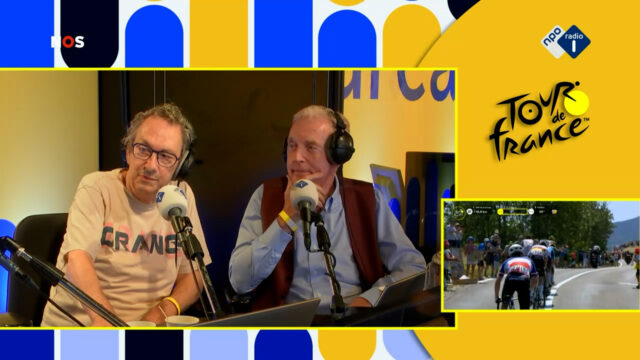
André van Duin and Ferry de Groot are appearing as guests on NPO Radio 1’s Tourcafé this Thursday. The appearance follows a wave of listener requests for nostalgic clips from the 1985 edition of Radio Tour de France, which Van Duin hosted for a single season.
A spokesperson reported on Thursday that there are quite a few registrations for today, with similar high demand expected for Friday and Saturday, according to Nieuws.nl.
While the venue allows spontaneous walk-ins, officials warned that full is full due to the café being regularly filled to the last seat in recent days. To manage the crowds, Beeld & Geluid and the NPO may create additional space if necessary, though the spokesperson noted that Sunday currently appears to be the quietest option for visitors, according to NPO Radio 1.
The 1985 Collaboration of Van Duin and De Groot
The current guest appearance is a callback to 1985, when Van Duin presented Radio Tour de France for one year. During that season, Ferry de Groot served as the program’s producer. The duo, who also created the popular Dik Voormekaar Show, frequently integrated comedic characters and sketches into the cycling coverage, as reported by Nieuws.nl.
The decision to bring the pair back stems from the audience. When the program recently asked for memorable moments from the history of Radio Tour de France, listeners massively submitted fragments from the Van Duin and De Groot era.
The Evolution of Dutch Tour Coverage: From 1936 to the Media Revolution
The current daily broadcasts from 14:00 to 18:00, hosted by Henry Schut and Ghislaine Plag, contrast sharply with the early days of Dutch cycling media. For decades, Dutch listeners faced significant delays in receiving race news. Before 1936, there was no radio coverage of the Tour de France in the Netherlands, despite daily broadcasts existing in France, Belgium, and Luxembourg, according to sportgeschiedenis.nl.
Interest spiked after Theo Middelkamp became the first Dutchman to win a stage on July 14, 1936. The V.A.R.A. broadcaster provided the first radio attention eight days later via reporter Joris van den Bergh, though listeners had to tune in as early as 7:00 a.m.

Even after World War II, live reporting remained absent. In 1950, the KRO and VARA jointly provided only ten broadcasts for the entire Tour, contingent on whether the presence of Dutch riders made it worth the effort. This lack of coverage peaked on July 16, 1951, when Wim van Est became the first Dutchman to wear the yellow jersey. The news did not hit the Dutch radio until late that evening.
The journalist in me was appalled by the misery: such news and then not being able to spout it hot off the press! Jan Cottaar, via sportgeschiedenis.nl
The success of Van Est and his subsequent fall into a ravine triggered a media revolution, shifting coverage from ten broadcasts per Tour to two daily broadcasts featuring finish reports and reviews.
Jan Cottaar’s Technical Challenges in Live Reporting
Pioneering the live format was not seamless. Jan Cottaar, a central figure in early Dutch cycling reporting, noted in 1959 that the speed of the race made identifying riders during mass sprints nearly impossible. He described the chaos of arms, legs and heads at the finish line, requiring him to track the winner with one eye and the runners-up with the other.
Cottaar preferred riders who were visually distinct from a distance.
- The lean and scrawny Coppi
- The crazy Ferdinand Kübler
- The beautiful Hugo Koblet
- The fiery Ockers
- Others including Graczyk, Robic, and Geminiani
Cottaar’s ideal scenario was a lone rider at the front for hours, which allowed him to describe the action meter by meter against the backdrop of cheering crowds. In a final reflection published in Het Leidsch Dagblad on June 30, 1984, Cottaar acknowledged the scale of his reach, stating he was aware that hundreds of thousands were listening, though he remained uncertain if his work was truly successful, according to sportgeschiedenis.nl.
The current Tour de France continues with the peloton riding the 18th stage from Voiron to Orcières-Merlette, ending with a first-category climb.
Related reading