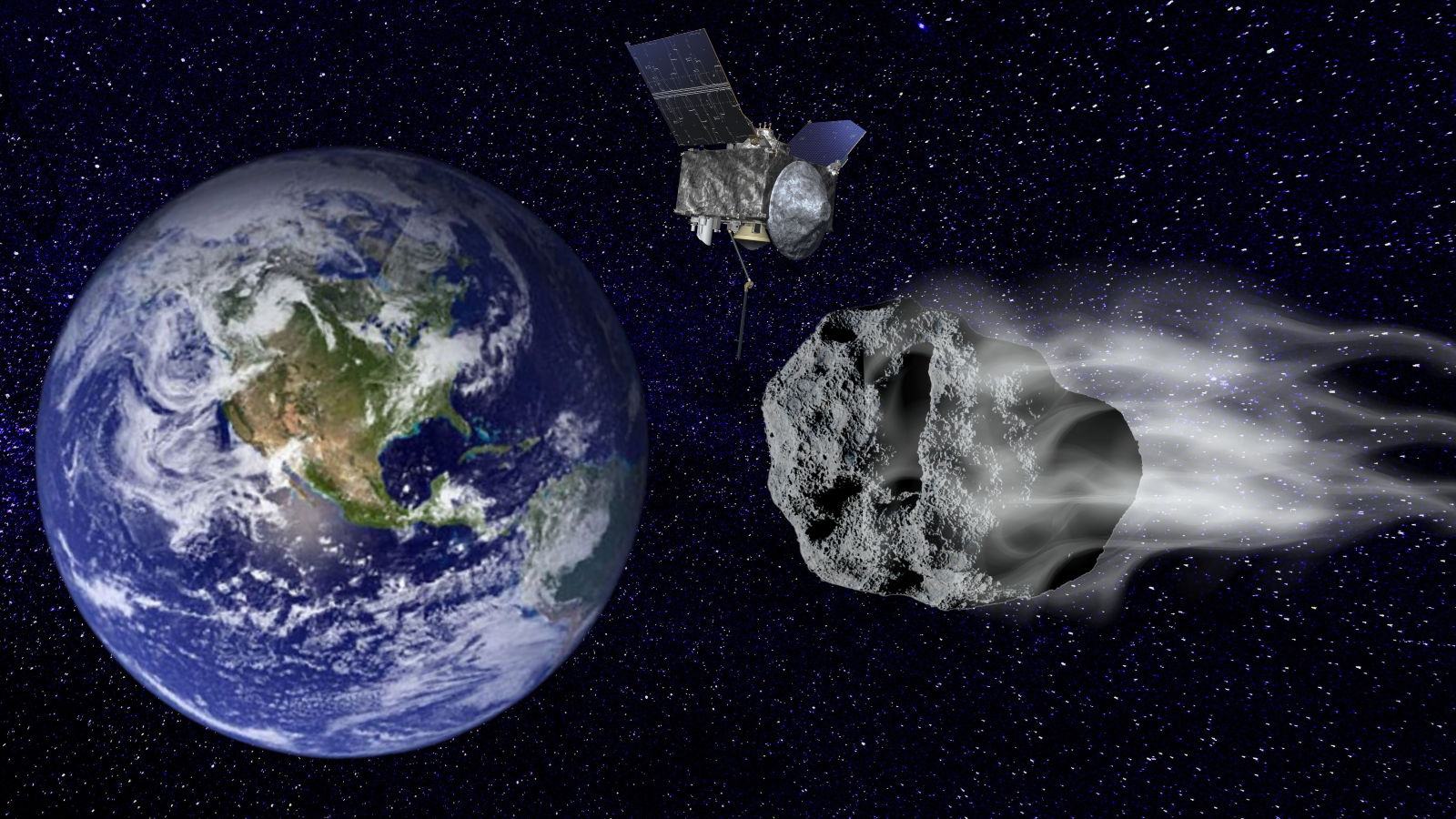
On April 13, 2029, the near-Earth asteroid 99942 Apophis will make an extraordinarily close flyby of our planet, passing within approximately 32,000 kilometers of Earth’s surface. This distance is closer than many geostationary satellites and represents one of the nearest approaches by an object of its size in modern astronomical history. Despite its ominous nickname “God of Chaos,” derived from the ancient Egyptian deity Apep, scientists have confirmed through extensive tracking that Apophis poses no impact risk to Earth during this encounter or for at least the next century.
The asteroid, measuring about 375 meters across at its longest dimension, will be visible to the naked eye under clear skies across parts of Europe, Africa and Asia during its closest approach. This rare celestial event offers an unprecedented opportunity for both professional astronomers and the general public to observe a significant near-Earth object without the need for telescopes. Space agencies worldwide are preparing observational campaigns to study Apophis during this flyby, aiming to gather valuable data about its composition, structure, and behavior under Earth’s gravitational influence.
Initial concerns about a potential collision arose following Apophis’s discovery in June 2004 by astronomers at the Kitt Peak National Observatory in Arizona. Early calculations suggested a modest but non-zero probability of impact in 2029, generating significant media attention and public interest. However, subsequent observations using radar and optical telescopes have progressively refined its orbital trajectory, eliminating the 2029 impact scenario and reducing uncertainties about its future path.
According to NASA’s Center for Near-Earth Object Studies (CNEOS), Apophis will pass Earth at a speed of approximately 7.4 kilometers per second during its 2029 approach. The asteroid belongs to the Aten class of near-Earth objects, characterized by orbits that spend most of their time inside Earth’s orbit around the Sun. Its orbit has an eccentricity of 0.191, causing it to cross Earth’s orbital path twice per revolution, though the 2029 encounter represents the closest predicted approach for the foreseeable future.
The asteroid’s physical characteristics have been studied through various observational techniques. Radar imaging suggests Apophis has an elongated, bilobed shape resembling a rocky peanut, with dimensions of approximately 450 meters by 170 meters. Its surface appears to be composed of silicate rock with a metallic component, consistent with an Sq spectral classification. Measurements indicate a mean density of about 3.2 grams per cubic centimeter, suggesting a relatively porous internal structure typical of rubble-pile asteroids.
Apophis exhibits a complex rotation state, with its primary spin period measured at approximately 30.6 hours. However, the asteroid also displays non-principal axis rotation, or tumbling, with additional periodicities detected in its light curve. This tumbling motion complicates predictions of how its orientation will change during the 2029 flyby but also provides scientists with a unique opportunity to study how gravitational tidal forces affect such objects during close planetary encounters.
Several space agencies have announced plans to observe Apophis during its 2029 approach. The European Space Agency’s (ESA) Hera mission, originally designed for the Didymos binary asteroid system, may be repurposed or supplemented with additional spacecraft to study Apophis. Japan’s Aerospace Exploration Agency (JAXA) is considering contributions to international observation efforts, building on its expertise from the Hayabusa missions. NASA has also outlined plans to employ its Deep Space Network for radar observations and may redirect existing spacecraft for opportunistic observations.
The close approach will subject Apophis to significant tidal forces from Earth’s gravity. Scientists predict these forces could induce surface changes, including potential landslides or reshaping of the asteroid’s surface features. There is also a possibility that the gravitational interaction could alter Apophis’s spin state, potentially dampening its tumbling motion over time. These effects make the 2029 flyby a valuable natural experiment for understanding asteroid geophysics and evolution.
Observability predictions indicate that Apophis will reach a visual magnitude of approximately 3.1 at its peak brightness during the 2029 encounter, making it easily visible to the naked eye under dark sky conditions. The asteroid will move rapidly across the sky, covering an angular distance equivalent to the diameter of the full Moon every few minutes. Optimal viewing locations will include parts of western Africa and Europe, where the asteroid will be high in the sky during the closest approach phase.
While the 2029 encounter poses no impact risk, it has renewed discussions about planetary defense strategies and the importance of tracking near-Earth objects. The event serves as a reminder of the ongoing need for comprehensive sky surveys to detect and monitor potentially hazardous asteroids. Programs like NASA’s Near-Earth Object Observations (NEOO) program and international collaborations through the International Asteroid Warning Network (IAWN) continue to improve our ability to identify and characterize such objects well in advance of any close approaches.
The scientific community views the 2029 Apophis flyby as a singular opportunity that may not be repeated for another asteroid of comparable size for decades, if not centuries. As one researcher noted in a recent ESA briefing, “This is a once-in-a-lifetime event for planetary science – we won’t get another chance to study an asteroid this large, this close, with the instrumentation we have available today.” The data gathered during this encounter could significantly improve our understanding of asteroid properties and inform future missions to similar objects.
As the date approaches, astronomers will continue refining predictions of Apophis’s exact trajectory and appearance using the latest observational data. Space agencies are coordinating observation plans to maximize scientific return while ensuring public safety. For skywatchers and astronomy enthusiasts, marking April 13, 2029 on calendars represents a chance to witness a remarkable celestial event that connects ancient mythology with cutting-edge space science.
The next major milestone in Apophis observation will occur during its 2029 close approach, with detailed tracking campaigns beginning several weeks beforehand. Official updates on observation opportunities and safety information will be provided by NASA’s Planetary Defense Coordination Office and the International Asteroid Warning Network as the date nears. Readers interested in following developments can visit the CNEOS website for the latest orbital parameters and visibility predictions.
What aspect of the Apophis 2029 encounter are you most excited to learn about or observe? Share your thoughts in the comments below and help spread awareness of this unique astronomical event by sharing this article with others who might appreciate this once-in-a-lifetime opportunity to witness cosmic history in real time.
Related reading