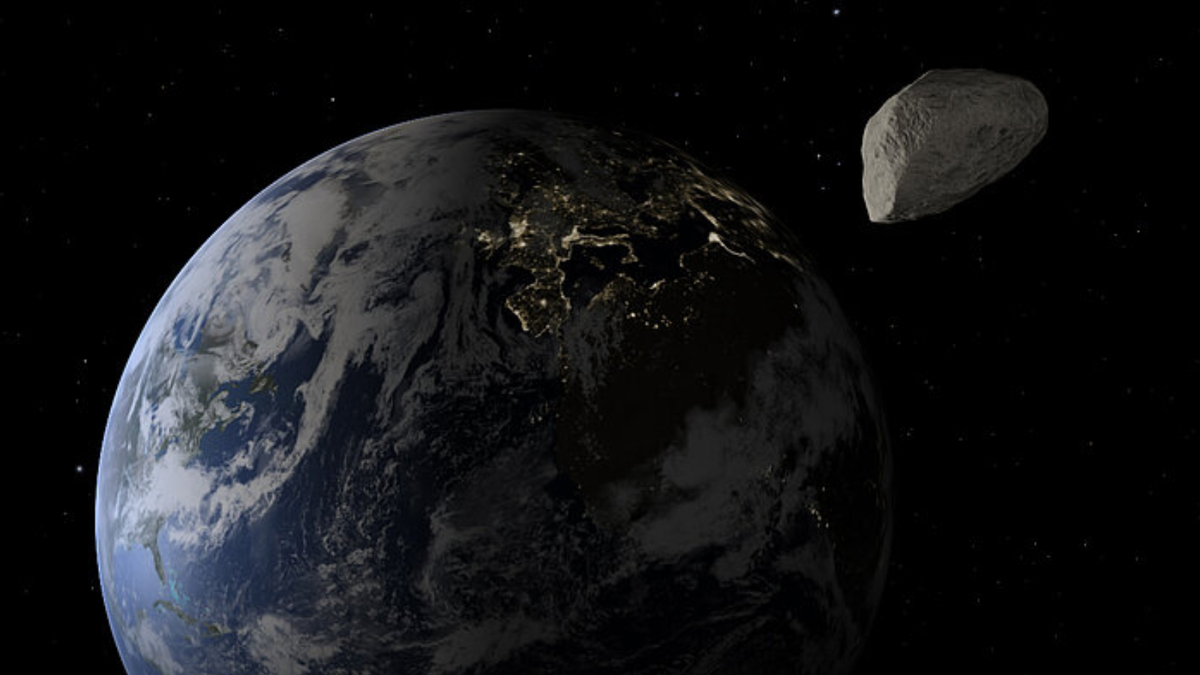
NASA has confirmed that asteroid Apophis, a near-Earth object measuring approximately 450 metres by 170 metres, will make a remarkably close approach to Earth on April 13, 2029. The space rock will pass within about 20,000 miles (32,000 kilometres) of our planet’s surface — a distance closer than many satellites in geosynchronous orbit, which typically hover at around 22,236 miles (36,000 kilometres) above the equator. This proximity has earned Apophis the informal nickname “God of Chaos,” referencing its namesake from ancient Egyptian mythology, though scientists emphasize there is no risk of impact during this flyby.
Initial concerns about a potential collision arose when Apophis was first discovered in June 2004 by astronomers Roy Tucker, David Tholen, and Fabrizio Bernardi at the Kitt Peak National Observatory in Arizona. Early calculations suggested a small probability of impact in 2029, but subsequent radar and optical observations have refined its trajectory. NASA now states with confidence that Apophis poses no threat to Earth for at least the next 100 years, eliminating any danger to people, satellites, or astronauts in space during its 2029 encounter.
The upcoming flyby presents a rare scientific opportunity. According to NASA, such close approaches by asteroids of Apophis’s size occur only once every few thousand years on average. This will be the first time in modern history that an asteroid this large passes so near Earth although being observable with advanced technology. Scientists plan to study Apophis extensively using ground-based telescopes and radar systems, and NASA has redirected the OSIRIS-APEX mission — formerly OSIRIS-REx — to rendezvous with the asteroid shortly after its Earth flyby.
OSIRIS-APEX will not only observe Apophis but may use its thrusters to disturb the surface regolith, allowing scientists to examine subsurface material. This could reveal insights into the asteroid’s composition, structure, and how it responds to planetary gravitational forces. During the close encounter, Earth’s gravity may induce tidal stresses on Apophis, potentially triggering surface changes such as small landslides or seismic activity, offering a natural experiment in asteroid geophysics.
Apophis is classified as a potentially hazardous asteroid due to its size and periodic proximity to Earth, but its orbit is now well understood. It completes one revolution around the Sun every 0.886 years (about 323.6 days), with a semi-major axis of roughly 0.9224 AU. Its spectral type is classified as Sq, indicating a rocky composition mixed with some metal content, and its geometric albedo suggests a moderately reflective surface. These physical characteristics assist scientists model how it might behave under gravitational stress.
While the 2029 approach is the most imminent, Apophis will make additional close passes in the coming decades, though none are expected to come as near as the 2029 event. Astronomers will continue monitoring its trajectory using observatories worldwide, including facilities in California and West Virginia that contributed radar imaging in 2021 when the asteroid was over 10 million miles away. These efforts ensure any future risks are identified well in advance.
For the public, the 2029 flyby may offer a naked-eye viewing opportunity, particularly in the Eastern Hemisphere, weather permitting. NASA notes that under clear skies, observers could see Apophis as a moving point of light — a rare chance to witness a celestial object the size of three football fields glide past Earth without the aid of telescopes.
As the date approaches, NASA and international space agencies will provide regular updates through official channels. The next major milestone is the asteroid’s closest approach on April 13, 2029, after which OSIRIS-APEX will begin its detailed study. Until then, continued observation remains critical to refining our understanding of near-Earth objects and improving planetary defense strategies.
Stay informed about asteroid Apophis and other near-Earth objects through NASA’s Asteroid Watch portal. Share this article to help spread accurate information about one of astronomy’s most anticipated events in the coming decade.
Worth a look