
The Apple Mac Studio serves as a high-performance desktop workstation positioned between the Mac mini and the Mac Pro, designed primarily for creative professionals, software developers, and data scientists. Since its introduction in 2022, the compact device has utilized Apple’s proprietary silicon to offer significant thermal efficiency and computing power in a small form factor, with current models featuring the M2 Max and M2 Ultra chips as of mid-2024. According to Apple’s official product specifications, the machine supports high-bandwidth memory architectures and extensive port connectivity, including Thunderbolt 4, to handle demanding professional workflows like 8K video editing and 3D rendering.
Understanding the Mac Studio Hardware Architecture
The Mac Studio is built around a singular thermal design that allows for sustained high-performance output without the noise typical of traditional tower workstations. The system utilizes Apple silicon, which integrates the CPU, GPU, and Neural Engine into a unified memory architecture. This design significantly reduces latency by allowing the processor and graphics cores to access the same pool of high-speed memory, a departure from the traditional separate VRAM found in discrete PC graphics cards. As noted by Apple’s technical support documentation, this architecture is particularly beneficial for tasks requiring large data sets, such as machine learning training or complex audio production.
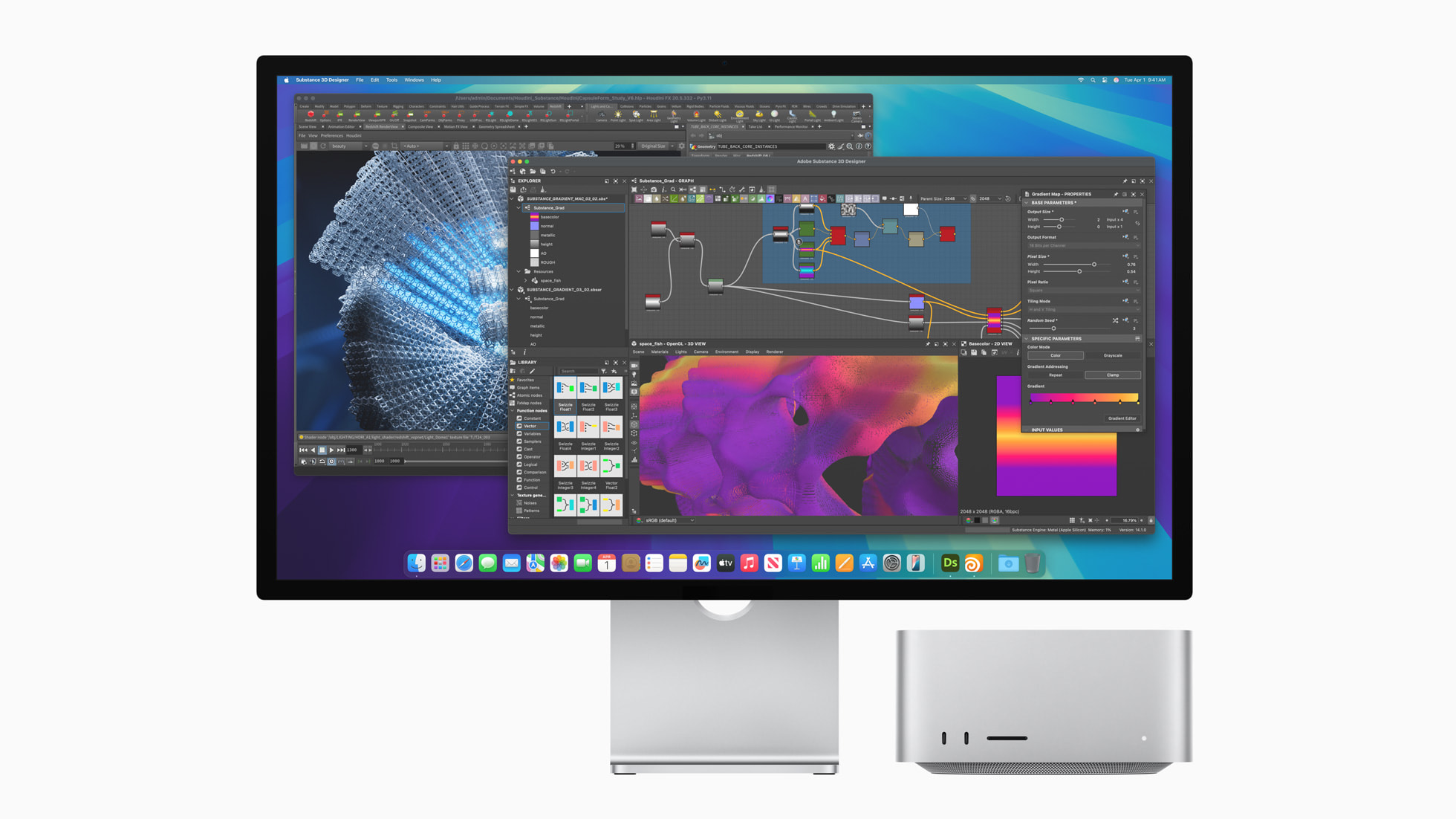
The device features a 7.7-inch square aluminum enclosure that is 3.7 inches high. Despite its small footprint, it includes a wide array of I/O ports. The front of the M2 Max model provides two USB-C ports and an SDXC card slot, while the M2 Ultra version upgrades these to two Thunderbolt 4 ports. The rear of the chassis houses four additional Thunderbolt 4 ports, two USB-A ports, an HDMI port, a 10Gb Ethernet port, and a professional-grade headphone jack. This connectivity suite is intended to minimize the need for external hubs in a professional studio environment.
Performance Comparison: M2 Max vs. M2 Ultra
The performance capabilities of the Mac Studio are determined by the chosen system-on-a-chip (SoC). The M2 Max features a 12-core CPU and up to a 38-core GPU, supported by up to 96GB of unified memory. For users with more intensive requirements, the M2 Ultra effectively doubles these specifications. According to Apple’s corporate newsroom, the M2 Ultra is constructed by connecting two M2 Max dies via the company’s UltraFusion interconnect technology, resulting in up to 24 CPU cores, a 76-core GPU, and support for up to 192GB of unified memory.
/article-new/2023/06/Mac-Studio-Desk.jpg "Performance Comparison: M2 Max vs. M2 Ultra")
This difference in core count has a direct impact on real-world throughput. For video editors, the M2 Ultra allows for the simultaneous playback of up to 22 streams of 8K ProRes 422 video. In contrast, the M2 Max is optimized for high-end creative work that does not require the massive multi-threaded processing power of the Ultra chip. Users should consider their specific software optimization, as many creative applications are still scaling to take full advantage of the high core counts provided by the Ultra-tier silicon.
Pricing and Configuration Considerations
Pricing for the Mac Studio varies significantly based on chip configuration, unified memory capacity, and internal storage. As of the current retail cycle, the base model featuring the M2 Max starts at $1,999, while the M2 Ultra configuration begins at $3,999. These prices reflect the base storage and memory tiers; upgrading to the maximum 192GB of memory and 8TB of SSD storage substantially increases the cost. Potential buyers should note that the unified memory is soldered onto the SoC and cannot be upgraded after purchase, making the initial configuration decision critical for long-term utility.
The internal SSD storage is also non-user-replaceable in the current generation, necessitating reliance on high-speed external Thunderbolt storage for projects that exceed the internal drive’s capacity. For those evaluating the total cost of ownership, it is important to factor in the cost of peripheral devices, as the Mac Studio is sold as a standalone unit without a display, keyboard, or mouse included in the box. Apple directs users to their online store configuration portal to calculate specific tax and shipping estimates based on their geographic region.
Limitations and Future Outlook
While the Mac Studio offers industry-leading performance-per-watt, it is not without limitations. The primary constraint for professional users is the lack of internal expandability. Unlike traditional workstation towers, the Mac Studio does not support the installation of internal PCIe cards for additional storage, networking, or GPU power. All expansion must occur externally via the Thunderbolt 4 ports. This design choice prioritizes a compact, quiet desk environment over the modularity traditionally sought by enterprise-level hardware integrators.
Industry analysts continue to monitor Apple’s silicon roadmap, particularly regarding the transition to the M4 generation of chips. While Apple has not announced a specific release date for a next-generation Mac Studio, the company typically updates its professional desktop lineup on a staggered schedule relative to its laptop releases. Consumers looking for the most current information regarding product availability and potential hardware refreshes should monitor the Apple Newsroom for official press releases and technical updates. For those currently in the market, the existing M2-based models remain the primary professional-grade desktop options within the Apple ecosystem.
Have questions about how the Mac Studio fits into your specific workflow or looking for advice on memory configurations? Share your experiences in the comments section below to join the conversation.
- Philips 700 Series: The Ultimate Ultra-Compact Mini Shaver for Precision Grooming
- Justice Investigation Continues as Family Mourns Victim
- CHAGEE Launches Apple English Breakfast Tea in Partnership With Tate (archyworldys.com)
- Berkshire Hathaway’s Top ETF Holdings and Apple Investment Analysis (archynewsy.com)