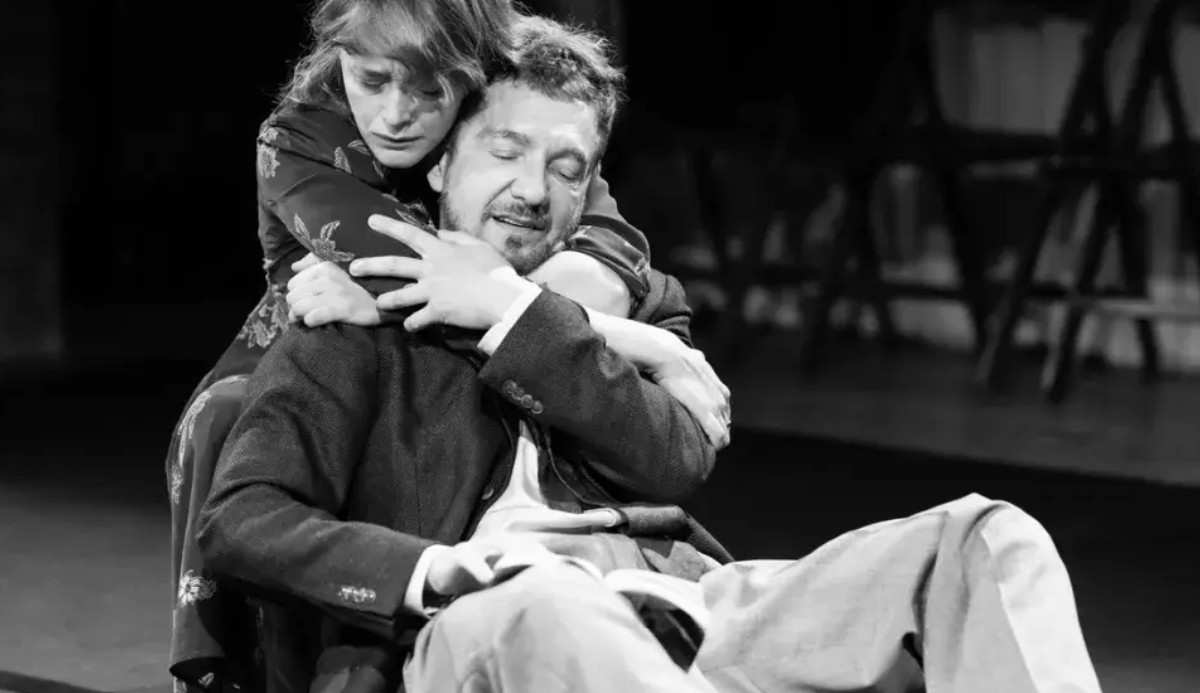
French director Arnaud Desplechin has teamed up with the Comédie-Française for a powerful new staging of Marguerite Duras’s renowned play La Musica deuxième, featuring acclaimed actors Adeline d’Hermy and Alexandre Pavloff. The production marks Desplechin’s third major collaboration with France’s historic national theater company, bringing a modern cinematic eye to a classic text about a divorced couple meeting one last time in a hotel lobby.
The staging brings together two prominent members of the Comédie-Française troupe to explore Duras’s intricate dialogue of separation and memory. First written as a television screenplay before being adapted for the stage, La Musica deuxième examines the lingering emotional resonance between Anne-Marie Roche and Michel Gautier as they finalize their divorce in the provincial town of Évreux. Duras, celebrated for her minimalist yet emotionally heavy style, uses the encounter to dissect the architecture of a failed marriage where love and pain remain inextricably linked.
Arnaud Desplechin Returns to the Comédie-Française
Arnaud Desplechin’s direction bridges the worlds of contemporary French cinema and classical theatrical tradition. Known for critically acclaimed films such as A Christmas Tale (Un conte de Noël) and Kings & Queen (Rois et reine), Desplechin brings a distinct psychological depth to his stage work. His prior collaborations with the Comédie-Française include notable productions like Father (Le Père) by August Strindberg, establishing a strong working relationship with the institution’s resident artists.
Working within the rigorous environment of the historic Parisian theater, Desplechin focuses on the rhythm of Duras’s language. The text relies heavily on silence, subtext, and the unspoken tension between two people who once shared a life. By casting Adeline d’Hermy and Alexandre Pavloff in the central roles, the production utilizes the nuanced chemistry of seasoned company members who understand the physical and vocal demands of performing repertory theater.
Interpreting Duras on the Modern Stage
Marguerite Duras wrote La Musica in 1965, later expanding it into La Musica deuxième. The narrative unfolds entirely in the neutral space of a hotel bar, stripping away distractions to isolate the psychological interplay between the former spouses. Michel has built a new life, while Anne-Marie has traveled extensively, yet neither can easily let go of the shared history that defined their youth.
For Adeline d’Hermy, whose extensive credits with the Comédie-Française range from classical comedy to heavy drama, the role of Anne-Marie offers a study in controlled emotion. Opposite her, Alexandre Pavloff brings a measured gravity to Michel, capturing a man caught between nostalgia and the necessity of moving forward. Under Desplechin’s direction, the actors avoid melodrama, opting instead for a precise, almost musical cadence that honors Duras’s unique theatrical rhythm.
Staging Details and Production Context
The collaboration highlights the Comédie-Française’s ongoing mission to invite prominent cinematic directors to helm theatrical repertory. These crossovers often allow film directors to experiment with theatrical space while giving stage actors the opportunity to work with directors known for intimate character studies. The production emphasizes minimalist staging, putting the primary focus on the actors’ delivery and the shifting emotional dynamics of the text.
Audiences attending the performances experience a masterclass in text-driven drama, where every pause carries as much weight as the spoken word. The minimalist approach reflects Duras’s own theatrical philosophy, which rejected elaborate sets in favor of raw emotional truth and linguistic precision.
The production runs as part of the Comédie-Française’s current repertory schedule in Paris. Theatergoers and fans of contemporary French drama can find ticketing information, performance dates, and availability directly through the official Comédie-Française website. Share your thoughts on this collaboration in the comments below.
Related reading