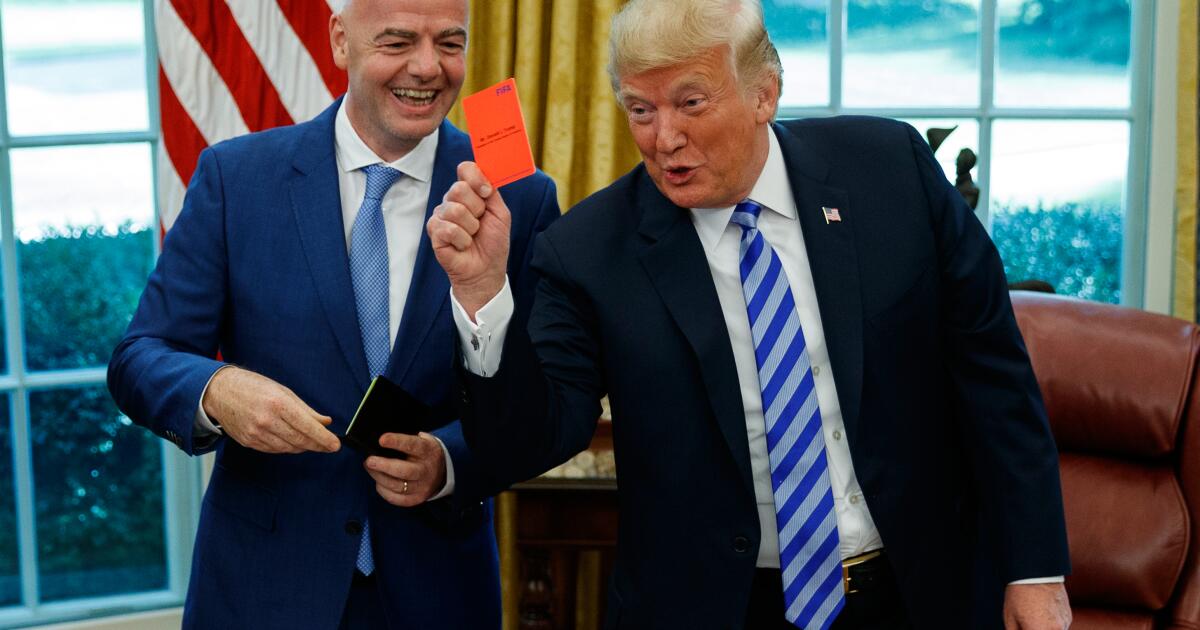
A coalition of artists and activists has announced plans to distribute symbolic red cards to spectators at the 2026 FIFA World Cup final, targeting both FIFA President Gianni Infantino and former U.S. President Donald Trump. The protest is intended to draw attention to concerns regarding FIFA’s governance under Infantino and the political rhetoric associated with Trump, as the tournament prepares for its final match in the United States.
The campaign, organized by a collective of advocacy groups and artists, aims to use the red card—a traditional symbol of expulsion in football—as a visual critique of the two figures. While the World Cup is governed by strict stadium conduct policies, organizers state their intent is to encourage fan participation in a global demonstration of dissent during the tournament’s concluding event, which is scheduled to take place at MetLife Stadium in East Rutherford, New Jersey, on July 19, 2026, according to official FIFA scheduling documents.
The Scope of the Protest
The activists behind the effort have cited a variety of grievances, primarily focusing on what they describe as a lack of accountability within international football’s governing body. Under Gianni Infantino’s leadership, which began in 2016, FIFA has faced sustained criticism regarding human rights records in host nations and the organization’s financial transparency, as noted in reports by Human Rights Watch. The protesters aim to present the red card as a call for a change in leadership and a re-evaluation of FIFA’s priorities.
Simultaneously, the inclusion of Donald Trump in the protest reflects the group’s opposition to the former president’s influence on the American political landscape and his past statements on immigration and civil rights. The intersection of global sport and domestic politics has become a recurring theme for organizers, who argue that the visibility of the World Cup provides a necessary platform for their message. The 2026 tournament is being co-hosted by the U.S., Canada, and Mexico, with the U.S. hosting the majority of matches, including the final, as confirmed by U.S. Soccer official information.
FIFA and Stadium Regulations
Any attempt to distribute or display materials inside a FIFA-sanctioned stadium must comply with the organization’s strict regulations regarding spectators. FIFA’s Tournament Code of Conduct generally prohibits the display of political, offensive, or discriminatory messages within the perimeter of the venue. Security personnel are authorized to confiscate items deemed to be in violation of these rules, which are enforced to maintain the neutrality of the sporting environment, according to FIFA’s official stadium code of conduct.
The organizers of the red card campaign have acknowledged the potential for security intervention. They maintain that the cards are intended as a peaceful form of expression and hope that the scale of the distribution will make the protest difficult to ignore, even if individual cards are confiscated by stadium staff. This strategy of high-visibility, low-impact protest has been utilized in various international sporting events to circumvent strict protest bans, often focusing on gathering public attention outside the immediate control of stadium security.
The Broader Context of Global Sport Activism
The protest at the 2026 final is part of a growing trend of athlete and fan-led activism at major sporting events. In recent years, players and spectators have increasingly used the global reach of tournaments like the World Cup and the Olympics to highlight social and political issues. This phenomenon has put pressure on governing bodies to balance their mandate for neutral competition with the reality of global geopolitical tensions.
The 2026 World Cup is expected to be the largest in history, featuring 48 teams and 104 matches, according to FIFA tournament data. With such a massive footprint, the logistical challenges for security and the potential for spontaneous demonstrations are significant. As the event approaches, the intersection of security protocols and the right to public protest is likely to remain a point of contention between activists and tournament organizers.
The next major checkpoint for the tournament will be the final release of the match schedule and the subsequent commencement of ticket sales, which will dictate how fans gain access to the venues. Those interested in following the developments of the 2026 FIFA World Cup can monitor the official FIFA website for updates on venue policies and tournament logistics. We invite readers to share their thoughts on the role of activism in international sports in the comments section below.
Related reading