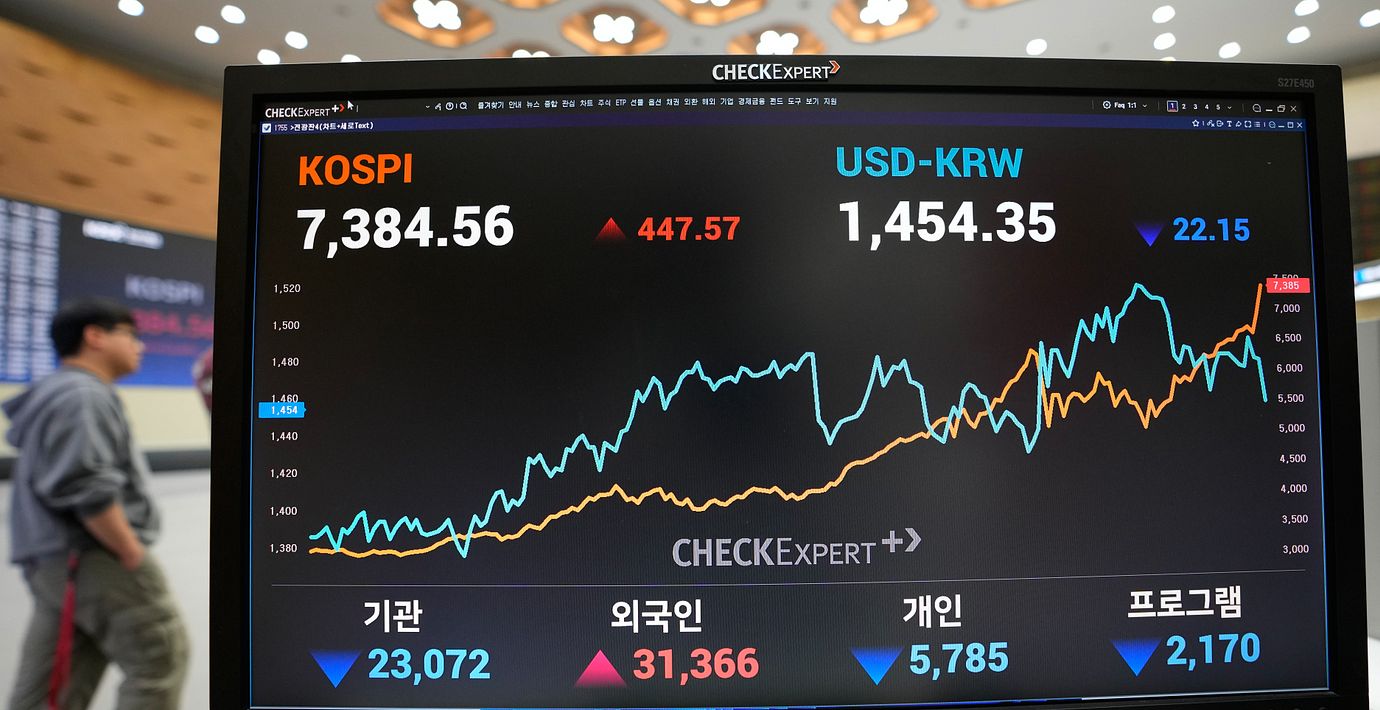
The Asian equity landscape is witnessing a significant shift in momentum, headlined by the South Korean benchmark index reaching unprecedented heights. The Kospi record high is not merely a statistical anomaly but a reflection of a deeper structural realignment within the global technology supply chain, particularly as the appetite for artificial intelligence (AI) infrastructure continues to accelerate across the globe.
For investors and policymakers, the surge in Seoul serves as a bellwether for the broader health of the semiconductor industry. As the world pivots toward generative AI, the demand for high-bandwidth memory (HBM) and advanced logic chips has transformed South Korea’s heavyweights from mere manufacturers into the indispensable architects of the modern digital economy. This rally is occurring against a backdrop of fluctuating energy costs and shifting monetary policies, creating a complex environment where growth optimism clashes with inflationary pressures.
From a macroeconomic perspective, the current trajectory of Asian markets suggests a cautious but determined return to risk-on sentiment. While regional indices have historically been sensitive to the volatility of the U.S. Dollar and Federal Reserve policy, the current driver is fundamentally industrial. The synergy between South Korean hardware and American software is creating a feedback loop that is lifting valuations across the region, providing a necessary cushion against the headwinds of geopolitical instability and erratic oil markets.
As Chief Editor of Business at World Today Journal, I have observed several cycles of “tech bubbles,” but the current expansion feels distinct. We are seeing a tangible integration of AI into the physical layer of computing. When the Kospi hits a record, it is often a signal that the “plumbing” of the internet—the chips and servers—is being upgraded on a global scale, which inevitably ripples through to other markets, from Tokyo to Stockholm.
The Semiconductor Engine: Driving the Kospi to New Heights
The primary catalyst for the Kospi’s recent performance is the extraordinary demand for semiconductors, specifically those used in AI accelerators. South Korea’s dominance in the memory chip market, led by giants such as Samsung Electronics and SK Hynix, has positioned the nation as a primary beneficiary of the AI gold rush. SK Hynix, in particular, has seen its valuation soar due to its leadership in High Bandwidth Memory (HBM3E), which is critical for the GPUs produced by NVIDIA Reuters.
This “chip rally” is more than just speculation; it is rooted in capital expenditure (CapEx) trends. Major cloud service providers—including Microsoft, Alphabet, and Amazon—have signaled sustained investment in data center expansions. Because South Korea controls a vast majority of the global DRAM and NAND flash markets, any increase in global AI compute capacity directly translates to increased order books for Seoul-listed firms. This fundamental demand is what has allowed the Kospi to break through previous resistance levels and establish new records.

However, the concentration of the index in technology means that the Kospi is highly susceptible to “sector rotation.” If investors move away from growth stocks toward value stocks, the index could see a sharp correction. Yet, the current narrative is supported by earnings growth rather than pure hype. The transition to AI-driven hardware represents a generational upgrade cycle, similar to the shift from mainframe computers to the PC, or the transition to mobile internet, which provides a more stable foundation for these record highs.
the South Korean government’s strategic focus on the “K-Semiconductor Belt”—a massive initiative to foster a domestic ecosystem of chip designers and materials suppliers—is reducing the country’s reliance on foreign intellectual property. By integrating the entire value chain, Korea is insulating its markets from some of the volatility seen in other tech-heavy indices, though it remains tethered to the broader geopolitical tensions between the U.S. And China regarding chip export controls.
Energy Volatility and the Global Inflationary Tug-of-War
While the equity markets are celebrating, the commodities market presents a more conflicted picture. Oil prices have remained volatile, reacting sharply to tensions in the Middle East and the strategic output decisions of OPEC+. For a nation like South Korea, which imports nearly all of its crude oil, rising energy costs act as a direct tax on industrial production and a drag on the current account balance.
The relationship between oil prices and the Kospi is typically inverse: when Brent crude spikes, the cost of logistics and manufacturing rises, squeezing margins for the very companies driving the stock market. Currently, Brent crude has fluctuated significantly, with prices often reacting to the perceived risk of supply disruptions in the Strait of Hormuz Bloomberg. When oil prices rise, the “inflationary tax” can dampen consumer spending and increase the cost of raw materials for the petrochemical industry, another pillar of the Korean economy.

This energy volatility is mirrored in other parts of the world, including Europe. In Sweden, for instance, the intersection of energy prices and inflation has created a precarious environment for households. Recent data indicates that while headline inflation may be cooling in some sectors, the volatility of electricity prices—sometimes spiking to extreme levels during winter peaks—continues to challenge the efficacy of monetary tightening. This illustrates a global trend: “cost-push” inflation, driven by energy and food, is harder for central banks to control than “demand-pull” inflation.
The global market is currently in a state of “fragile optimism.” Investors are betting that the productivity gains from AI will eventually offset the costs of higher energy and labor. If the AI revolution leads to significant efficiency gains in energy management or industrial automation, the sensitivity of markets to oil price spikes may diminish. Until then, the tug-of-war between tech-driven growth and energy-driven inflation will remain the dominant theme for global portfolios.
Asian Markets: A Synchronized Recovery?
The record-breaking performance of the Kospi is not happening in a vacuum. Across Asia, there is a visible trend of indices moving toward positive territory, driven by a combination of corporate governance reforms and a shift in global capital flows. The Nikkei 225 in Japan has similarly seen historic gains, fueled by a weakening yen that boosts exporters and a renewed focus on shareholder returns Financial Times.
In Hong Kong and mainland China, the recovery is more tentative. While there are hopes for peace deals and geopolitical easing—which would unlock massive amounts of institutional capital—the real estate crisis in China continues to act as a ceiling on growth. However, when the Kospi and Nikkei rally, it often creates a “halo effect” for the region, encouraging investors to look at Asian equities as a diversified alternative to the heavily concentrated S&P 500.
The “Asian lift” is also being supported by a gradual stabilization of regional currencies. For years, the dominance of the U.S. Dollar has drained liquidity from emerging markets. As the market begins to price in a potential pivot or pause from the U.S. Federal Reserve, capital is flowing back into high-growth hubs like Seoul and Tokyo. This shift in liquidity is essential for sustaining record highs; without it, the rally would be purely speculative. With it, the rally becomes a structural reallocation of global wealth toward the centers of technological production.
Key Market Drivers at a Glance
| Driver | Impact on Kospi/Asian Markets | Risk Factor |
|---|---|---|
| AI Hardware Demand | Strongly Positive (Valuation expansion) | Overcapacity or “AI Bubble” burst |
| Oil Price Volatility | Negative (Increases input costs) | Geopolitical escalation in Middle East |
| Fed Monetary Policy | Mixed (Influences capital flows) | “Higher for longer” interest rates |
| Corporate Governance | Positive (Attracts foreign investment) | Slow pace of regulatory reform |
What This Means for the Global Investor
For the average investor, the current state of the Asian markets provides a critical lesson in diversification. The surge in the Kospi demonstrates that while the U.S. May design the AI models, the physical manifestation of that intelligence happens in Asia. Diversifying into Korean or Japanese equities allows investors to capture the “picks and shovels” side of the AI revolution.
However, the risks are non-trivial. The high concentration of the Kospi in a few mega-cap tech stocks means that the index is effectively a proxy for the semiconductor cycle. Investors should be mindful of the “cyclicality” of this industry. History shows that semiconductor booms are often followed by periods of oversupply, leading to sharp corrections. The key is to monitor the lead times for HBM chips and the capital expenditure reports from the “Hyperscalers” (the big cloud companies). As long as those companies continue to spend billions on infrastructure, the floor for the Kospi remains relatively high.
the interaction between equity markets and inflation cannot be ignored. As we see in the Swedish example, nominal stock market gains can be eroded by the rising cost of living and energy. A “record high” in a stock index does not always translate to economic prosperity for the general population if inflation is eating away at purchasing power. This divergence between the “financial economy” (stocks) and the “real economy” (cost of living) is a tension that policymakers in Seoul, Stockholm, and Washington are all struggling to manage.
the current market pulse suggests that we are entering a period of “bifurcated growth.” We are seeing immense wealth creation in the high-tech sector, while traditional industries struggle with the transition to a greener, more expensive energy regime. The winners of this era will be those who can leverage the productivity of AI to offset the systemic costs of inflation and energy instability.
Looking Ahead: The Next Checkpoints
The sustainability of the Kospi’s record run will be tested in the coming weeks. The most critical checkpoint will be the upcoming quarterly earnings reports from Samsung Electronics and SK Hynix. These filings will provide the first hard evidence of whether the AI-driven revenue growth is meeting analyst expectations or if the market has priced in too much future success.
global investors are closely watching the next set of inflation data from the U.S. And the Eurozone. Any sign that inflation is becoming “sticky” could force central banks to keep interest rates higher for longer, which would put downward pressure on the valuations of growth stocks in Asia. The next Federal Open Market Committee (FOMC) meeting will be the definitive event for determining the direction of global liquidity flows.
As we navigate this volatile intersection of technological breakthrough and economic instability, the goal is not to predict the exact peak of the market, but to understand the forces driving it. The Kospi’s record is a signal of confidence in the future of computing, but the fluctuating price of oil is a reminder of our enduring dependence on the physical world.
We want to hear from you. Do you believe the AI-driven rally in Asian markets is a sustainable structural shift, or are we seeing the early signs of a speculative bubble? Share your thoughts in the comments below or join the conversation on our social channels.