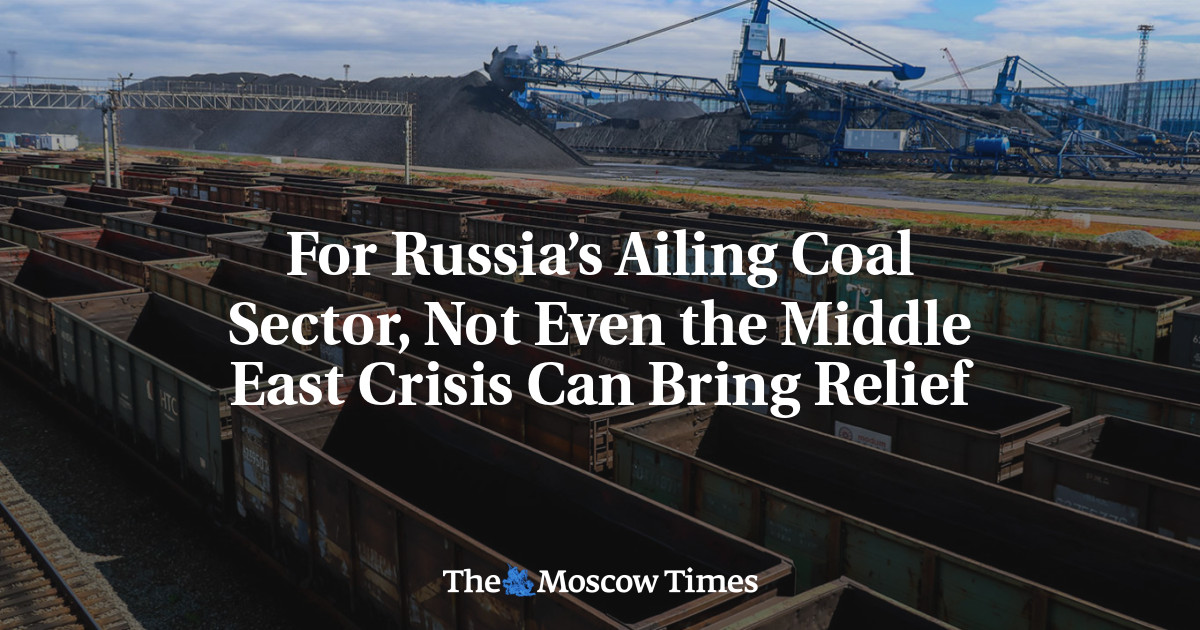
For Russia’s Ailing Coal Sector, Not Even the Middle East Crisis Can Bring Relief
SOFIA — Russia’s coal industry, long a cornerstone of its energy exports, is facing an unprecedented crisis that even the recent turmoil in the Middle East has failed to alleviate. Despite global energy market disruptions, analysts say the sector’s struggles are structural, deep-rooted, and unlikely to reverse soon. Instead, the crisis may be accelerating Asia’s pivot toward renewable energy, leaving Russia’s coal-dependent regions in a precarious position.
Maria Petrova, World Editor at World Today Journal, examines how geopolitical shifts, economic sanctions, and a global push for cleaner energy are converging to reshape Russia’s energy landscape—and why the coal sector’s decline appears irreversible.
The Collapse of a Once-Dominant Industry
Russia’s coal sector has been in steady decline for years, but 2024 marked a turning point. According to data from Russia’s Federal State Statistics Service (Rosstat), coal production fell by 7.2% in 2023, the steepest drop in over a decade. Exports, which once accounted for nearly half of Russia’s coal output, have also plummeted. The European Union’s ban on Russian coal imports, imposed in August 2022, cut off a key market, while logistical bottlenecks—particularly in rail transport to Asia—have further strangled trade.
The Middle East crisis, which sent global oil and gas prices surging in late 2023 and early 2024, offered a glimmer of hope for Russia’s coal producers. Analysts initially predicted that disruptions in oil and gas supplies would drive demand for alternative energy sources, including coal. However, the expected rebound never materialized. Instead, Asian buyers—Russia’s last major customers—have increasingly turned to renewable energy and liquefied natural gas (LNG) as long-term solutions.
“The idea that the Middle East crisis would rescue Russia’s coal sector was always a miscalculation,” said Sergei Guriev, a professor of economics at Sciences Po in Paris and former chief economist at the European Bank for Reconstruction and Development (EBRD). “Asia’s energy transition is happening faster than anyone anticipated, and coal is no longer the default option.”
Asia’s Shift Away from Coal: A Structural Challenge
For decades, Russia relied on China and India as its primary coal export markets. In 2021, China alone accounted for 25% of Russia’s coal exports, while India took another 15%, according to the International Energy Agency (IEA). However, both countries have since accelerated their transitions toward renewable energy, undermining Russia’s position.
China, the world’s largest coal consumer, has made significant strides in expanding its renewable energy capacity. In 2023, China added a record 230 gigawatts (GW) of solar and wind power, nearly double the amount installed in 2022, according to the Global Energy Monitor. Meanwhile, India has set an ambitious target to achieve 500 GW of non-fossil fuel energy capacity by 2030, with coal’s share in its energy mix projected to fall from 70% to 50% over the same period.
The shift is not just driven by environmental concerns. Economic factors are playing a decisive role. The cost of renewable energy has plummeted, making it a more attractive option than coal. According to a 2023 report by IRENA, the global weighted-average levelized cost of electricity (LCOE) for solar photovoltaics (PV) fell by 89% between 2010 and 2022, while onshore wind costs dropped by 69%. In contrast, coal prices have remained volatile, and logistical challenges—such as Russia’s reliance on the Trans-Siberian Railway for exports—have made its coal less competitive.
“Russia’s coal is simply too expensive to transport and too dirty to burn,” said Amantha Perera, an energy analyst at the Brookings Institution. “Asian buyers are looking for cleaner, cheaper alternatives, and Russia is not in a position to offer either.”
Sanctions and Logistical Nightmares
The war in Ukraine has exacerbated Russia’s coal woes. Western sanctions have not only cut off European markets but have also made it difficult for Russian companies to access critical equipment and financing. The U.S. And EU have imposed restrictions on transactions with major Russian coal producers, including SUEK and EVRAZ, complicating their ability to operate internationally.
Logistical challenges have further compounded the problem. Russia’s coal exports to Asia rely heavily on the Trans-Siberian Railway, which has faced chronic delays due to maintenance issues and capacity constraints. In 2023, rail shipments to China and India fell by 12% and 9%, respectively, according to Russia’s Federal Customs Service. Port bottlenecks in the Russian Far East have also slowed exports, with ships often waiting weeks to load coal.
“The sanctions have created a perfect storm for Russia’s coal sector,” said Nikolay Kozhanov, a non-resident scholar at the Carnegie Endowment for International Peace. “Even if demand were to rebound, Russia lacks the infrastructure to meet it.”
The Human Cost: Russia’s Coal Regions in Crisis
The decline of Russia’s coal industry has had devastating consequences for the communities that depend on it. The Kemerovo Oblast, often referred to as Russia’s “coal heartland,” has been particularly hard hit. Unemployment in the region has risen sharply, with coal mines and related industries shedding thousands of jobs. According to Kemerovo’s regional government, the unemployment rate in the oblast reached 8.5% in 2023, nearly double the national average.
Local authorities have struggled to diversify the economy, with limited success. While some efforts have been made to develop alternative industries, such as agriculture and manufacturing, these sectors have not been able to absorb the displaced workforce. The situation has led to growing social unrest, with protests erupting in several coal-dependent towns over unpaid wages and job losses.
“The coal industry was the backbone of our region for generations,” said Sergei Tsivilev, governor of the Kemerovo Oblast, in a 2023 interview with Kommersant. “Now, we are facing a crisis that threatens the very survival of our communities.”
Can Russia’s Coal Sector Recover?
Despite the bleak outlook, some analysts believe Russia’s coal sector could identify a lifeline in niche markets. Countries like Vietnam, Turkey, and Pakistan have increased their coal imports from Russia in recent years, albeit at discounted prices. However, these markets are too small to offset the losses in Europe and Asia, and their long-term demand remains uncertain.
Russia has also explored expanding its coal exports to Africa, but logistical and financial barriers have limited progress. The continent’s coal demand is growing, but infrastructure gaps and competition from other exporters, such as South Africa and Indonesia, have made it difficult for Russia to gain a foothold.
“Russia’s coal sector is not dead, but it is on life support,” said Kozhanov. “Without significant investment in infrastructure and a shift in global energy trends, it is hard to observe a path to recovery.”
What’s Next for Russia’s Energy Future?
As Russia’s coal sector continues to decline, the country is increasingly turning to other energy sources to fill the gap. Natural gas, which remains a key export, has seen a surge in demand, particularly in Europe, where some countries have temporarily lifted restrictions on Russian gas imports amid the Middle East crisis. However, this reprieve is likely to be short-lived, as Europe accelerates its transition to renewable energy.
Russia has also ramped up its nuclear energy exports, with state-owned Rosatom securing contracts to build nuclear power plants in countries like Egypt, Turkey, and Bangladesh. However, these projects are long-term and will not provide immediate relief to the coal sector.
For now, Russia’s coal industry appears trapped in a downward spiral, with no clear path to revival. The Middle East crisis, which many hoped would provide a temporary boost, has instead highlighted the sector’s structural weaknesses. As Asia continues its shift toward renewable energy, Russia’s coal-dependent regions face an uncertain future.
Key Takeaways
- Russia’s coal production fell by 7.2% in 2023, the steepest drop in over a decade, due to sanctions, logistical bottlenecks, and declining demand.
- Asia’s pivot to renewable energy is accelerating, with China and India leading the transition away from coal.
- Sanctions and infrastructure constraints have made it difficult for Russia to compete in global coal markets.
- Coal-dependent regions like Kemerovo Oblast are facing rising unemployment and social unrest as the industry collapses.
- Russia’s coal sector is unlikely to recover without significant investment in infrastructure and a reversal of global energy trends.
FAQ
Why is Russia’s coal sector struggling?
Russia’s coal sector is facing a perfect storm of challenges, including Western sanctions, logistical bottlenecks, and a global shift away from coal toward renewable energy. The European Union’s ban on Russian coal imports in 2022 cut off a key market, while Asia’s transition to cleaner energy has reduced demand for Russian coal.

How has the Middle East crisis affected Russia’s coal exports?
Initially, analysts predicted that the Middle East crisis would drive up demand for coal as an alternative to oil and gas. However, the expected rebound never materialized. Instead, Asian buyers have accelerated their shift toward renewable energy and LNG, leaving Russia’s coal sector without a lifeline.
What are the consequences for Russia’s coal-dependent regions?
Regions like Kemerovo Oblast, which rely heavily on coal mining, are facing rising unemployment and social unrest. The collapse of the coal industry has left thousands of workers without jobs, and local governments have struggled to diversify the economy.
Is there any hope for Russia’s coal sector?
Some analysts believe Russia’s coal sector could find a lifeline in niche markets like Vietnam, Turkey, and Pakistan. However, these markets are too small to offset the losses in Europe and Asia, and their long-term demand remains uncertain. Without significant investment in infrastructure and a reversal of global energy trends, the sector’s decline appears irreversible.
What Happens Next?
The next major checkpoint for Russia’s coal sector will be the release of the country’s 2024 energy export data, expected in early 2025. Analysts will be watching closely to see if the sector’s decline continues or if niche markets provide a temporary reprieve. In the meantime, Russia’s coal-dependent regions will continue to grapple with the social and economic fallout of the industry’s collapse.
Have thoughts on Russia’s energy future? Share your perspective in the comments below, and don’t forget to share this article to keep the conversation going.