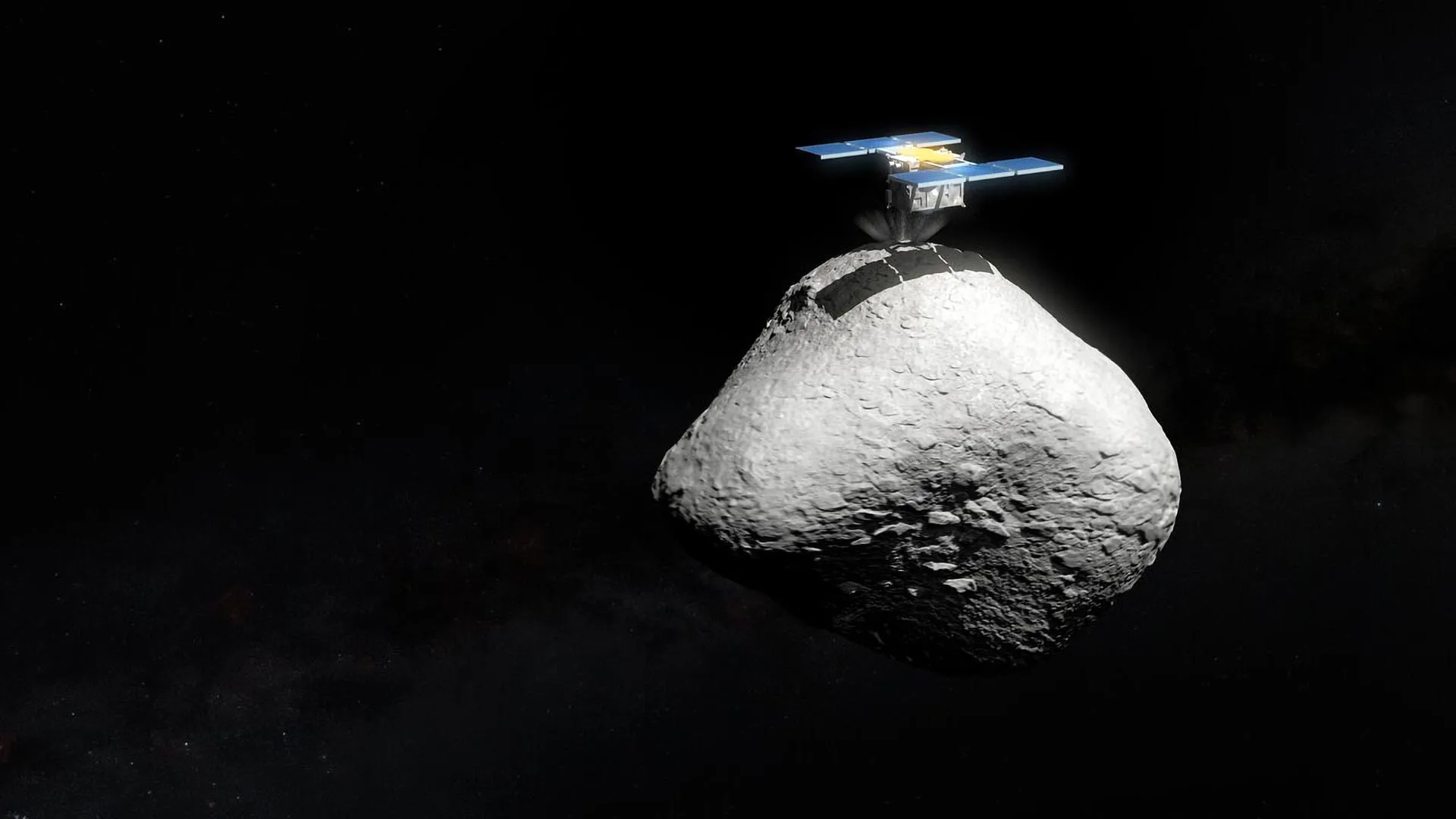
JAXA‘s Hayabusa2 Sets Sights on a Record-Breaking Asteroid Encounter: 1998 KY26
For decades, space exploration has pushed teh boundaries of our understanding of the solar system. Now, Japan’s Hayabusa2 spacecraft is poised to make history with a daring mission to 1998 KY26 – a remarkably small asteroid, barely 10 meters in diameter. This encounter, planned for 2031, will be the first time a spacecraft has ever visited an asteroid of this size, offering unprecedented insights into the formation and evolution of these celestial bodies.
Hayabusa2 already achieved remarkable success with its primary mission, visiting the larger asteroid 162173 Ryugu and successfully returning samples to Earth in 2020. Leveraging remaining fuel, JAXA has extended the spacecraft’s journey, setting a new course for this challenging, yet incredibly valuable, target.
Why is 1998 KY26 So Meaningful?
This mission isn’t just about visiting a small asteroid; it’s about unlocking basic knowledge.Here’s why 1998 KY26 is capturing the attention of planetary scientists:
* First of its Kind: All previous asteroid missions have focused on considerably larger objects. This is a leap into the unknown.
* Formation Clues: Understanding the composition of such a small asteroid could reveal clues about how larger asteroids – and even planets - formed. It might potentially be a remnant of a disrupted planet or a fragment from a larger collision.
* Planetary Defense: Studying these smaller asteroids is crucial for improving our ability to detect and possibly mitigate the threat of near-Earth objects.
* Resource Potential: The techniques developed for studying 1998 KY26 could pave the way for future asteroid mining endeavors.
ground-Based Observations Reveal Key Details
Before Hayabusa2 arrives, scientists are utilizing earth-based telescopes to gather as much information as possible. A team led by T. Santana-Ros recently published findings in Nature Communications based on observations from the European Southern Observatory’s very large Telescope (VLT) in Chile.
These observations where challenging, requiring the team to wait for a close approach of the asteroid to Earth and utilize some of the most powerful telescopes available. What they discovered is fascinating:
* Radiant Surface: 1998 KY26 appears to have a surprisingly bright surface, suggesting a reflective composition.
* Solid Rock or Rubble pile? The data indicates the asteroid is likely a solid piece of rock, but researchers can’t entirely rule out the possibility that it’s a loosely bound collection of debris. This is a key question Hayabusa2 will help answer.
* Rapid Rotation: The asteroid spins remarkably fast, completing a rotation twice as quickly as initially predicted.
Implications for Future Exploration
The success of these ground-based observations demonstrates a significant advancement in our ability to characterize even the smallest asteroids. As Santana-Ros points out,”We found that the size of the asteroid is comparable to the size of the spacecraft that is going to visit it! And we were able to characterize such a small object using our telescopes,which means that we can do it for other objects in the future.”
This capability has far-reaching implications:
* Improved Asteroid Detection: We can now better identify and track potentially hazardous asteroids, like the one that impacted Chelyabinsk, Russia, in 2013.
* Advancing Asteroid Mining: The methods used to study 1998 KY26 can be applied to assess the resource potential of other near-Earth asteroids.
* Refining spacecraft Design: Understanding the physical properties of small asteroids will inform the design of future missions.
Hayabusa2’s journey to 1998 KY26 represents a bold step forward in asteroid exploration. It’s a testament to the ingenuity of JAXA and the dedication of scientists worldwide. As we await the spacecraft’s arrival in 2031, the anticipation builds for the groundbreaking discoveries that are sure to follow.
Research Team: T. Santana-Ros, P. Bartczak, K.Muinonen, A. Rożek, T.Müller, M. Hirabayashi,D. Farnocchia, D. Oszkiewicz, M. micheli,
Worth a look