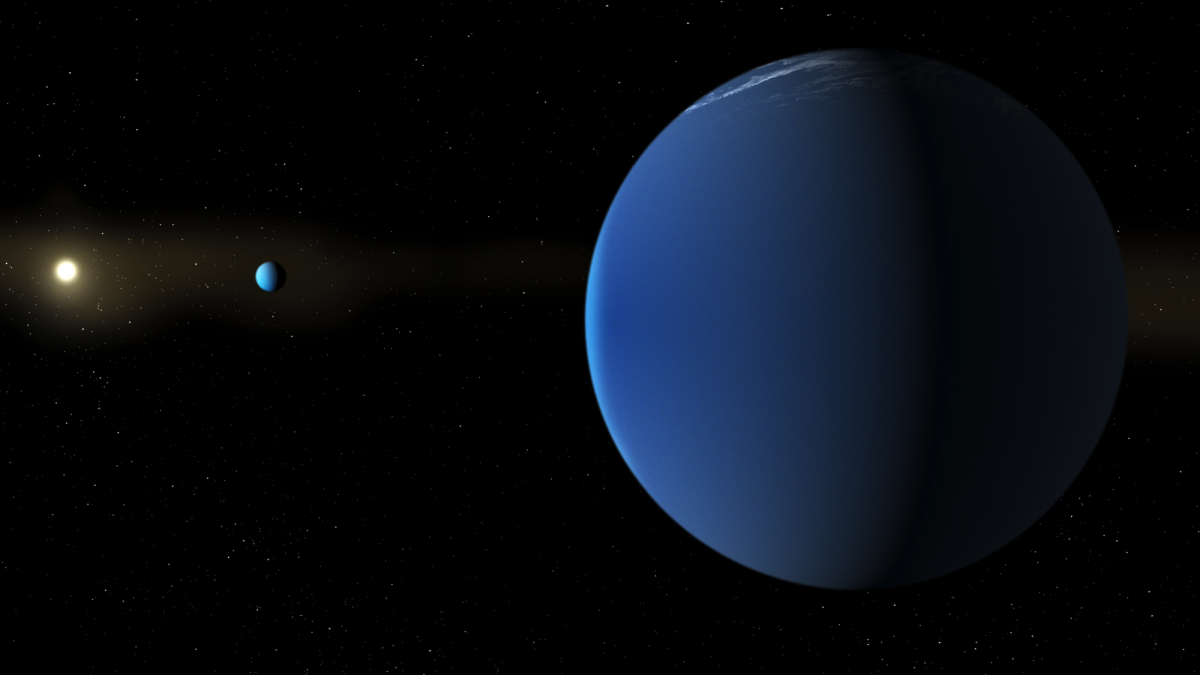
Astronomers have identified two rare, low-density exoplanets, TOI-791 b and TOI-791 c, that exhibit physical characteristics similar to cotton candy. Located approximately 1,110 light-years from Earth in the constellation Volans, these gas giants possess an exceptionally low density compared to planets in our own solar system, according to research published in the Monthly Notices of the Royal Astronomical Society.
The discovery of these “super-puff” planets provides new data for researchers studying planetary formation and evolution. George Dransfield, an astrophysicist at the University of Oxford and a co-author of the study, noted that finding two such planets within the same system is a rare occurrence. “Only a handful of these super-puffy planets are known, and it is even rarer to find two in the same system,” Dransfield stated. “Their extremely low densities make them fascinating targets for understanding how planetary systems form and evolve.”
Comparison of the exoplanets in the TOI-791 system with planets in our solar system. Image: NASA / Daniel Rutter
Understanding Super-Puff Planetary Density
The classification of “super-puff” refers to exoplanets that have a radius comparable to Jupiter but a significantly lower mass, resulting in a remarkably low density. According to the data analyzed by the research team, TOI-791 b has a density of 0.022 ounces per cubic inch, while TOI-791 c has a density of 0.027 ounces per cubic inch. In contrast, Earth holds a density of 3.18 ounces per cubic inch, and Jupiter, the largest planet in our solar system, averages 0.76 ounces per cubic inch. For context, the density of spun sugar used in common cotton candy is approximately 0.29 ounces per cubic inch.
Despite being roughly the same size as Jupiter, these two planets are between 28 and 35 times less dense than the gas giant in our own solar system. Researchers calculated these properties by measuring the transit of each planet across its host star, observing how much the light dimmed as the planets passed in front of the star. This method allowed the team to estimate the size and mass of the celestial bodies.
Dr. George Dransfield and colleagues with the Antarctic telescope, ASTEP (Antarctic Search for Transiting ExoPlanets), during a summer service mission in 2021/2022. Image: Karim Agabi / IPEV / PNRA
Discovery Through Citizen Science
The identification of TOI-791 b and TOI-791 c resulted from a multi-year effort involving both professional astronomers and citizen scientists. The planets were flagged as candidates in data collected by NASA’s Transiting Exoplanet Survey Satellite (TESS) through the Planet Hunters TESS project. Volunteers identified the signals, which were then verified by astronomers over the course of eight years using various ground-based observatories, including the ASTEP (Antarctic Search for Transiting ExoPlanets) telescope located at Concordia Station in Antarctica.
The system is unique not only for the density of its planets but also for their orbital relationship. The researchers confirmed that the two planets are in a 5:3 mean-motion resonance, meaning the inner planet completes five orbits for every three orbits of the outer planet. “These multi-planetary systems are complex, with gravitational interactions between the planets that evolve over very long periods, tens of years or more,” explained Tristan Guillot, a study co-author and astronomer.
Theories on Planetary Formation
While the exact origins of super-puff planets remain a subject of active research, one leading hypothesis suggests these planets developed in the colder, outer regions of a protoplanetary disc. In these environments, they likely accumulated massive atmospheres composed primarily of hydrogen and helium. These atmospheres remain puffed up, potentially due to the specific conditions of their host star and the distance at which they orbit.
To further investigate the composition of these atmospheres, the research team is considering the use of the James Webb Space Telescope. Future observations could help clarify how these planets maintained their low density over time and how they interact within their gravitational resonance. As the scientific community continues to monitor the TOI-791 system, researchers expect to refine their models of how such lightweight gas giants evolve. Readers interested in the latest updates on exoplanet research can find information through official NASA TESS mission bulletins or by following upcoming publications from the Royal Astronomical Society.
Related reading