Astronomers released a comprehensive 2D map of the universe covering roughly 75% of the sky in visible and near-infrared light, built from hundreds of thousands of telescope exposures combined with satellite data to aid ongoing cosmic expansion research.
A global team of researchers published what is set to remain the most comprehensive two-dimensional map of the extragalactic universe for years to come. Comprising data from more than 160 contributing scientists and a final dataset produced by 20 researchers, the map provides an un-obscured view of the sky not blocked by the dust and stars of our own Milky Way.
Combining Ground Surveys and Satellite Missions
The new map was constructed by combining 263,407 individual telescope exposures drawn from three separate ground-based sky surveys. These include the Dark Energy Camera Legacy Survey (DECaLS) hosted at the National Science Foundation’s Cerro Tololo Inter-American Observatory, the Mayall z-band Legacy Survey (MzLS) at the NSF Kitt Peak National Observatory, and the Beijing-Arizona Sky Survey (BASS) operated at the University of Arizona’s Steward Observatory.
Organizers supplemented those ground observations with years of data collected by NASA’s Wide-field Infrared Survey Explorer (WISE) satellite mission alongside other public data sets. Arjun Dey, co-lead of the Legacy Surveys and an astronomer at NSF NOIRLab, emphasized the dual purpose of the release, noting that while the data serves specialized scientific investigations, the skies belong to everyone.
“For our team, these data are fundamental to our investigation of the expansion history of the universe and the formation of our galaxy,” said Arjun Dey, co-lead of the Legacy Surveys and an astronomer at NSF NOIRLab. “But the skies belong to everyone, and this survey gives everyone the chance to explore the sky and marvel at its wonders.”Arjun Dey, co-lead of the Legacy Surveys and an astronomer at NSF NOIRLab
Mapping the Dark Energy Spectroscopic Instrument Targets
The Legacy Imaging Surveys were initially established to prepare for the Dark Energy Spectroscopic Instrument (DESI) survey. Functioning as a deep photograph that records the apparent positions and brightness of stars and galaxies, the 2D map serves as a vital preliminary step. It allows DESI to select specific objects and measure light across various wavelengths to calculate distances, ultimately building the largest high-resolution three-dimensional map ever made.

Researchers study how galaxies cluster across different cosmic epochs to track dark energy over time. In April 2026, DESI concluded its initial five-year survey ahead of schedule while gathering significantly more objects than anticipated. Those early findings have introduced surprising indications that dark energy’s impact may be weakening over time, presenting a potential paradigm shift for theoretical models of the universe’s ultimate fate. DESI anticipates publishing refined results using its first five years of observations in 2027 while continuing data collection through 2028.
Probing Accelerating Expansion With the Dark Energy Survey
Parallel to the DESI preparations, the Dark Energy Survey (DES) released findings from a six-year observation campaign summarized across 18 supporting papers. Utilizing the 570-megapixel Dark Energy Camera (DECam) mounted on the Víctor M. Blanco 4-meter Telescope at the NSF Cerro Tololo Inter-American Observatory in Chile, DES scientists captured nearly 300,000 images between 2013 and 2019, cataloging 669 million galaxies, thousands of galaxy clusters, and more than 3,000 supernovas.
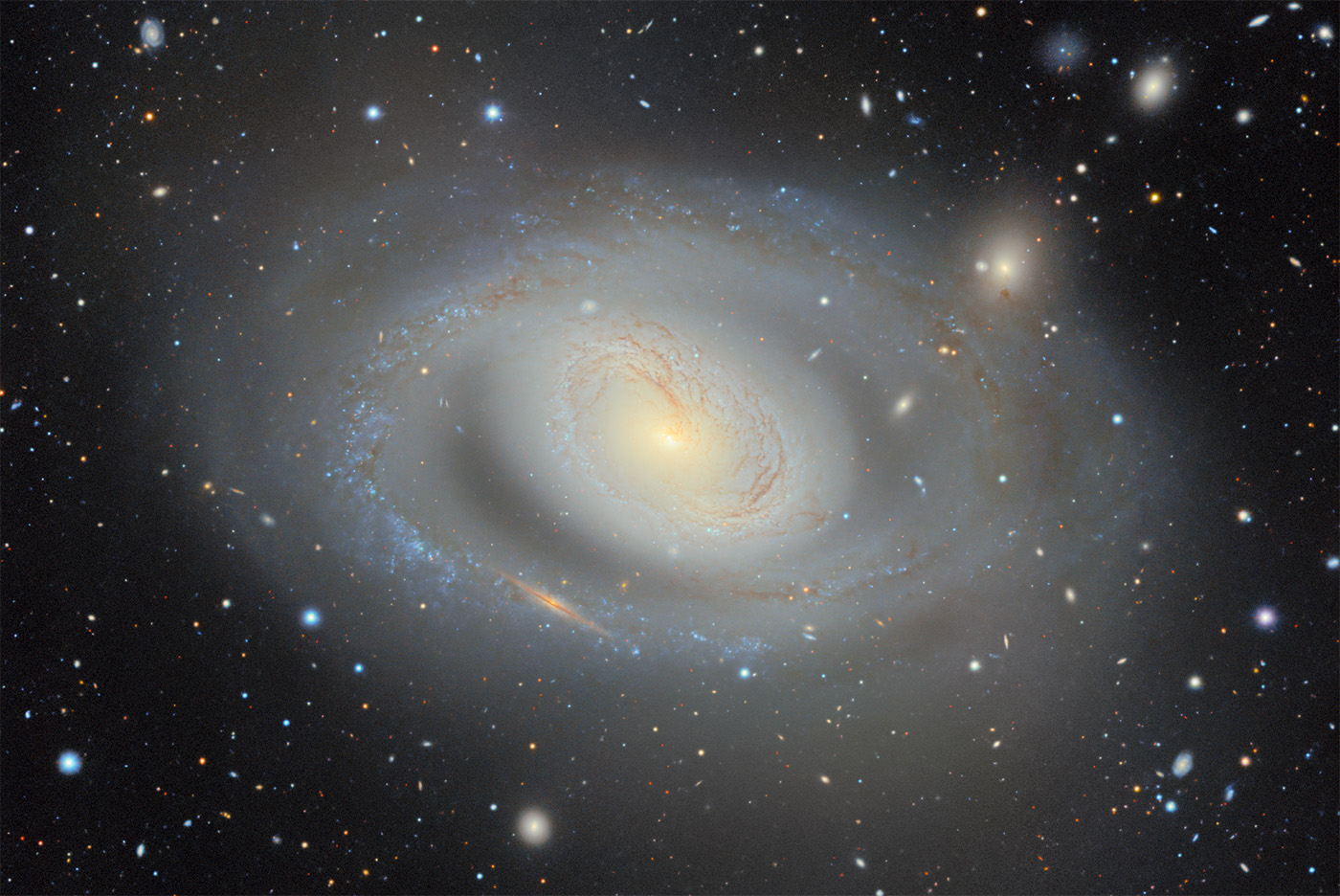
The U.S. Department of Energy’s Argonne National Laboratory processed this vast imaging repository into scientific measurements by applying advanced cosmological modeling. Matthew Becker, an Argonne physicist and DES collaborator, stressed the importance of these datasets in understanding cosmic structure.
“Argonne is delivering essential advances in theoretical modeling and simulation that connect the galaxies we observe to the underlying dark matter shaping the universe,” said Matthew Becker, an Argonne physicist and DES collaborator. “If we want to understand how galaxies and larger structures formed, we must understand dark energy.”Matthew Becker, an Argonne physicist and DES collaborator
Coordinated Cosmological Probes and Future Analysis
Discovered in the late 1990s when astronomers realized that cosmic expansion is accelerating rather than slowing under gravity, dark energy now accounts for roughly 70% of the universe. Because it cannot be imaged directly, researchers rely on four primary observational probes outlined two decades ago by the Dark Energy Task Force: baryon acoustic oscillations, type 1a supernovas, galaxy clusters, and weak gravitational lensing.
The DES collaboration represents the first survey to incorporate all four probes into a unified observational strategy. Argonne led the weak lensing analysis, measuring how invisible matter bends light from distant galaxies to evaluate cosmic evolution as observations continue across international institutions.
Keep reading