Spectacular Auroral Display Lights Up Skies Over Iceland and Canada
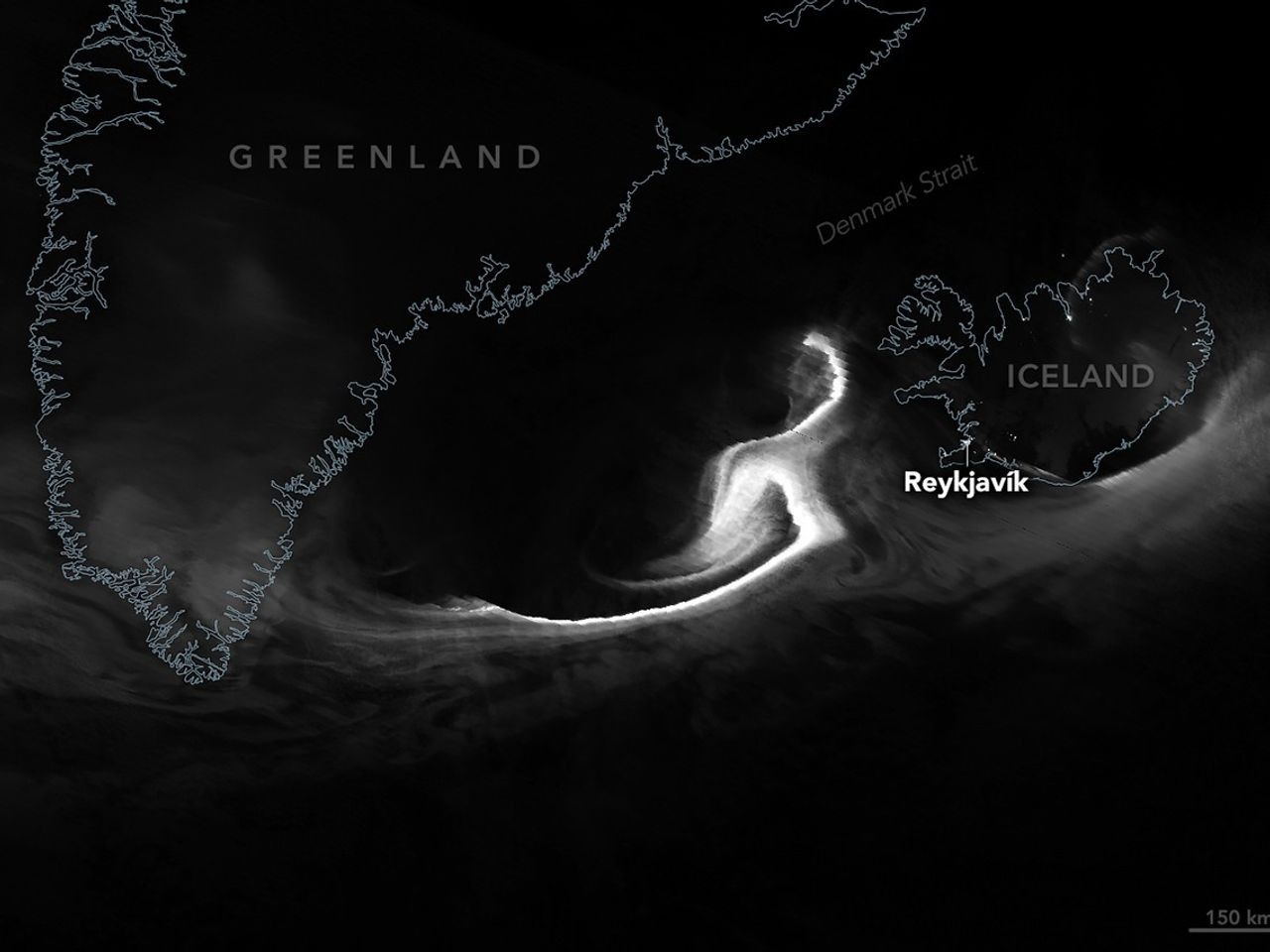
A vibrant display of the aurora borealis, commonly known as the Northern Lights, captivated observers across Iceland and Canada on February 16th. The stunning spectacle was captured by the Visible Infrared Imaging Radiometer Suite (VIIRS) aboard the Suomi NPP satellite, revealing the ethereal glow stretching across the night sky. This event highlights the ongoing interplay between solar activity and Earth’s atmosphere, and the increasing capabilities we have to observe and understand these phenomena.
The VIIRS instrument, a key component of the joint NASA/NOAA Suomi National Polar-orbiting Partnership (Suomi NPP) program, is designed to collect imagery and radiometric measurements of the land, atmosphere, cryosphere, and oceans. NASA’s Earthdata website details the instrument’s capabilities and its role in monitoring our planet. The images taken on February 16th showcase the aurora over the Denmark Strait and Iceland at 4:45 UTC (4:45 a.m. Local time in Reykjavík), and later, dancing above the Canadian provinces of Québec and Newfoundland and Labrador around 6:30 UTC (1:30 a.m. Local time in Montreal).
Even as the images from VIIRS appear in grayscale, the aurora itself is a breathtaking display of color, ranging from vibrant greens to deep purples. The instrument detects light across various wavelengths, including visible and near-infrared, and employs filtering techniques to specifically identify auroral signals. This allows scientists to study the aurora even when it’s not directly visible to the naked eye.
The Science Behind the Northern Lights
The aurora borealis is a natural light display in the sky, predominantly seen in the high-latitude regions (around the Arctic and Antarctic). It’s caused by disturbances in the magnetosphere, the region around Earth controlled by the planet’s magnetic field. These disturbances are typically triggered by solar wind – a stream of charged particles released from the sun. When these particles collide with atoms and molecules in Earth’s upper atmosphere, they excite those atoms, causing them to emit light.
The February 16th aurora was triggered by a geomagnetic storm, initially classified as a G1 storm. According to the Space Weather Prediction Center (SWPC), a branch of the National Oceanic and Atmospheric Administration (NOAA), G1 storms are considered minor geomagnetic disturbances. While less intense than higher-category storms, G1 events can still cause minor disruptions to electrical systems and satellite operations, and are frequently associated with auroral displays. Interestingly, the initial G1 storm escalated to a G2 storm shortly after, indicating an increase in geomagnetic activity.
The intensity and frequency of geomagnetic storms are directly linked to the sun’s activity cycle. The sun goes through roughly 11-year cycles of increased and decreased activity, with periods of high activity resulting in more frequent and intense solar flares and coronal mass ejections – the primary drivers of geomagnetic storms. Currently, the sun is approaching the peak of its 25th solar cycle, which began in December 2019, meaning we can expect increased auroral activity in the coming months and years.
VIIRS and the Legacy of Earth Observation
The VIIRS instrument builds upon the legacy of previous Earth-observing sensors like the Advanced Very High Resolution Radiometer (AVHRR) and the Moderate Resolution Imaging Spectroradiometer (MODIS). As detailed on Wikipedia, VIIRS was launched aboard the Suomi NPP satellite on October 28, 2011, and continues to provide valuable data for monitoring Earth’s changing environment. It collects data in 22 different spectral bands, allowing scientists to study a wide range of phenomena, including cloud cover, sea surface temperature, vegetation health, and fire activity.
VIIRS data is used for both operational and research purposes. NOAA utilizes the data to generate environmental data records (EDRs) used by the National Weather Service for forecasting and monitoring. NASA, uses the data to create Earth System Data Records (ESDRs) for broader scientific studies. This dual-stream approach ensures that the data benefits both immediate practical applications and long-term scientific understanding.
The ability to generate global coverage every 14 hours makes VIIRS an invaluable tool for tracking changes on Earth. By combining VIIRS data with historical data from MODIS and AVHRR, scientists can assess the impacts of climate change over the past two decades and gain a better understanding of long-term trends.
NASA’s Modern Mission to Understand the Ionosphere
Understanding the complex processes that drive auroral displays requires a deeper understanding of the ionosphere – the ionized part of Earth’s upper atmosphere. NASA’s recently launched mission, GNEISS (Geophysical Non-Equilibrium Ionospheric System Science), is specifically designed to investigate the electrical environment that produces auroras. The mission aims to unravel the mysteries of the ionosphere and its role in space weather events.
GNEISS will utilize a network of ground-based and space-based instruments to measure electric fields, plasma densities, and particle precipitation in the ionosphere. This data will help scientists to develop more accurate models of the ionosphere and improve our ability to predict and mitigate the impacts of space weather on Earth-based technologies. The mission represents a significant step forward in our quest to understand the complex interactions between the sun, Earth, and the space environment.
The data collected by GNEISS, combined with observations from instruments like VIIRS, will provide a more comprehensive picture of the processes that drive auroral displays and the broader space weather system. This knowledge is crucial for protecting our increasingly technology-dependent society from the potential disruptions caused by geomagnetic storms.
Key Takeaways
- The aurora borealis, or Northern Lights, was visible over Iceland and Canada on February 16th, captured by the VIIRS instrument on the Suomi NPP satellite.
- The aurora was triggered by a geomagnetic storm, initially classified as a G1 storm, which later escalated to a G2 storm.
- VIIRS builds on the legacy of previous Earth-observing sensors, providing valuable data for both operational and research purposes.
- NASA’s GNEISS mission is dedicated to understanding the ionosphere and the processes that drive auroral displays.
As the sun continues its journey towards the peak of its 25th solar cycle, we can anticipate more frequent and spectacular auroral displays in the years to approach. Continued investment in Earth observation missions like VIIRS and GNEISS will be essential for monitoring these events and protecting our planet from the impacts of space weather. Stay tuned to World Today Journal for further updates on space weather and Earth science.
What are your thoughts on this stunning display? Share your experiences and photos in the comments below, and don’t forget to share this article with your friends and family!
Worth a look